Udaipur: Spilling Opulence

Udaipur

Udaipur

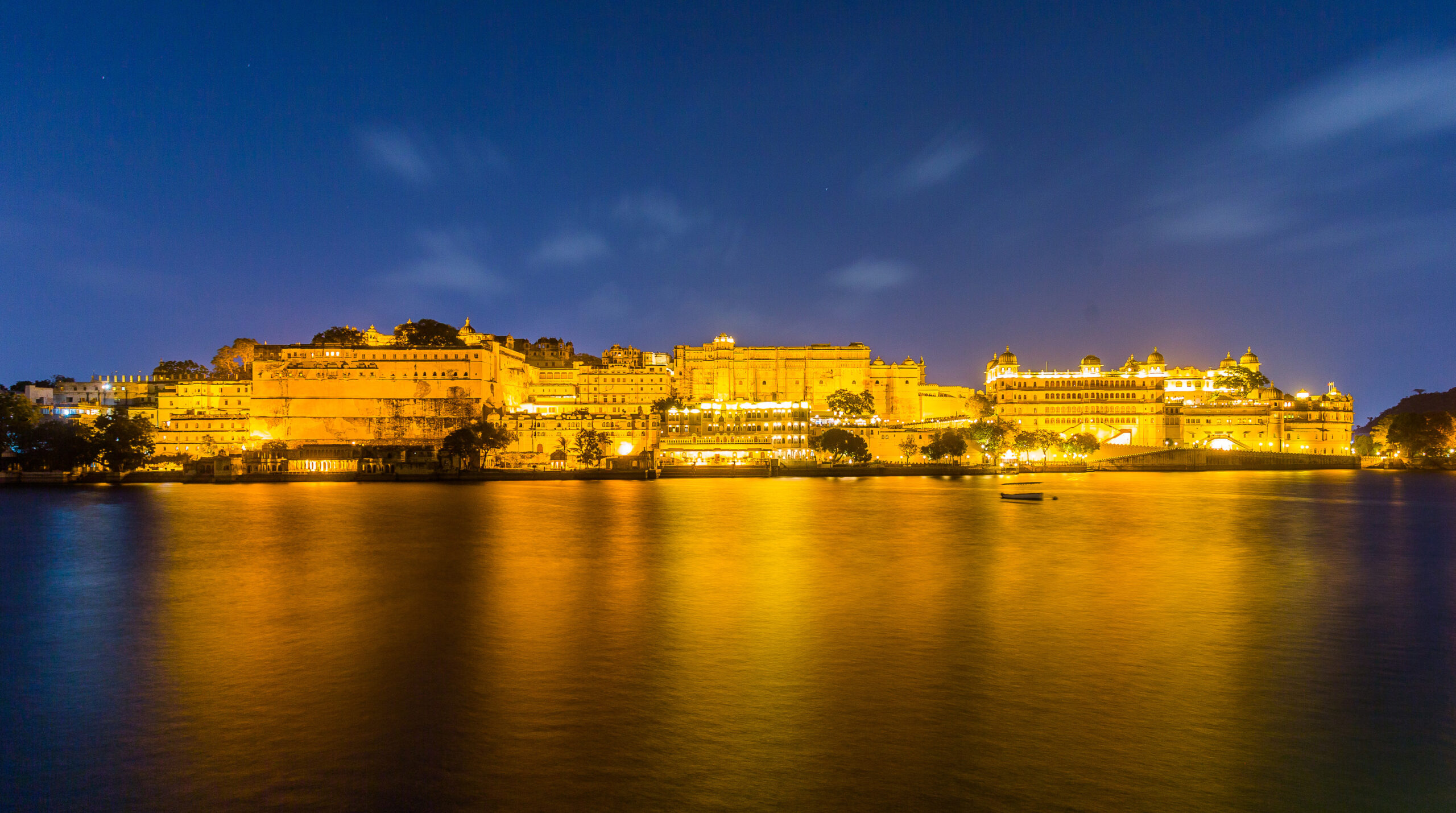
Its famed precincts have served as a setting for movies as varied as Octopussy and Yeh Jawani Hai Diwani. Its picturesque setting dotting the magnificent Lake Pichola has ensured that it remains India’s best destination wedding. Mallik Thatipalli takes a walk down the majestic City Palace in Udaipur and details the wonder that is the City Palace Museum

The brown façade of the City Palace can be viewed the minute one enters Udaipur. The city of lakes has long been a favoured destination for many a traveller since time immemorial and the City Palace is its crowning glory.      Built in the year 1569 by Maharana Udai Singh II, and home to 42 rulers from the House of Mewar for over 400 years, the complex consists of 11 palaces built over centuries. Each ruler brought their taste, resulting in an eclectic melange of styles ranging from Rajasthani and Mughal to Oriental and European. Today, the City Palace is divided into three parts: The City Palace Museums, the heritage hotels and the private residences of the Mewar Royals.

The Museum

Once you enter the gates of the majestic Badi Pol, a triple arched structure beckons you inside. It is where victorious Ranas and armies were welcomed back from their battles and even today, as tourists jostle to take selfies, one notices its regal aura.

The City Palace Museum was open to the public in 1969. Spread across 20,000 square metres, it is a literal walk-through the rich history of the House of Mewar. Immaculately maintained, it is interconnected via a labyrinthine maze of corridors and centuries-old staircases.  

On an annual average, the museum receives more than 10,00,000 visitors.

It provides direct employment to over 500 staff-members; indirect employment to 200,000 of Udaipur’s residents. Apart from the many galleries, the museum is known for the Maharana Mewar special library, established in 1999-2000 in the underground vaults of The City Palace and spread over 2000 square metres.

The extension of the library also houses the Maharana Mewar Research Institute which was established in 1985 and is today acknowledged as a unique research institute of Rajasthan.

The History of the Mewar Royals

The royal family of Mewar and its mighty kingdom are believed to have descended from the Sun, Suryavanshis as they are called, tracing its lineage from Lord Rama through his elder son Lav. 

Rawal Jaitra Singh (r. 1213-53 CE) shifted the capital to Chittor and constructed the fort wall for the first time. In the 16th century, Chittor faced several invasions; including rulers from Delhi, Malwa and Gujarat who were very ambitious and wanted to acquire Chittor for themselves. 

Maharana Udai Singh II (r. 1537-1572 CE) realized that he had to look elsewhere, someplace peaceful to establish his capital. After much wandering and deliberation, he came to this area, today known as Udaipur, named after the Maharana, in 1553 CE. The City Palace, Udaipur grew with successive reigns of the Maharanas, most of whom zealously pursued the architectural constructions and expansions of the established Palace Complex. 

The majestic City Museum

With its sprawling courtyards and jharokha offering panoramic views, each area offers a speciality which shows the grandeur of India royals at the zenith of their power and influence. 

The many collections the museum offers can rival the best museums in Europe and come showcasing the full might of Indian culture. 

  • Sculpture collection

The collection represents an unbroken tradition of stone carving from the 7th to 20th century including fine specimens from the Gurjara-Pratihara period; predominantly of serpentine and marble with limited examples of limestone and sandstone. 

All of the 308 sculptures in the collection were once part of thriving temples in and around Shree Eklingnath Ji Temple, Kailashpuri. Hinduism and Jainism being two faiths flourishing in Rajasthan and surrounding regions, the collection is composed of Brahmanical and Jain icons or sculptural motifs. 

It includes Gods, Goddesses, Surasundaris, animal motifs, architectural elements, narrative and decorative panels, and memorial stones. There are no Buddhist images in the collection. Each of the items provides an insight into the religious beliefs, faith and cultural traditions of the regions concerned. 

  • Photographs Gallery

The City Palace Museum, Udaipur, boasts of 28,000+ objects in the photographic archive, including old cameras, equipment, and glass plate negatives. The photographs vary in size and technique; cartes-de-visite, card photographs, photomontages, painted photographs with techniques including albumen prints, silver gelatin prints, platinum prints, and others, making for a vast repository of photographic material dating from the mid 19th to the early 20th centuries. They capture and feature not just the Maharanas and their courts or royalties from other regions but also the local elements; persons involved in the nitty-gritty of the Palace, as also visitors. The oldest photograph in the collection dates to 1860 CE, from the period of Maharana Swarup Singh (r. 1842-1861 CE).

  • Paintings Gallery

There are around 1800 paintings in the collection, the oldest of which dates to the late 1500s. The painting belongs to the Mewar School and makes use of rich, vibrant colours. Gold and silver were also used to highlight important elements in the painting.

Several aspects of the life in Mewar and the involvements of the local folk are captured in this medium of paint. The Maharanas at times commissioned portraits of themselves. They also patronized works which illustrated royal processions, celebrations and rituals, visits to religious places or shrines, extravagant hunting scenes, animal fights and wrestling scenes. They serve as excellent visual narratives of the past.

  •  The Silver Gallery

The museum also boasts of a vast collection of silver items, previously under the custodianship of several generations of the Mewar family. Much of these are on display in the Silver Gallery; the first of its kind in all of Asia. Some of the items were hitherto rarely glimpsed by even residents of the Palace or visitors to Udaipur but are now open to the public. 

Being a living heritage, some of the items find their way out of the gallery during certain parts of the year for rituals. The Ram Rewari, a portable shrine, is an example which transcends from a museum object into a sacred one for the Jal-Zoolni Ekadashi festival.

‘Regal seating’ in the collection includes a jewel-encrusted, lion motif throne, a Howdah to be mounted atop elephants, and a Tam-Jaam or a carry chair. Be it luxury or leisure, silver was carefully crafted to uttermost perfection; Huqqas, pen and inkstands, toys and even dressing cases. The museum also houses an exquisite collection of horse and elephant jewellery, and trappings that were used in grand ceremonial processions.

There are many other galleries ranging from arms and armament to clothes and musical instruments. Ideally, it takes one full day to take in the splendour on display, click that selfie and soak in the splendour of centuries of the House of Mewar. 

The museum can be visited by the public anytime between 9:30 AM – 5:30 PM. The entry fee of the museum is Rs 250/- per person and different fares apply for carrying cameras and video recorders inside the museum. 

  • The royal family of Mewar and its mighty kingdom are believed to have descended from the Sun, Suryavanshis as they are called, tracing its lineage from Lord Rama through his elder son Lav. 
  • The museum boasts of a vast collection of silver items, on display in the Silver Gallery; the first of its kind in all of Asia.

Leave a comment

Your email address will not be published. Required fields are marked *

The 5 Most Expensive Private Islands You Can Rent For New Year’s

There’s celebration, and then there’s arrival. New Year’s Eve isn’t meant to be lost in crowded parties or noisy resorts. It’s a moment that deserves space, serenity, and a horizon wide enough to hold your dreams for the year ahead. As India’s luxury travel scene steps into 2026, the idea of escape has transformed. No longer just vacations, private island rentals have become portals where time slows down, sea wind feels like scripture, and silence heals in ways noise never can. Dhanush Kumar writes about the five most extravagant private islands you can rent for the New Year in and around India. 1. Munjoh Private Island- Andaman & Nicobar Islands, India Tucked deep within the turquoise cradle of the Andaman lies Munjoh Private Island, a sanctuary carved for those who prefer whisper over crowds. This ultra-luxury island offers private beaches, palm-lined coves, and villas that blend barefoot simplicity with refined indulgence. At night, the sky becomes a cathedral of stars. At dawn, the island wakes in a golden hush.  Private chefs craft ocean-fresh menus, spa therapists arrive at your doorstep, and your very own yacht stands ready. 2.Fregate Island- Seychelles Just a few hours from India by air, the Seychelles unfold like a dream, and Fregate Island is its crown jewel. This is luxury at its most uncompromised. Only a handful of villas exist on the entire island, each carved into the landscape with an artist’s touch. Think infinity pools suspended above the sea, private butlers who know your preferences before you speak, and beaches so untouched they look ancient. Fregate is where billionaires and Hollywood royalty choose to vanish. A perfect place to let the New Year rise without the world watching. 3.Sirai Island, Zanzibar, Tanzania Far across the Indian Ocean, but spiritually close to India’s sense of coastal

Healing Temples: Where Faith Meets Alternative Medicine In India

In India, the divine and the medicinal have never lived apart. Here, faith isn’t just a prayer; it’s a pulse. It flows through temple corridors scented with camphor, rises with mantras at dawn, and lingers in the herbal smoke of age-old rituals. Long before laboratories and hospitals defined health, Indians sought balance between the physical and the spiritual, between body, mind, and the cosmos. Today, as the modern world burns out in its search for healing, these healing temples stand quietly, bridging belief and therapy, mysticism, and science. They remind us that medicine need not always come in a bottle; sometimes, it’s found in devotion, energy, and sacred tradition. Dhanush Kumar takes us on a journey through the heart of India, where faith and alternative medicine walk hand in hand. 1.Vaitheeswaran Koil, Tamil Nadu Tucked in the heart of Tamil Nadu lies Vaitheeswaran Koil, named after Vaidyanatha Swamy, a form of Lord Shiva known as the Divine Healer. For centuries, devotees have arrived here with faith in the temple’s sacred waters and rituals for their curative powers. The temple’s theertham is believed to have medicinal properties, infused with herbs used in ancient Siddha medicine even the priests here know the old healing chants and herbal combinations. From skin diseases to chronic pain, this temple is seen as a place where faith amplifies natural healing, where medicine is both prayed for and practiced. 2.Kottiyoor Shiva Temple, Kerala Deep within the lush forests of Kerala’s Kannur district, the Kottiyoor Shiva Temple blooms every year during its monsoon festival. What makes it extraordinary isn’t its architecture but its elemental simplicity. Built near natural springs, it turns into an open-air altar of mud, water, and air, the original Ayurvedic ingredients. Devotees bathe in the spring believed to balance the body’s doshas, Vata, Pitta, and

Hidden Gems I Can’t Stop Talking About

Who: Dimpi Sanghvi – Travel & Lifestyle Creator, Storyteller, and Curator of Slow Travel Experiences With a lens that finds beauty in the simplest of details, Dimpi Sanghvi is redefining mindful travel. A creator with a love for storytelling and design, she transforms ordinary journeys into visual poetry evoking nostalgia, warmth, and curiosity in every frame. Through her platform, she brings together her twin passions travel and slow living encouraging her audience to pause, wander, and feel. Whether she’s exploring Cuba’s colourful streets or uncovering hidden gems around the world, Dimpi’s storytelling reminds us that travel isn’t just about distance it’s about depth. Featured Destination: Cuba Why Dimpi Recommends It:“Cuba is like stepping into another era,” Dimpi says. “Havana’s pastel-hued buildings, cobblestone lanes, and beautifully preserved vintage cars feel like a living time capsule. What makes it special is the rhythm the music that flows through the streets, the impromptu dancing, and the locals’ warmth that instantly makes you feel at home. Cuba isn’t just a destination; it’s a mood, a melody, an emotion.” Top 3 Must-Do Experiences: Take a ride in a classic vintage car through the vibrant streets of Havana the city’s most iconic experience. Witness the cannon shot ceremony at La Cabaña, a fascinating ritual that’s been performed nightly since the 18th century. Visit a Cuban cigar and Havana rum factory to experience the meticulous artistry behind the island’s most famous exports.Best Local Dish or Drink: “Order a Daiquiri at El Floridita the birthplace of the cocktail and Ernest Hemingway’s favourite haunt,” Dimpi says. “It’s the perfect way to cool off after a day under the Cuban sun.” One Thing Travellers Should Know: Vegetarian options can be limited, so carrying some essentials or snacks is a good idea. “But honestly, the charm of Cuba more than makes

Places I’d Go Back to in a Heartbeat

Who: Roop Verma Travel Creator, Storyteller, and Seeker of Global Magic Meet Roop Verma, a creator who finds joy in both quiet European mornings and electric Asian nights. Whether it’s sipping espresso on a sun-drenched street in Paris or chasing neon reflections through Tokyo’s midnight rain, Roop travels to feel alive to find beauty in hidden corners and capture fleeting moments that make the world pause. Through his lens and words, Roop brings his audience along for the ride every trip feels like a shared heartbeat, a collective discovery. “Travel changes you,” he says. “Each place leaves me a little more in awe and a lot more in love with this crazy, beautiful world.” Featured Destination: Provence, France Why I Recommend It: “Provence feels otherworldly,” Roop says with a smile. “It’s a place where lavender fields stretch forever, sunsets look hand-painted, and every village feels like a dream you never want to wake up from.” What Makes It Special: “There’s a calm magic here a rhythm that makes you slow down and just exist. In Provence, time doesn’t rush; it breathes.” Top 3 Must-Do Experiences: Wander through endless lavender fields at sunrise.2. Sip rosé in a café in Gordes, watching the village come alive.3. Explore local markets in Aix-en-Provence overflowing with cheeses, pastries, and vintage trinkets. Best Local Dish or Drink: “Freshly baked tarte aux fruits paired with a chilled glass of rosé it’s Provence on a plate,” says Roop. “And my favourite thing? Losing myself in the farmers’ markets of Aix-en-Provence they’re pure sensory bliss.” One Thing Travelers Should Know: “Provence moves at its own pace slow, intentional, and full of wonder. So, don’t rush it or you’ll miss the magic.” Insider Tip: “Rent a car and drive through the lavender hills. Every turn is a postcard, every stop

You May Also Like

Connect with us