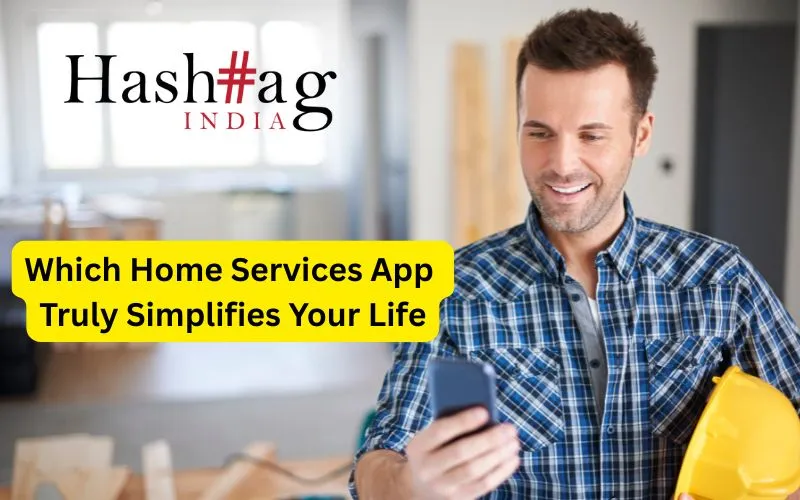
Which Home Services App Truly Simplifies Your Life

For decades, the foundation of a comfortable home relied on a Rolodex full of scattered contacts. The temperamental electrician, the hard-to-schedule parlour lady, and the elusive plumber. Today, that chaotic system has been replaced by a single, elegant solution: the Home Services App.

But with a growing market, which app reigns supreme for your specific needs? Dhanush Kumar conducts a meticulous deep dive into the four major players Urban Company, Yes Madam, Broomies, and Hit A Cook to help you master the modern, hassle-free home.

1. Urban Company:

If you are looking for an all-in-one solution, Urban Company is the dominant market leader and the go-to platform.
The app operates on a fixed price service model for most categories. You select a service, for example: AC Repair or Deep Cleaning. Choose specific tasks within that category, select your time slot, and the app instantly provides the final, non-negotiable price. A verified professional is then assigned to your job.

Core Services Offered:

  • Home Repairs & Maintenance: Electricians, Plumbers, Carpenters, AC Servicing & Repair, Geyser Repair.
  • Cleaning & Pest Control: Deep Home Cleaning, Sofa/Carpet Cleaning, Pest Control.
  • Beauty & Wellness: Salon at Home (for men and women), Massage Therapy.
  • Others: Appliance Repair (Washing Machine, Refrigerator, etc.).

2.Yes Madam

Yes Madam has risen as a strong competitor, particularly in the beauty and wellness space, focusing on cost-effectiveness and a unique product-transparency model.

The app’s core difference from UC lies in its product transparency. For beauty and salon services, they charge only for the service and allow customers to keep any unused product from the single-use kits. You book your service, choose your time, and the professional arrives with the sealed, pre-packaged kits.

Core Services Offered:

  • Beauty & Wellness: Salon at Home (Waxing, Manicure, Pedicure, Facial, Hair Spa), Makeup Artists.
  • Men’s Grooming: Haircut and Shave services.
  • Massage: Full-body massages at home.

3. Broomies

While less diversified than UC, Broomies focuses on recurring, fundamental household cleaning needs, and regular staffing.
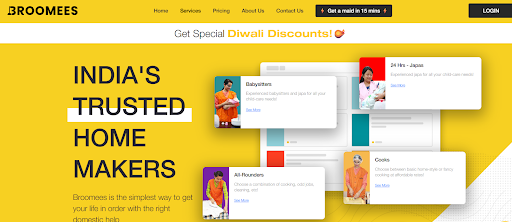
Broomies often focus on a subscription or regular service model for recurring help, rather than one-off, large-scale repairs. You typically hire for a cleaning package or to book a specific domestic helper on a contractual basis.

Core Services Offered:

  • Housekeeping & Maid Services: Daily, weekly, or deep cleaning.
  • Domestic Help: Hiring of cooks, nannies, or full-time domestic help (depending on the region).

4. Hit A Cook

The newest wave of home services is hyper-specialized, and Hit A Cook is the leader in solving the perennial problem of everyday cooking.
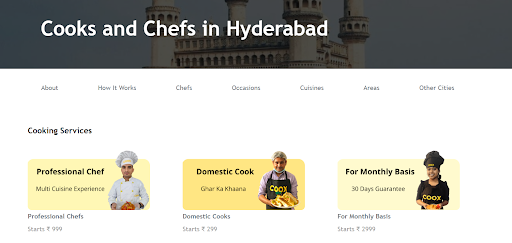
This is a pure-play service platform for finding and hiring professional cooks for your home. You can book a cook on a temporary or a permanent basis. The professional comes to your home, uses your groceries, and prepares meals tailored to your needs (daily cooking, party catering, etc).

 Core Services Offered:

  • Daily Meal Cook: Hiring a cook for breakfast, lunch, and dinner preparation.
  • Party & Event Cook: Cooks hired for a single event or small gathering.
  • Cuisine Specialization: Access to cooks specializing in regional Indian, Continental, or specific dietary meals.

Conclusion

The explosion of home service apps is a clear signal; the future of domestic life is simple, professional, and on-demand. Embracing these digital platforms is not a luxury; it is a necessity for the contemporary lifestyle. Stop wasting hours negotiating with unreliable local vendors. Download the app that matches your most significant need and reclaim your time to focus on what truly matters.

Leave a comment

Your email address will not be published. Required fields are marked *

4 Content Creators Who Are Making A Difference Online

Social media often gets a bad reputation for endless trends, fleeting virality, and mindless scrolling. But beyond the perfectly curated feeds and viral challenges, a new generation of creators is proving that the internet can also be a force for empathy, education, and genuine connection. They’re using their platforms not just to entertain, but to spark important conversations, build supportive communities, and remind people that they are not alone. From a father reshaping India’s understanding of autism and an ASMR artist helping millions find comfort at the end of the day, to a creator championing body confidence and another offering refreshingly honest life advice, these voices are creating impact far beyond likes and views. In a digital world where attention is currency, they’re choosing to spend it on something meaningful. Meet four creators who are making the internet a kinder, more thoughtful place, one post at a time. 4 Creators Changing Conversations, One Post at a Time Indian Girl ASMR: The Voice putting India to sleep For Vedashree Pendharkar, better known online as Indian Girl ASMR, creating content has always been about offering people a moment of calm in an increasingly noisy world. One of India’s pioneering ASMR creators, she produces immersive roleplays, guided relaxation sessions, and soothing sound experiences designed to help viewers sleep better, manage stress, and unwind. Having been an avid ASMR viewer herself for nearly six years, Veda decided to try creating videos during the COVID-19 lockdown in 2020. What began as a creative outlet soon evolved into something much bigger. “As viewers began sharing stories about how the videos helped them sleep better, relax after stressful days, or cope with anxiety, I realised that ASMR had the power to make a genuine difference in people’s lives,” she says. Being among the early creators in the

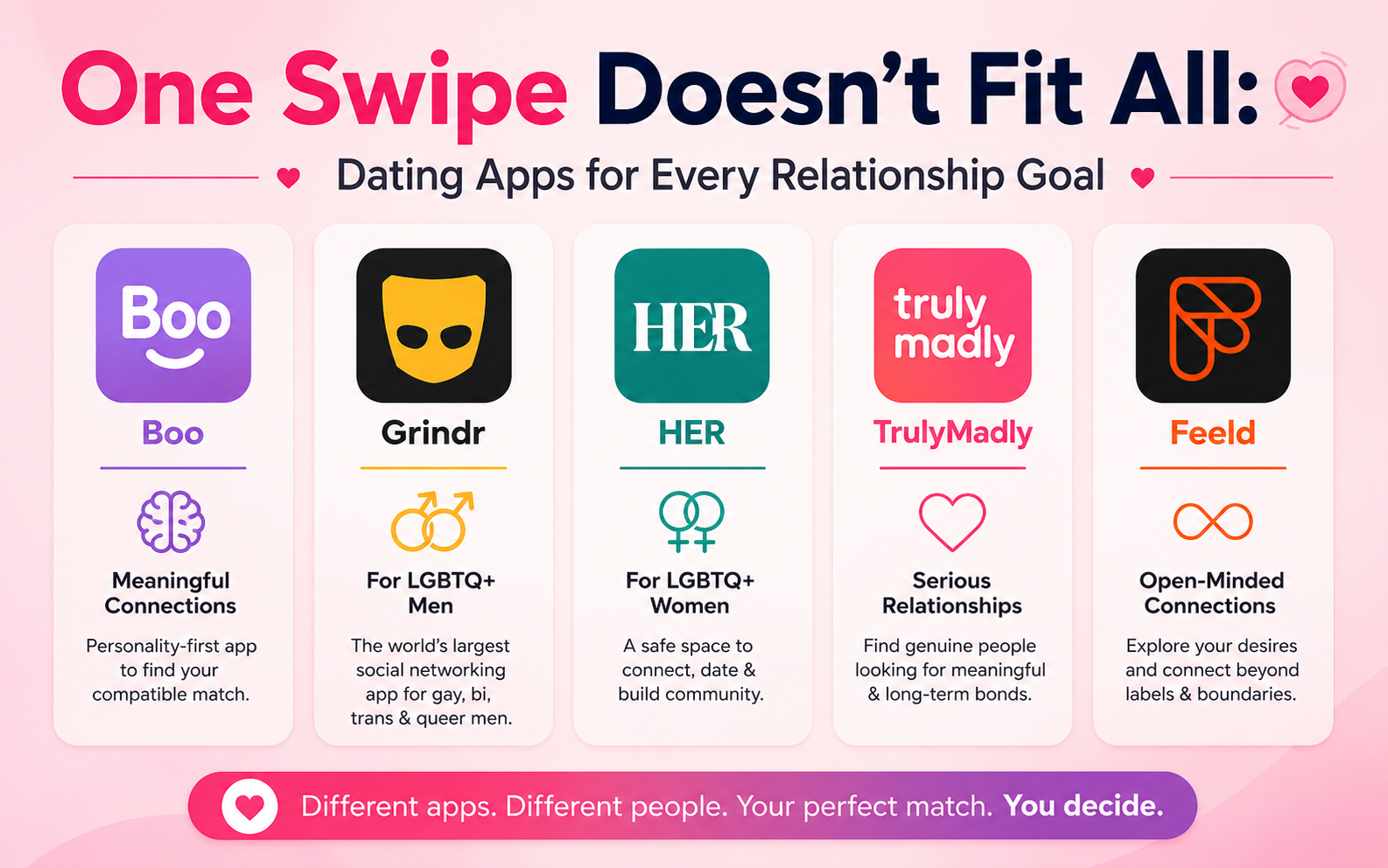
One Swipe Doesn’t Fit All: Dating Apps for Every Relationship Goal

For years, online dating in India was largely synonymous with a handful of familiar names. But as conversations around love, companionship, and identity evolve, so are the ways people choose to connect. Today’s users aren’t all looking for the same thing, and they don’t expect one app to deliver it all. While some are searching for long-term relationships, others are seeking friendships, queer communities, meaningful conversations, or simply people who share their interests and values. As modern dating becomes more intentional, a new generation of platforms is stepping in to cater to these different needs. From apps built for serious commitment and LGBTQIA+ users to those helping people find friends or connect over common passions, there’s no longer a one-size-fits-all approach to finding meaningful connections. Here are the platforms redefining how India dates, befriends, and builds relationships in 2026. Boo: For Introverts Seeking Deeper Connections Small talk isn’t everyone’s love language, and Boo knows that. Designed around personality compatibility, the app uses the Myers-Briggs framework and shared interests to help users connect beyond appearances. Instead of endless swiping, Boo encourages people to build relationships based on values, communication styles, and common passions. It has become especially popular among introverts and those looking for slower, more intentional connections. For people who would rather discuss books, movies, or personality types than exchange generic pickup lines, Boo offers a refreshing alternative to traditional dating apps. Grindr: For Gay, Bi, Trans, and Queer Dating Long before many mainstream apps began prioritising inclusivity, Grindr was creating a space for queer connections. The location-based app remains one of the world’s most recognised platforms for gay, bi, trans, and queer people, allowing users to meet others nearby and build everything from friendships and communities to romantic relationships. In countries like India, where safe queer spaces can still

Top Dashcam and Car Safety Tech Products Every Driver Should Have in 2026

Best dashcams and car safety tech every driver needs in 2026, from AI collision alerts to tyre monitors. Drive smarter, drive safer. Think about the last time you were on a highway at night. Trucks overtaking from the left. Potholes with no warning signs. Someone running a red light at a junction you thought was clear. Indian roads are not forgiving. They are among the most unpredictable in the world, and that is not an exaggeration. In 2024, India recorded over 1.7 lakh road accident deaths, which is roughly one every three minutes. But here is what is changing. In 2026, the technology available to ordinary drivers, not just luxury car owners, is genuinely remarkable. Dashcams that record everything and call for help automatically. Tyre sensors that warn you before a blowout happens. Blind spot monitors: systems that keep you awake on long drives. Viofo A229 Pro 3-Channel If there is one dashcam built for Indian road reality, this is it. The Viofo A229 Pro covers three angles simultaneously: front, rear, and the cabin interior. So whether someone rear-ends you, you have a dispute at a toll booth, or a passenger causes trouble, it is all on record. The 4K front camera footage is clear enough to read number plates even at night. And night is when most serious accidents happen on Indian highways. The Sony STARVIS 2 sensor inside handles low light better than most cameras twice the price. It also has built-in GPS, which stamps your exact location and speed onto every clip, making it incredibly valuable as evidence in insurance claims or legal disputes.The parking mode is genuinely useful too. Park on a busy street, and if anyone bumps your car or breaks in, the camera wakes up and records it. In cities like Bengaluru and Mumbai,

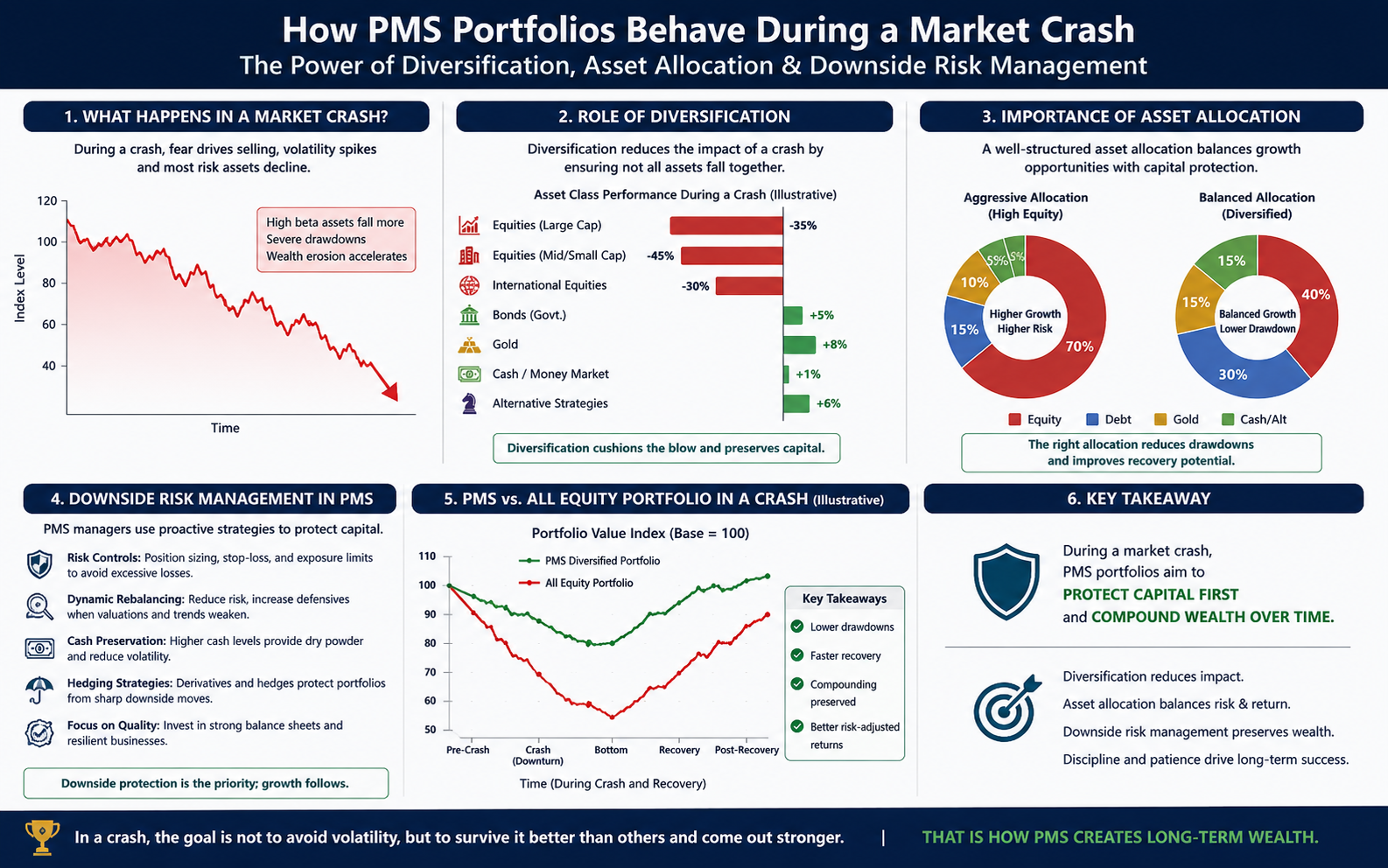
How PMS Portfolios Perform During a Market Crash | Risk Management Guide

Market crashes are the ultimate stress test for any investment strategy. While returns dominate conversations during bull markets, it is during downturns that the true structure and resilience of a PMS portfolio become visible. Many investors assume that all portfolio management services portfolios behave similarly in a crash. In reality, outcomes can vary significantly depending on how the portfolio is constructed. 1. What a Traditional PMS Looks Like A traditional equity PMS is typically built as a concentrated portfolio of 15–30 individual stocks. This structure is intentional: Managers aim to generate alpha through high-conviction bets Capital is allocated meaningfully to each idea Diversification is limited compared to mutual funds However, during a market crash, this concentration becomes a double-edged sword. What happens in a crash? If a few key holdings fall sharply, the overall portfolio can decline disproportionately Single-stock risk gets amplified Liquidity issues in mid and small caps can worsen drawdowns For example, if a PMS holds 20 stocks and 3–4 of them fall 40–50%, the portfolio impact can be severe. This is the structure most investors picture when they think “PMS in a crash” — and it is also what has given PMS an unfair reputation for being high-risk by default. But concentration in direct stocks is a choice, not a requirement of the PMS structure. What sits inside the portfolio is what determines crash behaviour. 2. Not All PMS Portfolios Are Built the Same It is a common misconception that all PMS providers only buy direct stocks. In reality, a PMS is simply a personalized account managed by a professional. The strategy inside can vary wildly. While many providers stick to equities, others take a multi-asset approach. These providers build portfolios using a mix of mutual funds, direct bonds, gold, REITs (Real Estate Investment Trusts), and InvITs

You May Also Like

Connect with us