Sacred Plants We Cherish in Indian Cultures and Homes

Sacred Plants We Cherish in Indian Cultures and Homes

In the vibrant tapestry of Indian culture, the line between nature and the divine is beautifully blurred. Plants are not merely flora, they are revered as living manifestations of gods and goddesses, acting as conduits of peace, prosperity, and spiritual purity right within our homes and communities.

While the ubiquitous Tulsi often takes center stage, a closer look reveals a whole ecosystem of sacred plants, each with a profound story, a religious connection, and a practical use woven into the daily lives of millions. Dhanush Kumar writes about the six green deities that hold an irreplaceable spot in the Indian spiritual and cultural landscape.

Tulsi

The Holy Basil, or Tulsi, is arguably the most essential plant in a Hindu Household. It is traditionally grown on a special pedestal, the Tulsi Vrindavan, in the central courtyard. Tulsi is considered an earthly manifestation of the Goddess Lakshmi, the consort of Lord Vishnu. 

No worship of Vishnu or Krishna is complete without a Tulsi leaf. The plant is worshipped daily, especially by women, and the annual festival of Tulsi Vivah celebrates her ceremonial marriage to Lord Vishnu. It is also known as the Queen of Herbs, its leaves are a staple in Ayurvedic medicine for treating colds, coughs, and boosting immunity. 

The Peepal

Few trees command as much reverence as the majestic Peepal, also known as the Bodhi Tree. It is believed to be the abode of the Trimurti, Lord Brahma (The roots), Lord Vishnu (in the Trunk), and Lord Shiva (in the leaves), Gautama Buddha attained enlightenment under this very species. Devotees perform parikrama and offer water, often tying sacred threats to seek blessings for longevity and to mitigate planetary woes.

The Peepal is one of the few trees that releases oxygen both day and night, embodying its sacred association with the life-giving force.

The Banyan

The Banyan is an emblem of immortality and resilience, serving as India’s National Tree. With its ever-expanding canopy and aerial roots, it symbolizes eternal life and the divine creator, Brahma.  It is often compared to the mythological Kalpavriksha, the wish-fulfilling tree. The Banyan is central to the festival of Vat Savitri Vrat, where married women fast, and pray for the longevity of their husbands.

It is revered as the Ashwatha Vriksha (Tree of wisdom) and traditionally served as the natural gathering place for community and learning.

The Bael

The Bael or Wood Apple tree holds a profound, singular connection to Lord Shiva. Its distinctive trifoliate leaves are considered a representation of the Trinetra of Lord Shiva. Offering Bael Leaves is an essential act of devotion. During the festival of Maha Shivaratri, Bael leaves are an indispensable offering to the Shiva Linga, symbolizing purification and the removal of sins.

The Bael fruit, pulp and leaves are highly valued in Ayurveda for their benefits, particularly for digestive health, linking physical health to spiritual practice.

Neem

The humble but powerful Neem tree is celebrated as much for its life-saving properties as its spiritual connection. Neem is often associated with the goddess Sitala Mata, the deity of health and protection from illness. Neem branches are hung over doorways during festivals like Ugadi to ward off sickness. The tree is also integral to various purification rituals.

Nearly every part of the Neem tree is used in traditional medicine, as an anti-fungal, anti-bacterial, and anti-inflammatory agent, earning it the name Nature’s Pharmacy.

Lotus

While not a household plant in the same way, the Lotus is a vital symbol in Indian art, mythology, and worship. The Lotus symbolizes purity, spiritual awakening, and detachment, as it grows from the mud but remains spotless and untouched. Goddess Lakshmi, and Goddess Sarswati are often depicted seated upon or holding a lotus. The flower is used in almost all rituals, and its iconography is central to Yoga, where the Padmasana is a fundamental posture for meditation.

It represents the birth of the Universe, emerging from the navel of Lord Vishnu.

These six sacred plants teach us a timeless lesson; respect for nature is inseparable from devotion. By planting, nurturing, and honoring those botanical giants and humble herbs, Indian culture creates a living temple right in the backyard. This reverence ensures the plant’s preservation, recognizing that they not only sustain our bodies and purify our air but also nourish our souls and connect us to the timeless flow of the divine.


Leave a comment

Your email address will not be published. Required fields are marked *

Mehzabin Shaikh (Maahie) | Mumbai

Meet Maahie, a Mumbai-based travel content creator who transformed her passion for storytelling into a full-time career. After stepping away from engineering to follow her creative calling, she has spent the last 3.5 years building a journey around travel, exploration, and meaningful connections. For Maahie, travel goes beyond popular destinations; it is about discovering lesser-known places, meeting people, understanding their lifestyles, and experiencing cultures through local food, conversations, and everyday moments. Supported by her best friend and travel partner Rahul Yadav, Maahie continues to create stories that inspire people to step beyond their comfort zones and discover that every journey has a story worth sharing. 1. Bhadarwah, Jammu — A Hidden Paradise Beyond the Usual Kashmir Trail “When people think of snowfall and breathtaking Himalayan landscapes, Kashmir is often the first destination that comes to mind. But for me, Bhadarwah in Jammu is one of the most beautiful places I have ever experienced.” What makes Bhadarwah special is its untouched beauty. The snow-covered landscapes feel peaceful, personal, and far away from the crowds and commercialisation of popular hill stations. However, the real magic of Bhadarwah lies in its people. During my first visit, we stayed at a small homestay run by a family of three a husband, wife, and their young daughter. We instantly connected, and by the end of the trip, saying goodbye felt impossible. Over time, they became more than hosts; they became family. Today, visiting Bhadarwah has become an annual ritual. It is a place that reminds me that travel is not just about destinations; it is about the people and relationships you discover along the way. 2. Thailand — The Journey That Introduced Me to Freedom “Thailand will always hold a special place in my heart because it gave me a feeling I had never experienced

Kahanda Kanda: A Rain-Kissed Escape in Galle

Rain, mist and 17 villas that don’t look alike. Kahanda Kanda is a hidden gem above Koggala Lake in Galle, Sri Lanka. Spread across 14 acres of tea-fringed grounds, this intimate retreat is built around one simple idea: slowing down. Sinduri Vuppala spends a few unhurried days at the estate, discovering its distinctive design, fascinating history and the quiet luxury of doing very little. There’s a particular kind of luxury that has nothing to do with thread counts or infinity pools, and everything to do with being left alone in the best possible way. That’s the feeling that defines a stay at Kahanda Kanda, a boutique estate tucked into the hills above Koggala Lake in Galle, Sri Lanka. The journey there is part of the story. After a stint in the busier coastal town of Bentota, the drive inland feels like a decompression, roads turning greener and quieter, the pace of the island slowing with every mile. By the time the gates swing open onto a sweep of tea bushes, garlands, and a welcome glass of estate-grown lemongrass cordial, you’ve already left the “resort” mindset behind. We arrived off-season and were the only guests on the property. There’s something disorienting about having a place this beautiful entirely to yourself, mist over the tea plantation, no queue for breakfast, just birdsong somewhere in the canopy. When the rain came, it didn’t spoil anything; it turned the estate into something softer and more private. The Villas Kahanda Kanda comprises 17 stand-alone villas, and the property’s defining trick is that none of them looks alike. Rather than the interchangeable rooms you’d find at a larger resort, each villa here has its own layout, its own mix of antiques, and its own mood, a blend of European and Asian pieces alongside contemporary art, none

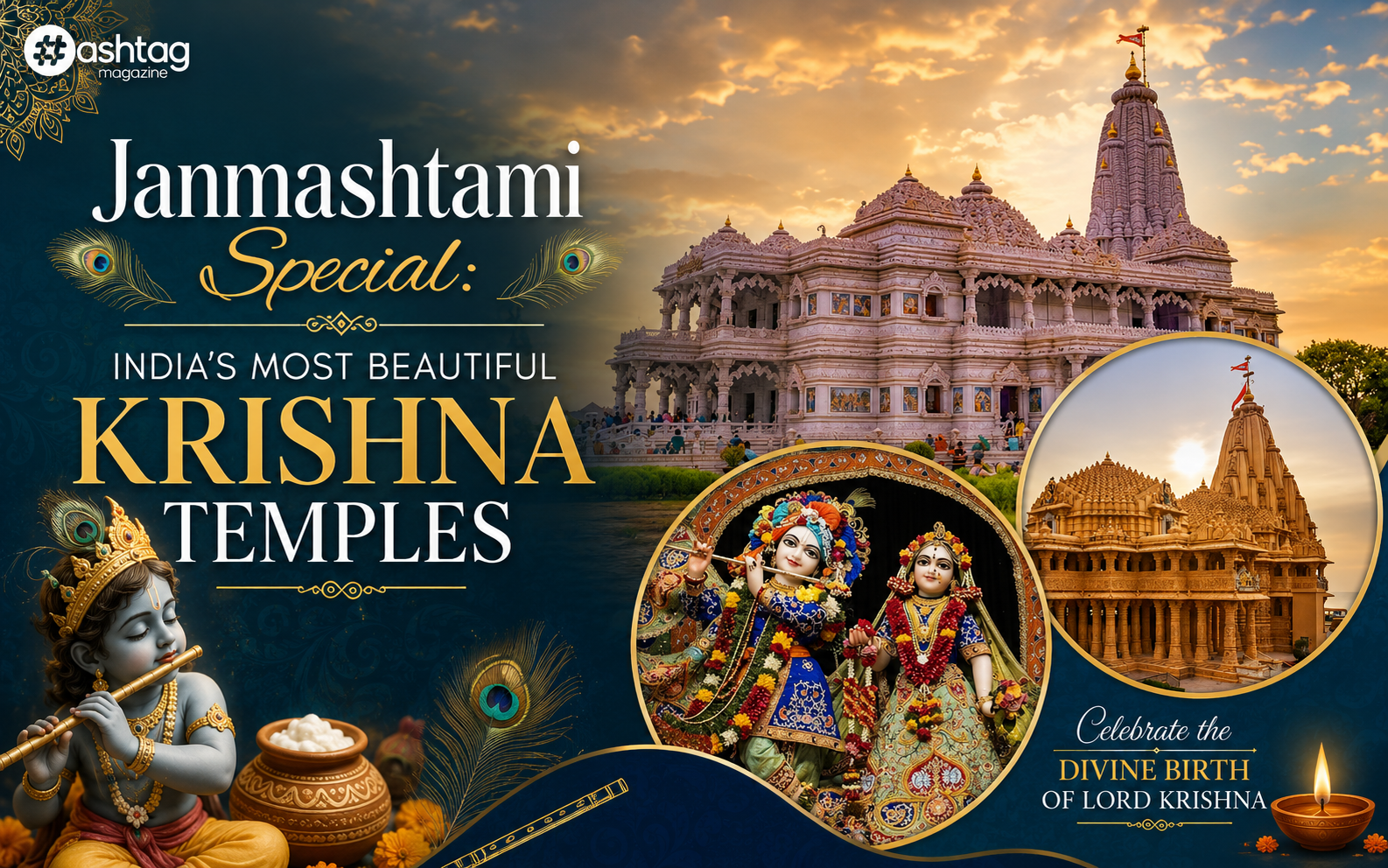
Janmashtami Special: India’s Most Beautiful Krishna Temples

Every year, as the monsoon clouds part and the fragrance of tulsi and jasmine fills temple courtyards across India, millions of devotees prepare to celebrate the birth of Lord Krishna, the playful cowherd, the divine statesman, the eternal beloved, Janmashtami is more than a festival, it is a nationwide outpouring of devotion, music, and midnight joy, marking the moment Krishna was born in a Mathura prison cell over 5,000 years ago. While Krishna’s story unfolds across the length and breadth of India, a handful of temples stand out not just for their spiritual significance, but for their sheer visual splendour. Marble carvings that seem to breathe, gold-plated domes that catch the sunrise, silver windows through which only a sliver of the deity is visible. This Janmashtami, Dhanush Kumar writes about eight of India’s most beautiful Krishna temples worth adding to your pilgrimage list. Banke Bihari Temple, Vrindavan: Tucked into the narrow lanes of Vrindavan, Banke Bihari is famous for its curtained deity; the eyes of Banke Bihari are considered so powerful that the curtain is drawn and redrawn constantly to prevent devotees from being overwhelmed. On Janmashtami, the temple performs its once-a-year Mangala Aarti at dawn, drawing enormous crowds who believe witnessing it wards off financial hardship. Prem Mandir, Vrindavan: Built entirely from Italian marble, Prem Mandir is arguably the most photogenic Krishna temple in India. Every surface is carved with scenes from Krishna’s life, and the temple’s evening fountain and light show transform the complex into a shimmering spectacle. During Janmashtami, the grounds glow with thousands of lamps, making it a favourite for both pilgrims and photographers. Dwarkadhish Temple, Dwarka, Gujarat: Perched on the banks of the Gomti River where it meets the Arabian Sea, this temple marks the site of Krishna’s legendary kingdom. Its soaring five-story spire, visible

Sanya Batra: From Corporate Career to Travel Storyteller

Sanya Batra is a Delhi-based travel content creator and storyteller who traded a decade-long corporate career for a life driven by exploration and creativity. With experience across marketing, sales, innovation, and entrepreneurship, Sanya brings a unique perspective to travel storytelling. Through her content, she goes beyond showcasing destinations, sharing experiences of personal growth, cultural discoveries, and the transformative impact of stepping outside one’s comfort zone. Her journey inspires others to embrace independence, pursue their passions, and create a life that feels truly fulfilling. 1. Thailand — A Destination for Every Kind of Traveller “Thailand holds a special place in my heart because it offers the perfect balance of adventure, relaxation, culture, and discovery.” From pristine beaches and scenic mountains to thrilling activities, vibrant nightlife, luxury experiences, and incredible local cuisine, Thailand has something for every traveller. As a solo female traveller, I also find Thailand to be one of the safest and most accessible destinations, making it an ideal choice for those looking to explore independently while experiencing a warm and welcoming culture. 2. Switzerland — A Real-Life Postcard “Switzerland feels like stepping into a dream. The snow-covered mountains, charming villages, crystal-clear lakes, and breathtaking train journeys make every moment feel magical.” What makes Switzerland truly special is its beauty in every season. Whether surrounded by winter landscapes or exploring its lush summer countryside, every corner offers a picture-perfect experience. It is a destination that captures the imagination and leaves you with memories that feel almost unreal. 3. Spiti Valley, India — A Journey of Transformation “Spiti Valley is unlike any other destination I have experienced. Raw, rugged, and untouched, it offers a sense of adventure and introspection that stays with you long after the journey ends.” From dramatic mountain landscapes and ancient monasteries to remote villages and endless star-filled