Hidden in the opulent state of Rajasthan lies Bundi, a little-known heritage. A site of architectural wonder, Bundi remains an un-spoilt paradise with few tourists visiting it every year. MD Masarrath Ali Khan gives us the lowdown on the historical significance of structures in and around Bundi…
Ever thought of travelling back in time and losing yourselves in an ‘out-of-a-fairy tale’ destination where you can ramble, relax and soak in the beauty of culture at your own pace? How about chiselling the image of a magnificent fort in your heart, while the sun paints it with gold? If this idea resonates with you, then Bundi is the place for you! The queen of Hadoti in Rajasthan, Bundi is immensely rich in art, culture, heritage, and natural beauty. Here are the must-visit places in Bundi…
Taragarh Fort

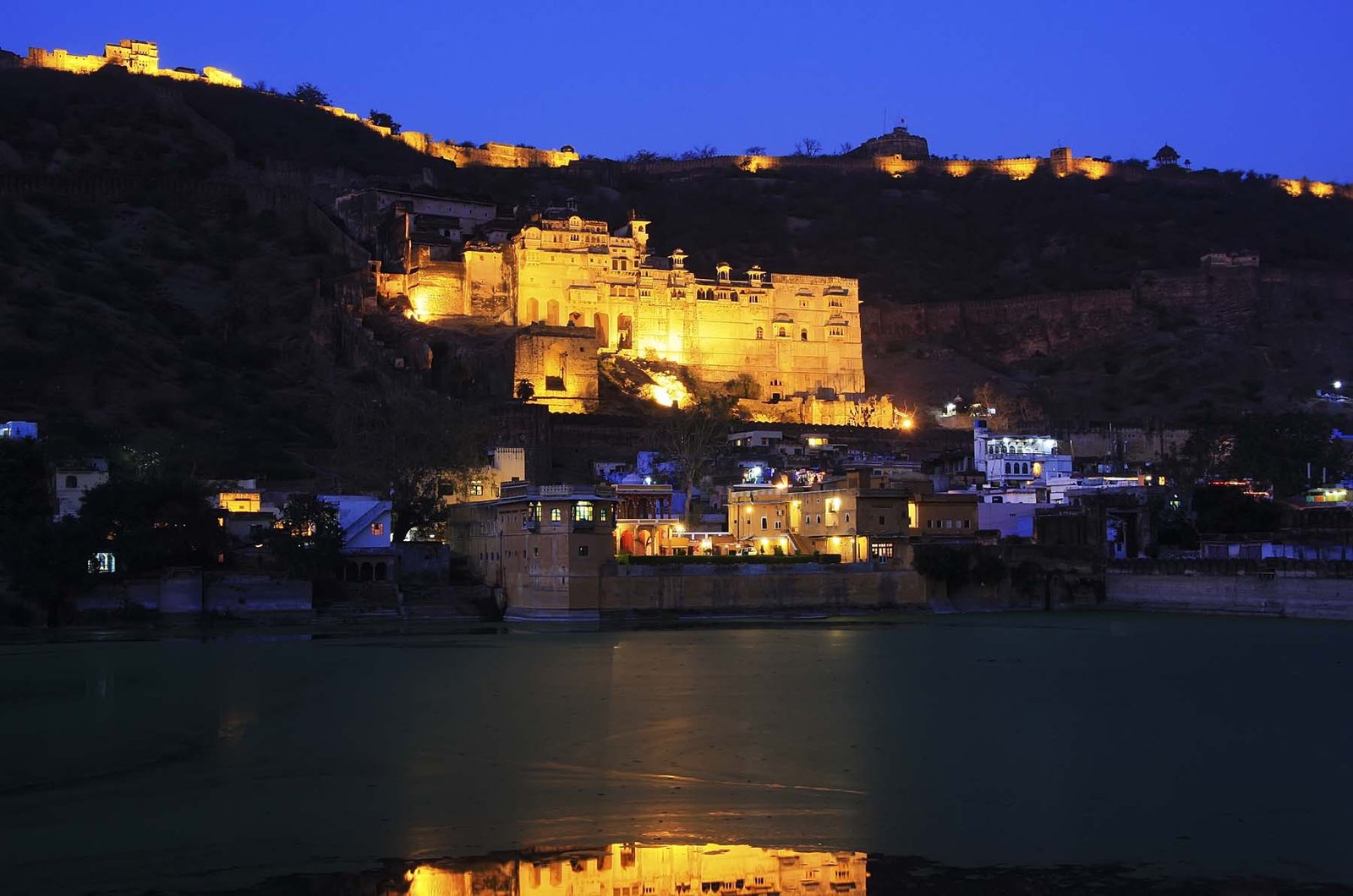
The star attraction of Bundi, this fort crowns the crest of a steep hill overlooking region. Its mighty presence dominates the landscape for miles around. Rao Deva commissioned the fort in 1298 AD and Rao Raja Bar Singh built it in 1354 AD at a height of 1,426 feet. The oldest fort was built on the top of the hill, perhaps by Rao Narpal sometime in the mid-14th century. It was later modified, and further additions were done by Maharao Anirudh Singh and Maharao Vishnu Singh. The fort ranks amongst the most impregnable and well-preserved structures of the Rajput legacy, with massive battlements and ramparts. Faujdar Dalil, of Jaipur, constructed the outer fort wall. Many of the buildings inside the fort complex are in a state of disrepair. There are four reservoirs atop the fort for collecting rainwater.
A little history…
This region was home to some of India’s ancient tribes. The Hada Rajput king Rao Deva wrested this territory from them and established control over the city of Bundi in 1241AD. The name Bundi is derived from the tribe chieftain’s name Bunda Meena. The successive Hada kings beautified the city with a glittering series of monuments, palaces, hunting lodges and stepwells.
The Magic of Bundi
Garh Palace
The Garh Palace complex sits at the foot of the fort and spills picturesquely down the hillside towards the town. It is adorned with intricately carved pillars, panels, impressively projecting balconies, latticed windows, elegant doors, and marvellous arches, and ranks amongst the finest architectural compositions of the medieval period.
The Garh Palace is an amazing integration of a cluster of several palaces built over a period of time. The Phool Mahal and Badal Mahal were built by Rao Bhoj Singh while Ratan Daulat (Diwan-i-Am) and Hathi Pol were built by Rao Ratan Singh. The Chhatar Mahal was built by Rao Chhathrasal while the Chitrashala, Rang Vilas and Anirudh Mahal were built by Rao Raja Anirudh Singh. Rao Raja Umed Singh built the final Hazari Pol and Hathi Pol.
A steep ramp takes you to the Hathi Pol (elephant gate), the main entrance into the palace complex. Here, the Ratan Daulat Palace has fine arrangements for keeping torches in its walls. There is also a marble throne of the Hada kings. A small door from Ratan Daulat takes you into the Chattar Mahal, where you can visit the Hathiya Sal Palace adorned with elephant-capitalized columns. At the Zenana Mahal one can see paintings showing Krishna’s birth, a king sitting on a lion seat (simhasana) and a princess being bedecked. Similarly, the Badal Mahal has lavishly drawn frescoes and murals depicting Krishna’s legends, court scenes, procession scenes and hunting episodes.
Chitrashala

The most lavish display of Bundi murals is found in the art gallery of paintings – the Chitrashala in Ummed Mahal. Influenced by the Mughal and Mewar schools, they depict a variety of themes like the ragamala paintings, love stories and court processions. The colours have a scheme: green for backgrounds, white for human bodies and red, blue, black and yellow for traditional dresses. While a dazzling damsel attired in Mughal dress comes alive on one wall, you can see a princess on horseback being attended by many women on the other. One can see here paintings showing Dhola waiting for his spouse under the shade of a tree; Rasamandala (the great cosmic dance) being enacted on the banks of Yamuna; Krishna lifting Mount Govardhan and a depiction of Cheeraharan (Krishna stealing the clothes of gopies).
Chaurasi Khambon ki Chhatri

Water bodies of Bundi: Kunds (reservoirs) and Baoris (stepwells)
Kunds and baoris (stepwells) are water bodies unique to Bundi. The Hada kings were quite aware of the need for conserving water; as such, they built the water bodies for religious as well as utilitarian purposes. Rani Nathavatji (queen to Rao Raja Anirudh Singh) is said to have built 21 baoris in the town. There are nearly 40 baoris (wells) in Bundi, known as the city of stepwells.
Some famous baoris of Bundi are Naval Sagar Ki Baori, Dadhimati Maheswari ki Baori, Shree Abhaynath Mahadev Ki Baori, Sisodiaji Ki Baori, Purushottam Ki Baori, Sukhi Baori, Manoharji Ki Baori, Hiralalji Ki Baori, Nahar Doos Ki Baori and Bhawalde Ki Baori.
The best known and most visited step-well is Raniji Ki Baori outside the Chaugan Gate. Rani Nathavatji (queen to Rao Raja Anirudh Singh) built it in 1699 AD, during the reign of her son Maharao Raja Budh Singh. Raniji Ki Baori is 40 feet wide (at the top) and 165 feet deep. With 200 steps descending into the water, it is a fine specimen of craftsmanship and is known for its architectural beauty. You can see here sculptures of standing Bhairava, Ganesha, Saraswathi and Gajendra along with 10 incarnations like Matsya, Varaha, and Narasingh. An inscription of 31 lines at the entrance describes the genealogy of the Hada rulers of Bundi.
Of the kunds, Dhabhai Ka Kund is another beautiful kund in Bundi. This 150 feet x 180 feet stepped tank is about 173 feet deep and is adorned with two beautiful chhatris (elevated dome-shaped pavilion). Nagar Kund and Sagar Kund are a pair of matching baoris (stepwells) outside Chaugan Gate. These stepwells were built by Maharani Chandrabhanu Kumari in 1871-75 AD, during the reign of Maharao Raja Ram Singh.
Nawal Sagar is a large rectangular artificial lake measuring approximately 820 feet x 574 feet, and is located close to Garh Mahal. A temple dedicated to Varuna, the Aryan god of water, stands half-submerged in the centre of the lake.
Shikar Burj
This is the royal hunting lodge built by Maharaja Umed Singh in 1770 A.D. Surrounded by a thick forest cover, wild animals are said to have frequently visited this place in ancient times. The exterior wall of this edifice is pierced with a series of holes, in which the muzzle of the gun was placed, and animals were shot at.
Sukh Mahal
Rao Raja Vishnu Singh built a palace on the banks of the Jait Sagar Lake, under the supervision of his Diwan Sukhram, in 1773 AD. So came to be the palace known as Sukh Mahal. Rudyard Kipling, writer of The Jungle Book and the 1907 Noble Prize Winner of Literature, lived in the Sukh Palace for some time. He is said to have derived inspiration for his famous novel Kim (1901) from the scenes that he saw here. The palace houses a small museum.
Kajari Teej Festival of Bundi
The Kajari Teej Festival of Bundi is an important annual festival that is celebrated in Bhadra month, on the 3rd day after the full moon in the Krishna Paksha. This year it falls on 24th or 25th August, depending on the moon’s cycles. Bundi’s Kajari Teej is one of those rare Hindu festivals which falls during the phase of the waning moon.

The legend of Kajari Teej: Thakur Balwant Singh of Gothda once set out to steal the idol of teej from the festivities in Jaipur for his own village. The journey back must have taken 5 to 10 days, as Balwant Singh then took out a teej procession in his village on the 3rd day after the full moon in the month of Bhadra (15 days after the Teej celebrations in Jaipur). After the death of Thakur Balwant Singh in a battle, Rao Raja Ram Singh brought the idol to Bundi and continued the tradition started by his predecessor by celebrating teej in the month of Bhadra, 15 days after it is celebrated in Jaipur.
Kajari Teej sees the entire Bundi town illuminated in colourful lighting. Women and children in their finest attires assemble outside their home from early afternoon to catch a glimpse of their favourite goddess. The teej procession starts from Naval Sagar after dusk and winds its way through the narrow lanes of Bundi. Gorgeously decorated elephants, camels and horses accompany the procession. Traditional folk artists sing and dance along the path of teej. Carried in a decorated palanquin, the deity is halted along the way to enable the waiting groups to offer prayers. Though the main function of Bundi, teej is only on two days the celebrations continue till Janmashthami.