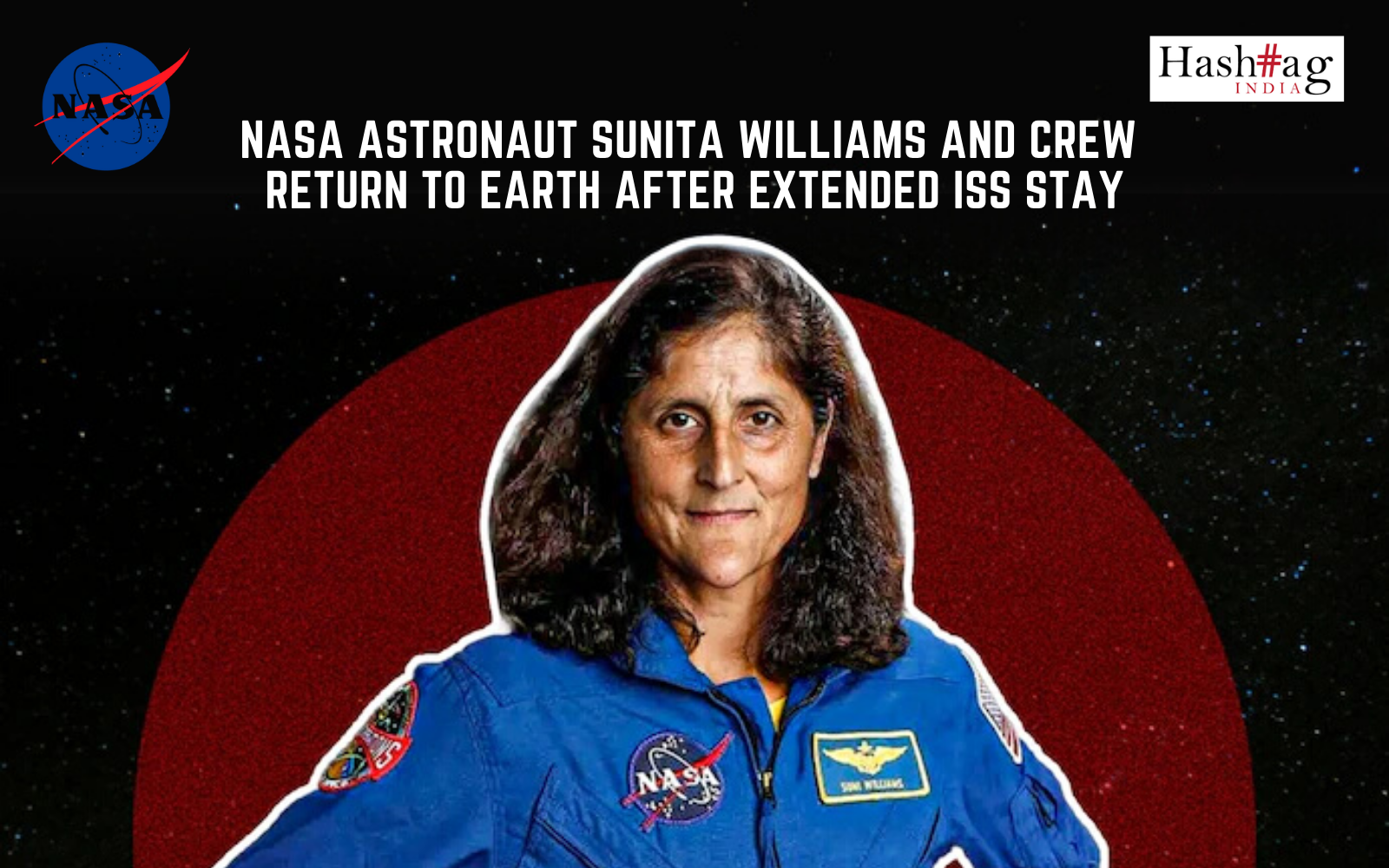
NASA Astronaut Sunita Williams and Crew Return to Earth After Extended ISS Stay

NASA astronaut Sunita Williams and her fellow crew member, Butch Wilmore, have safely returned to Earth after an unexpectedly prolonged stay aboard the International Space Station (ISS). The two astronauts, who originally launched aboard the Boeing Starliner for a planned eight-day mission, ended up spending over nine months in space due to technical issues with their spacecraft. Hashtag Magazine gives you an overview of the mission that went on longer than expected.

Launch and Initial Mission Plans

Williams and Wilmore lifted off aboard the Boeing CST-100 Starliner on June 5, 2024, from Cape Canaveral, Florida. This mission, called the Crew Flight Test (CFT), was meant to be a short-duration test of Boeing’s new spacecraft, which NASA had chosen as part of its Commercial Crew Program. The goal was to demonstrate that the Starliner could successfully transport astronauts to and from the ISS, providing an alternative to SpaceX’s Crew Dragon.

Upon arriving at the ISS, Williams and Wilmore were welcomed by the station’s existing crew. Their responsibilities included running scientific experiments, testing the Starliner’s systems, and participating in routine station maintenance. However, what was intended to be a brief stay soon turned into an unexpectedly long mission due to complications with their return vehicle.

Technical Issues and Delays

Shortly after docking at the ISS, NASA engineers detected multiple technical issues with the Starliner. The most significant problems included malfunctions in five of its thrusters and a persistent helium leak in the propulsion system. These concerns made it unsafe for the astronauts to use the spacecraft for their planned return.

Boeing and NASA engineers worked tirelessly to diagnose and fix these problems remotely. Extensive tests were conducted to determine whether Starliner could safely bring Williams and Wilmore back to Earth. Given the complexities of spaceflight and the need for absolute safety, the return was postponed multiple times to allow for additional troubleshooting.

Despite the delays, NASA assured the public that Williams and Wilmore were safe aboard the ISS. The station had enough resources, and the astronauts were integrated into the daily operations of the crew. They also took part in scientific research and outreach programs, even celebrating milestones like Thanksgiving and Christmas in space.

Successful Return and Splashdown

After months of assessment, NASA and Boeing confirmed that the Starliner was ready for its return journey. On March 18, 2025, the spacecraft successfully undocked from the ISS. Williams and Wilmore re-entered Earth’s atmosphere and made a parachute-assisted landing in the southwestern United States. This marked the first time a crewed Starliner mission had completed both the journey to and from space.

Upon landing, the astronauts were met by NASA’s recovery team and underwent standard medical evaluations. Despite spending much longer in microgravity than planned, both Williams and Wilmore were reported to be in good health.

Lessons from the Starliner Mission

The delays faced by Williams’ mission highlight the difficulties of space travel, particularly with new spacecraft. Boeing’s Starliner program, which was meant to be a competitor to SpaceX’s Crew Dragon, faced multiple setbacks but also provided valuable lessons. NASA and Boeing will now use the data gathered from this mission to refine Starliner’s systems and improve future flights.

For Sunita Williams, this mission added to her already impressive career as an astronaut. A veteran of multiple spaceflights, she has now spent over 500 days in space across her missions. Her resilience and adaptability, even in unexpected circumstances, once again demonstrated the dedication required for human space exploration.

As she returns to Earth, Williams’ journey underscores both the challenges and triumphs of pushing the boundaries of spaceflight.


Leave a comment

Your email address will not be published. Required fields are marked *

Which Home Services App Truly Simplifies Your Life

For decades, the foundation of a comfortable home relied on a Rolodex full of scattered contacts. The temperamental electrician, the hard-to-schedule parlour lady, and the elusive plumber. Today, that chaotic system has been replaced by a single, elegant solution: the Home Services App. But with a growing market, which app reigns supreme for your specific needs? Dhanush Kumar conducts a meticulous deep dive into the four major players Urban Company, Yes Madam, Broomies, and Hit A Cook to help you master the modern, hassle-free home. 1. Urban Company: If you are looking for an all-in-one solution, Urban Company is the dominant market leader and the go-to platform. The app operates on a fixed price service model for most categories. You select a service, for example: AC Repair or Deep Cleaning. Choose specific tasks within that category, select your time slot, and the app instantly provides the final, non-negotiable price. A verified professional is then assigned to your job. Core Services Offered: Home Repairs & Maintenance: Electricians, Plumbers, Carpenters, AC Servicing & Repair, Geyser Repair. Cleaning & Pest Control: Deep Home Cleaning, Sofa/Carpet Cleaning, Pest Control. Beauty & Wellness: Salon at Home (for men and women), Massage Therapy. Others: Appliance Repair (Washing Machine, Refrigerator, etc.). 2.Yes Madam Yes Madam has risen as a strong competitor, particularly in the beauty and wellness space, focusing on cost-effectiveness and a unique product-transparency model. The app’s core difference from UC lies in its product transparency. For beauty and salon services, they charge only for the service and allow customers to keep any unused product from the single-use kits. You book your service, choose your time, and the professional arrives with the sealed, pre-packaged kits. Core Services Offered: Beauty & Wellness: Salon at Home (Waxing, Manicure, Pedicure, Facial, Hair Spa), Makeup Artists. Men’s Grooming: Haircut and

The Rise of Blockchain in iGaming

The iGaming industry has witnessed significant technological advancements over the years, but few innovations have been as transformative as blockchain technology. While its application in iGaming is still evolving, blockchain has primarily made its mark in one critical area: payment methods. By offering secure, transparent, and decentralized transactions, blockchain has addressed many of the challenges associated with traditional payment systems, such as delays, high fees, and lack of transparency. One standout example of blockchain’s impact is Lucky Block, a platform that has embraced this technology to streamline payments for its users. By leveraging blockchain, Lucky Block casino ensures faster deposits and withdrawals, reduced transaction costs, and enhanced security, making it a preferred choice for players seeking efficiency and reliability. As blockchain continues to gain traction in iGaming, its role may expand beyond payments, but for now, it remains a game-changer in how players interact financially with online casinos. What is Lucky Block? A New Era of Online Casinos Lucky Block is redefining the online casino experience by combining cutting-edge blockchain technology with a user-centric approach. As a next-generation iGaming platform, Lucky Block stands out for its innovative features, seamless functionality, and commitment to transparency, making it a trailblazer in the rapidly evolving world of blockchain casinos. At its core, Lucky Block leverages blockchain to revolutionize payment processes, offering players instant deposits and withdrawals without the need for intermediaries. This not only reduces transaction fees but also ensures a higher level of security and privacy for users. Unlike traditional online casinos, Lucky Block eliminates the delays and inefficiencies often associated with conventional banking systems, providing a smoother and more enjoyable gaming experience. But Lucky Block is more than just a payment solution. The platform offers a diverse range of games, from classic casino staples to modern, interactive options, catering to players

AI Sports Predictions: Accuracy Test

What are the odds of AI winning the prediction game? Way better than your home boy’s gut feeling but still not quite fortune-teller level. Can an algorithm outthink a seasoned sports analyst? Well, it doesn’t drink beer while watching the game, so that’s a plus. In the billion-dollar world of sports betting, AI is hyped as the ultimate game-changer. But does it truly predict, or just make educated guesses with a fancy calculator? We put it to the test, comparing its accuracy across sports, stacking it against human experts, and checking if platforms like N8Casino truly benefit from AI-driven predictions. Or old-school instinct still holds the upper hand? Spoiler: AI is good, but it still can’t predict a referee’s bad day. Analytical Intelligence vs. Human Instinct The battle between AI-driven sports predictions and human expertise is like watching an old-school coach argue with a stats nerd: both have their strengths, but only one can crunch millions of data points without a coffee break. Research suggests that AI models have a slight but significant edge over human analysts, thanks to their ability to process terrifyingly large datasets and spot patterns invisible to the human eye. A study by Beal et al. (2020) found that machine learning models reached 63.18% accuracy in predicting match outcomes. Apparently, knowing how many times a team sneezed during warm-ups does matter. Meanwhile, Huynh (2024) pushed AI even further, achieving a 61.54% accuracy rate—still leagues ahead of random guessing at 33% , which, let’s be honest, is how some people bet. But, before you throw your favorite pundit out the window, human analysts still bring intuition, gut feeling, and an uncanny ability to smell an upset brewing. Just something AI struggles with. Predictor Prediction Accuracy (%) AI Model 1 67% AI Model 2 72% AI Model 3

10 Wedding Tech Trends Defining 2025

Weddings in 2025 are no longer just about tradition they’re about blending love, creativity, and cutting-edge technology. As couples seek ways to make their big day more personal, seamless, and unforgettable, tech innovations are stepping in to redefine celebrations. 1. Elevated Digital Invitations Paper invites are making way for stylish, interactive digital invitations. These chic e-invites often feature custom animations, background music, and interactive RSVP options. Not only are they eco-friendly, but they also allow couples to set the tone of their wedding from the very first click. 2. Wedding Content Creators Forget waiting weeks for edited wedding videos. In 2025, couples are hiring dedicated content creators to capture behind-the-scenes moments in real time. From candid TikToks to Instagram Reels, these professionals ensure your special day trends online as beautifully as it unfolds in person. 3. QR Codes for Photo Uploads Guest photos are now part of the official wedding story. With QR codes placed at tables or on signage, guests can upload their pictures instantly into a shared digital album. This feature creates a live, crowd-sourced collection of memories from every perspective. 4. AI-Supported Wedding Design Couples are turning to artificial intelligence for personalized wedding planning. AI tools generate mood boards, décor suggestions, seating layouts, and even floral color palettes in seconds helping bring dream weddings to life faster and with more creativity. 5. 360° Photo Booths Say goodbye to static snapshots. 360° photo booths let guests capture glamorous slow-motion videos and panoramic shots. Popular at celebrity red carpets, these booths add a luxe, interactive experience that guests love to share. 6. Augmented Reality Venue Tours Couples no longer need to visit multiple venues physically. With augmented reality (AR), they can virtually walk through spaces, visualize seating arrangements, and preview décor setups all from the comfort of their homes.

You May Also Like

Connect with us