Ravi Mittal, founder of the QuackQuack dating app, discusses with Surabhi Goel how he transformed his tech passion into a top Indian app connecting singles nationwide from Hyderabad.
Ravi Mittal, born in Vijayawada and raised in Hyderabad, is the innovative force behind QuackQuack, a leading Indian dating app. Despite dropping out of college at 16 to manage his family’s manufacturing business, Ravi’s entrepreneurial spirit and passion for technology propelled him to create QuackQuack. Today, the app operates from Hyderabad with a dedicated team of 26 people, connecting singles across India. Ravi’s journey from a young business manager to a successful tech entrepreneur is a testament to his perseverance and vision. With no formal technical qualifications, he continually experiments with consumer internet applications, learning and adapting to drive QuackQuack’s success. Ravi Mittal’s story highlights how dedication and a willingness to embrace new challenges can turn a simple idea into a thriving business.
QuackQuack dating app – Ravi Mittal
- Can you share your journey with Quack Quack from its inception to its current success? What motivated you to start a dating app in India?
We started QuackQuack in 2010. I had recently dropped out of college at 16 and worked with my father for seven years. Without a social circle, I explored dating websites but found none tailored to India. Seeing this need, I created QuackQuack. In the beginning, I rented a small 2 BHK apartment near my house and started with a team of just two people. Our desktop website went live in 2010, and we gradually began attracting users, with our first paying customer arriving three months after launch. We operated without external funding, growing slowly and steadily. In 2015, we launched our Android and iOS apps, which significantly boosted our traffic.
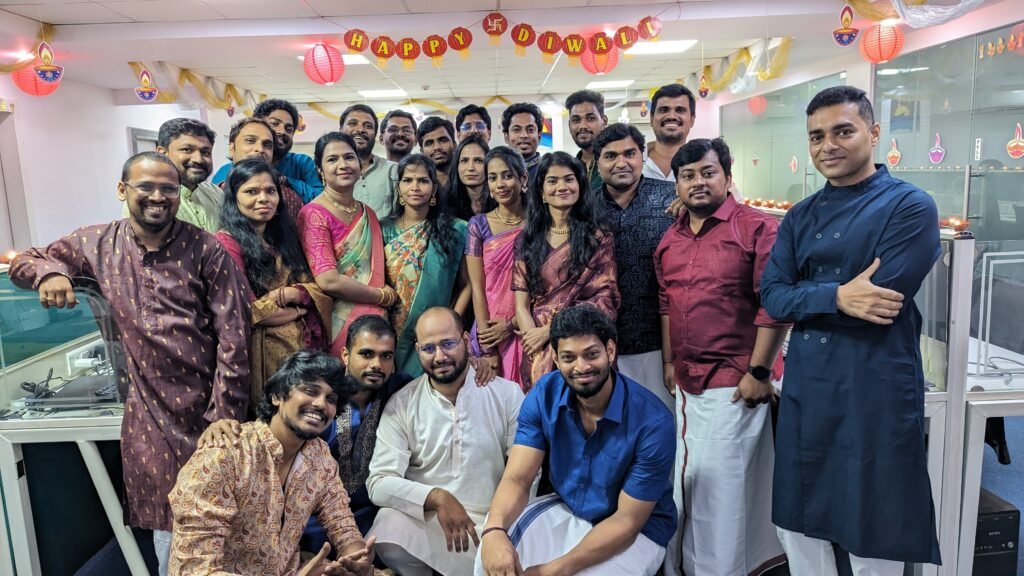
By 2019, we had reached 5 million users, and the pandemic accelerated our growth as more people turned to mobile apps. Since then, we’ve been adding nearly 1 million users every three months, reaching 32 million users in just four years. Our success stems from fulfilling a personal need and growing sustainably.
- In the competitive landscape of dating apps, how does Quack Quack differentiate itself from other players in the market?
While many dating apps in India focus on matching people within a specific radius, like Tinder or Bumble, QuackQuack takes a different approach. We primarily target users in Tier 2 and Tier 3 cities, smaller towns, and rural areas. Our platform allows people to connect with others from anywhere in India, not just within a few kilometers. QuackQuack enables users to make friends across the country. It’s common to see someone from Chennai befriending someone from Punjab or a person from Kolkata connecting with someone from Bangalore. Many of our users are not just looking for dates but are open to making new friends. This is especially important for those from smaller towns who may have limited opportunities to interact with the opposite gender. QuackQuack provides a unique space for these connections, setting us apart from more urban-focused dating apps.
- How do you navigate the challenges and complexities of running a dating application, especially in terms of user safety and data privacy?
Navigating user safety and data privacy is a top priority for QuackQuack. With the rise of scams in the digital age, including dating apps, we face significant challenges. To address these, we employ a dedicated team of moderators available 24/7 and use advanced artificial intelligence to enhance security.
Our moderation system is robust, detecting and suspending about 90% of scammers during profile creation. We also adapt to evolving scam patterns, such as those involving cryptocurrencies or fake offers on Telegram or cafes, and we continuously update our methods to stay ahead. It’s a constant battle, but our commitment to protecting users remains unwavering.

- How has the Indian dating scene changed since QuackQuack launched, and what trends and opportunities do you foresee in your target market?
Since the pandemic, we’ve seen a dramatic increase in user traffic, with our growth rate shifting from gaining 100,000 users annually to adding 1,000,000 users every three months. The average age of our users has dropped from 29 to 25, reflecting a surge in younger, Gen Z users who prefer dating apps over traditional matrimonial sites. While dating used to be more casual, there’s now a noticeable shift towards serious relationships, with many users sharing testimonials about finding their matches and even getting married.
Our target market primarily spans ages 25 to 35, which includes people looking for both dating and potential marriage. However, we’re also seeing growing interest from the 18 to 20 age group and are working to understand their preferences better. Additionally, the perception of dating apps among women is changing; more women are joining, albeit with a focus on privacy and cautious sharing of personal information. This evolving dynamic highlights the increasing acceptance and utility of dating apps across diverse demographics.
- What role has user feedback played in shaping Quack Quack, and can you give an example of a significant change implemented based on user suggestions?
User feedback is crucial to our development process at QuackQuack. We continuously gather and analyze user suggestions to enhance our platform and improve engagement. For instance, we once received feedback that our app was using an unusually high amount of data. Surprisingly, this issue wasn’t related to video streaming but rather to the frequent loading of images for a highly active user.
After investigating, we discovered that this user’s excessive logins and image loading were causing significant data consumption. We addressed this by optimizing our data usage, and reducing the load on our users. This example highlights how we take user feedback seriously, as we believe that one reported issue often represents many unreported ones. We are committed to addressing bugs and implementing improvements based on user input to ensure a better experience for all.
- What was the most challenging part of your journey till now?
One of the most challenging aspects of my journey has been shifting perceptions around dating in India. Initially, dating apps faced skepticism and were often viewed negatively. Changing this mindset and gaining acceptance was a significant hurdle. Today, our challenges continue to evolve, with user safety and security being major concerns. Ensuring protection against scammers and maintaining a trustworthy platform remain ongoing challenges. As we move forward, we anticipate new challenges will arise, but adapting to these shifts is part of the entrepreneurial journey.
- What are your future goals and plans for Quack Quack? Are there any new features or expansions on the horizon?
Our plans for QuackQuack involve refining and testing new features aimed at enhancing user connections through micro-matching. We’re exploring ways to match people based on very specific criteria, such as those at the same airport, attending the same music concert, or from the same college.
Currently, our focus is on strengthening our presence in India, where QuackQuack is the most downloaded dating app, surpassing even Tinder. We believe there is significant growth potential within the Indian market before considering international expansion.

Quick Takes
- what is your favorite pastime or hobby?
One of my favorite pastimes is exploring and testing new apps. I enjoy signing up for various apps and analyzing their user interfaces to learn from them. Additionally, I’m a fitness enthusiast, often hitting the gym early in the morning. On weekends, I like to balance my routine by experimenting with different foods and indulging in my love for culinary adventures.
- What habit do you believe contributes most to your productivity?
One habit that significantly boosts my productivity is making detailed notes. By jotting down tasks and important points, I ensure that nothing slips through the cracks and that I stay organized. This habit keeps me on track and helps me complete my work efficiently.
- How do you de-stress and unwind after a busy day?
I like to unwind by watching web series or movies, particularly crime and murder mysteries. It’s a relaxing way for me to disconnect and enjoy some downtime.
- What has been your favorite travel destination and why?
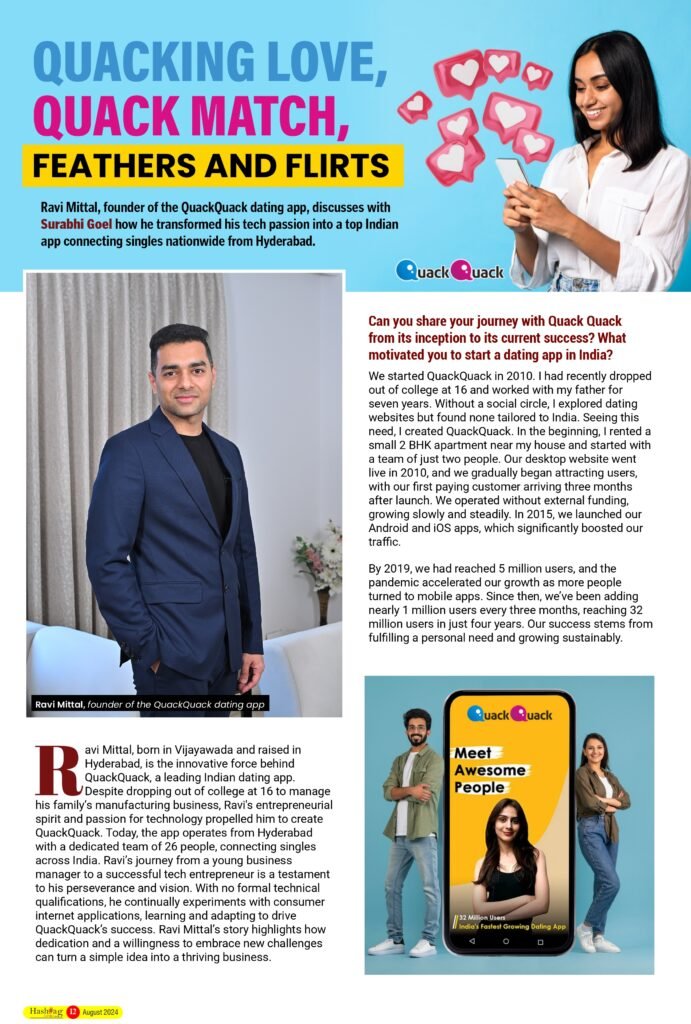
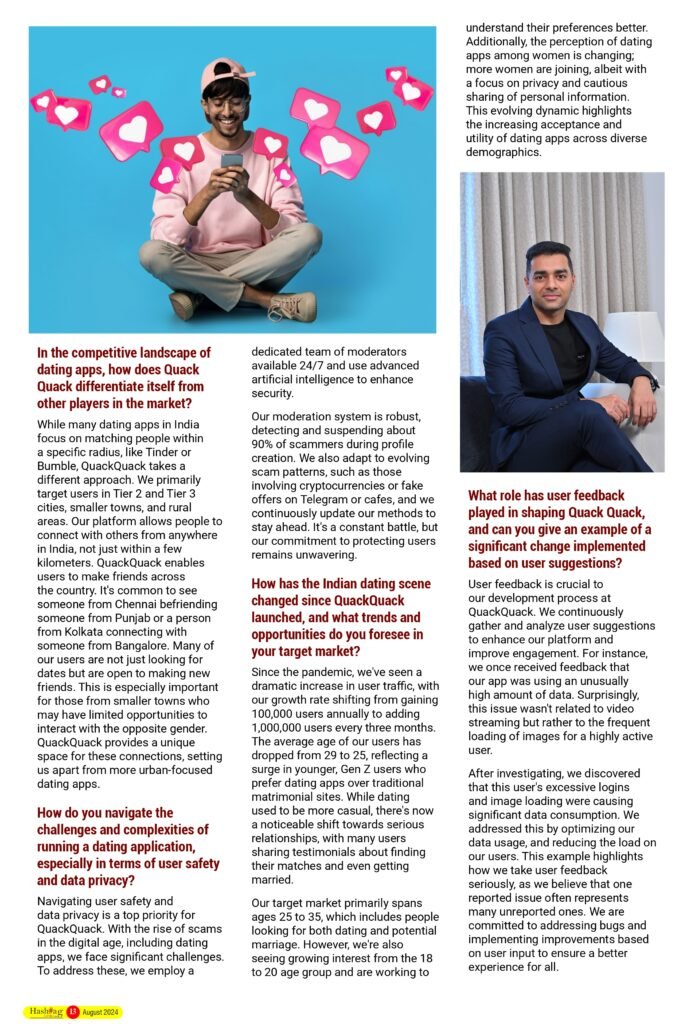
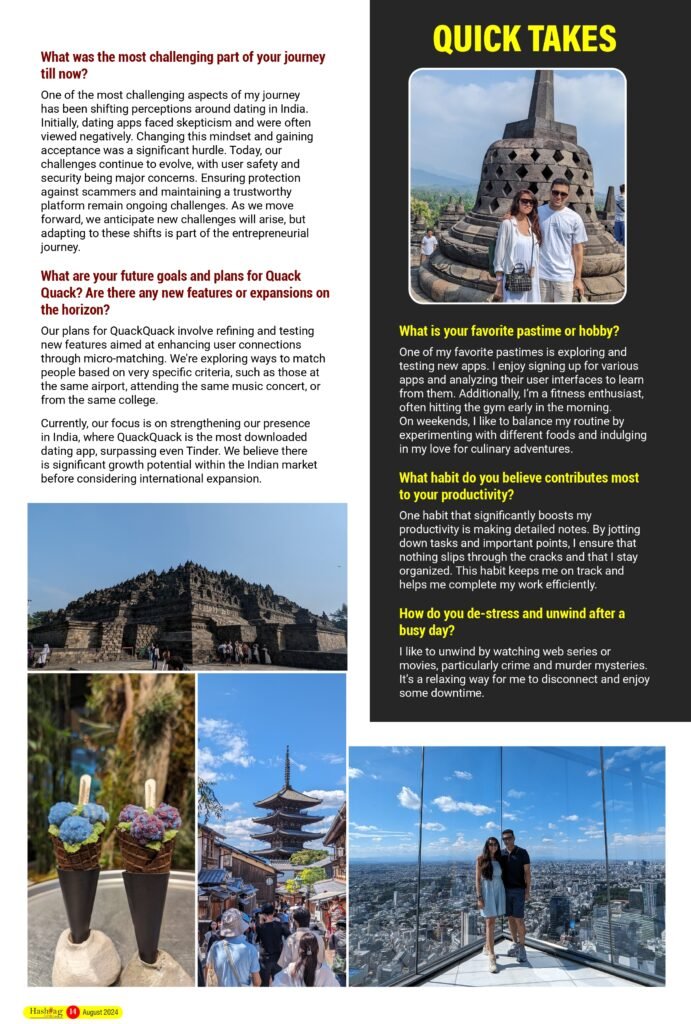
Having traveled extensively in Asia, I would say Taiwan and Japan are my top favorites. Japan, in particular, is a must-visit for its stunning beauty and unique culture. I highly recommend experiencing Japan at least once in a lifetime for its incredible landscapes, rich history, and vibrant cities.
- Can you share a book or movie that has had a significant impact on you?
The movie 3 Idiots had a significant impact on me. Working with my dad, inspired me to follow my passion and pursue my path, leading to the creation of QuackQuack. Its message about pursuing what you love was a major eye-opener for me.