
Beat the Heat: 7 Natural Home Cooling Hacks to Keep You Cool

7 Natural Home Cooling Hacks

As the scorching summer sun beats down on our homes, it’s essential to find ways to keep our living spaces cool and comfortable. While air conditioners and fans provide temporary relief, they can be expensive and harmful to the environment. Fortunately, there are several natural and effective ways to beat the heat without breaking the bank or harming the planet.

In this article, Hashtag Magazine gives you 7 natural home-cooling hacks to help you keep your home cool and comfortable during the sweltering summer months. From allowing ventilation to bringing in greenery, these simple yet effective tips will help you create a cooler, more sustainable living space.

1. Allow Ventilation: The Power of Cross Breeze

One of the simplest and most effective ways to cool your home is by allowing ventilation. By opening windows and doors on opposite sides of your home, you can create a cross breeze that pulls hot air out and brings cool air in. This technique is especially effective in homes with large windows or sliding glass doors.

To maximize ventilation, consider the following tips:

  • Open windows and doors during the cooler morning and evening hours to allow cool air to enter.
  • Close windows and doors during the hottest part of the day (usually between 11am and 3pm) to keep hot air out.
  • Use window screens or mesh doors to keep insects out while still allowing airflow.

By allowing ventilation, you can significantly reduce the temperature inside your home without relying on air conditioning.

2. Install Blinds: Blocking Out the Sun’s Rays

Another effective way to keep your home cool is by blocking out the sun’s rays. Installing blinds or shades on your windows can help reflect sunlight and keep your home cooler. Consider using:

– Light-colored blinds or shades to reflect sunlight.

– Thermal or blackout curtains to block out sunlight and keep warmth in.

– Solar screens or window films to block UV rays and reduce heat gain.

By installing blinds, you can reduce the amount of direct sunlight that enters your home, keeping it cooler and more comfortable.

3. Use Natural Fabrics: The Cooling Power of Cotton and Linen

The type of fabrics you use in your home can also impact its temperature. Natural fabrics like cotton and linen are breathable, allowing air to circulate and cool your home. Consider using:

– Cotton or linen curtains or drapes to allow airflow and filter sunlight.

– Natural fiber rugs or mats to add warmth and texture to your floors.

– Cotton or linen bedding to keep you cool and comfortable while sleeping.

By incorporating natural fabrics into your home decor, you can create a cooler, more comfortable living space.

4. Incorporate Cool Colors: The Psychology of Color

The colors you use in your home can also impact its perceived temperature. Cool colors like blue, green, and purple can create a calming, cooling effect, while warm colors like red, orange, and yellow can create a cozy, warming effect. Consider using:

– Cool-colored paints or wallpapers to create a calming atmosphere.

– Blue or green-tinted windows or glass doors to filter sunlight and reduce heat gain.

– Cool-colored bedding or curtains to keep you cool and comfortable while sleeping.

By incorporating cool colors into your home decor, you can create a cooler, more comfortable living space.

5. Treat Your Roof: The Importance of Insulation

Your roof plays a critical role in regulating your home’s temperature. By treating your roof with insulation, you can reduce heat gain during the summer and heat loss during the winter. Consider using:

– Insulation materials like fiberglass, cellulose, or spray foam to reduce heat transfer.

– Radiant barrier materials like aluminum foil or plastic sheeting to reflect sunlight and heat.

– Cool roof coatings or paints to reflect sunlight and reduce heat gain.

By treating your roof, you can significantly reduce your energy bills and create a more comfortable living space.

6. Get Smart with Wall Paint: The Science of Heat Reflection

The paint you use on your walls can also impact your home’s temperature. By using specialized paints or coatings, you can reflect sunlight and heat, keeping your home cooler. Consider using:

– Heat-reflective paints or coatings containing materials like titanium dioxide or zinc oxide.

– Cool wall paints or coatings with high solar reflectance index (SRI) values.

– Textured or patterned paints to create a cooling, shading effect.

By getting smart with wall paint, you can reduce heat gain and create a cooler, more comfortable living space.

7. Bring in Greenery: The Cooling Power of Plants

Finally, one of the most effective ways to cool your home is by bringing in greenery. Plants are natural air purifiers, and they can help cool your home by:

– Providing shade and blocking direct sunlight.

– Releasing moisture into the air through transpiration.

– Purifying the air and removing toxins.

Conclusion:

As the summer sun continues to shine brightly, it’s essential to find natural and effective ways to keep our homes cool and comfortable. By incorporating these 7 simple yet powerful hacks, you can significantly reduce your energy bills and create a cooler, more sustainable living space. Stay cool, stay natural, and beat the heat with ease!


Leave a comment

Your email address will not be published. Required fields are marked *

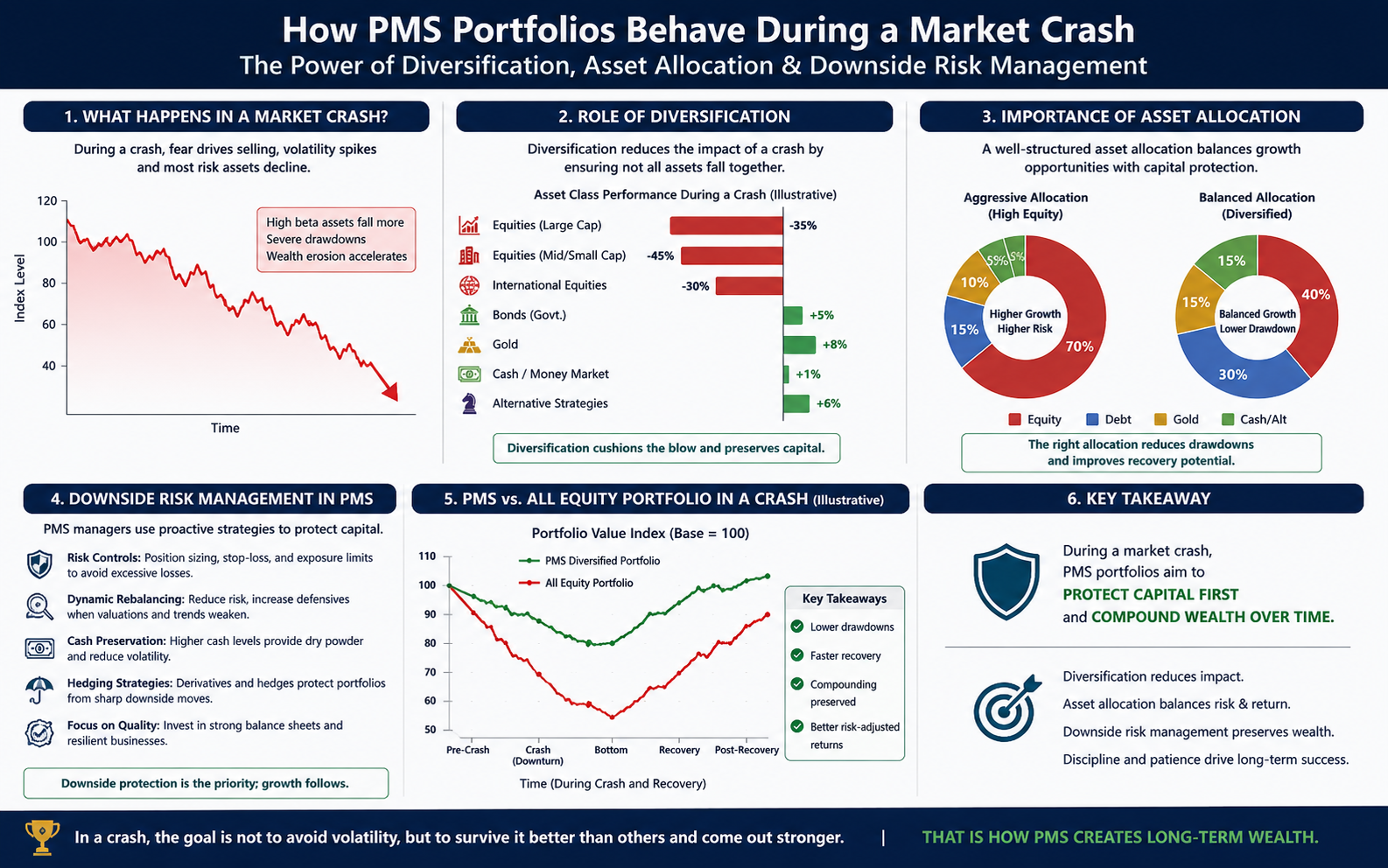
How PMS Portfolios Perform During a Market Crash | Risk Management Guide

Market crashes are the ultimate stress test for any investment strategy. While returns dominate conversations during bull markets, it is during downturns that the true structure and resilience of a PMS portfolio become visible. Many investors assume that all portfolio management services portfolios behave similarly in a crash. In reality, outcomes can vary significantly depending on how the portfolio is constructed. 1. What a Traditional PMS Looks Like A traditional equity PMS is typically built as a concentrated portfolio of 15–30 individual stocks. This structure is intentional: Managers aim to generate alpha through high-conviction bets Capital is allocated meaningfully to each idea Diversification is limited compared to mutual funds However, during a market crash, this concentration becomes a double-edged sword. What happens in a crash? If a few key holdings fall sharply, the overall portfolio can decline disproportionately Single-stock risk gets amplified Liquidity issues in mid and small caps can worsen drawdowns For example, if a PMS holds 20 stocks and 3–4 of them fall 40–50%, the portfolio impact can be severe. This is the structure most investors picture when they think “PMS in a crash” — and it is also what has given PMS an unfair reputation for being high-risk by default. But concentration in direct stocks is a choice, not a requirement of the PMS structure. What sits inside the portfolio is what determines crash behaviour. 2. Not All PMS Portfolios Are Built the Same It is a common misconception that all PMS providers only buy direct stocks. In reality, a PMS is simply a personalized account managed by a professional. The strategy inside can vary wildly. While many providers stick to equities, others take a multi-asset approach. These providers build portfolios using a mix of mutual funds, direct bonds, gold, REITs (Real Estate Investment Trusts), and InvITs

Top Gaming Laptops That Can Handle Indian Summer Heat

April in Hyderabad, May in Delhi, and June in Chennai, you know what that feels like! The kind of heat that makes your phone hot just sitting on a table. The kind that turns a power cut into a genuine crisis. Now imagine gaming in that.Most laptops panic. The fans scream. The frame rates drop. The machine thermal throttles, which is a technical way of saying it gives up and slows down to stop itself from burning alive. But some laptops were built differently. Dhanush Kumar writes about the laptops that handle the heat, keep their cool, and let you game through an Indian summer without melting down. ASUS ROG Strix G16 If there is one laptop that truly understands Indian summer, it is this one. Asus put a Tri-fan technology system inside the ROG Strix G16, three fans working together, so no single part of the machine overheats. There are also liquid metal thermal compound pads on the CPU, which is a premium touch you usually only find on much more expensive machines. Even during long gaming sessions at room temperatures of 35 to 38 degrees, this laptop holds steady. Frame rates stay consistent. The keyboard doesn’t become a frying pan. The RTX 4070 inside pushes beautiful visuals in everything from BGMI to Cyberpunk. This is the one we would put our money on for an Indian summer. Lenovo Legion Pro 5i Gen 9 Lenovo’s Legion line has always been serious about thermal management, and the Pro 5i Gen 9 is their best effort yet. The Cold Front 5.0 cooling system uses a hybrid fan design with a bigger air intake. Translation: more cool air comes in, more hot air goes out, faster. What makes this special for India is how it handles dust. Indian summers come with dust.

Top AI Tools Everyone Must Use in 2026

Artificial Intelligence is no longer limited to tech companies or programmers. In 2026, AI tools are becoming essential everyday companions for students, professionals, entrepreneurs, designers, and content creators. From writing emails and designing visuals to coding software and researching complex topics, AI-powered platforms are transforming how we work and create. Experts say generative AI tools now help automate repetitive tasks, speed up creativity, and improve productivity across industries. They allow users to produce content, analyze data, generate visuals, and even compose music within minutes. Here are some of the most powerful AI tools everyone should consider using in 2026. 1. ChatGPT – The All-Purpose AI Assistant ChatGPT remains one of the most widely used AI tools globally. It can help users write articles, generate ideas, summarize information, plan projects, and even assist with coding. Its conversational interface allows people to interact with AI as if they were talking to a colleague. Best for: Writing and editing content Brainstorming ideas Coding and debugging Learning new topics For many professionals, ChatGPT has become a daily productivity companion. 2. Google Gemini – AI for Research and Productivity Google Gemini is designed to integrate deeply with Google’s ecosystem, including Gmail, Docs, Sheets, and Android devices. It excels at analyzing large amounts of information, summarizing reports, and answering complex research questions. Best for: Research and information analysis Email drafting and document summaries Data insights and knowledge work Because of its integration with Google tools, Gemini is especially useful for students and professionals. 3. Microsoft Copilot – The Workplace AI Microsoft Copilot is embedded directly into Microsoft 365 apps like Word, Excel, Outlook, and Teams. It can generate reports, create presentations, summarize meetings, and analyze spreadsheets. Best for: Office productivity Data analysis in Excel Drafting professional emails and reports For businesses and corporate teams, Copilot acts

India’s New Digital Leisure Trends: From Streaming to Interactive Gaming

India is increasingly going digital in every facet imaginable. That should not be super surprising given that the country now has close to a billion Internet users and more than six hundred and fifty million active smartphone ones. According to many, the digital revolution in the world’s most populous nation began in the mid-2010s, when the Digital India platform launched, spreading fiber optic infrastructure across the nation, Reliance Jio activated 4G while lowering data transfer rates, and Chinese smartphones entered this market. These three things, along with the rise of UPI-powered payments, fueled a wave of digital adoption in The Golden Sparrow, which dramatically increased during the start of the 2020s, amidst the COVID pandemic and stay-at-home government-imposed measures. This was a time when people had to look for more modern forms of entertainment, and OTT streaming platforms posted record user numbers. People also turned to playing mobile games and enjoying sites like Casino Days in India. Hence, the 2020s marked a new era in leisure activities in this part of the world, and below, we explore the trends that have defined this new age characterized by novel ways to have fun. The JioHotstar and OTT Streaming Explosion At the start of this decade, India saw a massive expansion of OTT users, with the number of individuals subscribing to these platforms continuing to grow throughout today. As noted above, COVID-19 spurred many Indians to test streaming video entertainment. Because movie theaters were closed for months during the pandemic, some film studios decided they could not wait for them to open back up and chose to release their movies directly on streaming platforms. This further boosted the visibility of Over-the-Top services, as they are called here, which skyrocketed their subscriber counts. The fact that more people than ever had smartphones that

You May Also Like

Connect with us