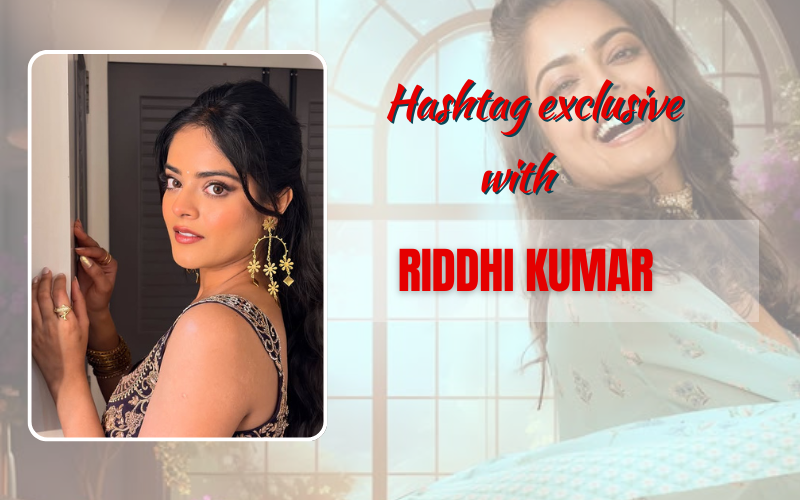
In a freewheeling chat with LIPIKA VARMA for HASHTAG INDIA, Tollywood actor RITU VARMA talks about her personal life, being an outsider, belonging to an educationist family, and yet getting a strong foothold in the Tollywood industry, her parents, her professional life and more…
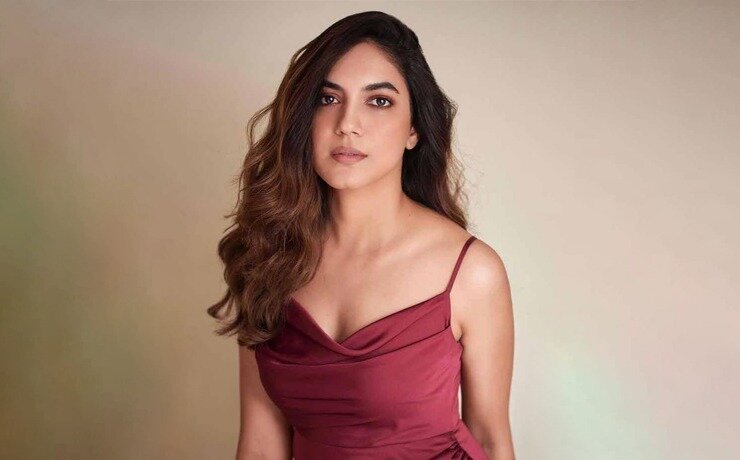
Tollywood actor Ritu Varma is well known for her work in Telegu and Tamil films. Born and bred in Hyderabad, she is fluent in Telegu. However, being a North Indian, she also dubs her Telugu films in her voice, which is a rarely found quality. Her exuberant performance in the Telegu short film Anukokunda brought recognition for this petite beauty. After Varma’s role as the female lead in the Telugu film Pelli Choopulu, a romantic comedy starring Vijay Deverakonda, there has been no looking back for Ritu. With a slew of films lined up – Tuck Jadish with Nani for release, ongoing shooting for Varudu Kaavalenu, and Oke Oka Jeevitham with Sharwanand being in post-production, Varma is certainly with her hands full. She takes some time to reflect on her journey so far…
On her personal life and family –
I live in Hyderabad. I’m a North Indian but was born and raised in Hyderabad. I do speak good Telugu and I dub for my films, but my mother tongue is Hindi. My dad is from Madhya Pradesh. My family is from Bhopal. My mom’s family has always been in Hyderabad. I’m a total Hyderabadi.

On relationships and dreams – I would like to be single and focus on my career. There is a lot of time for love. If it happens it will probably happen. I have a good set of friends, love my family, and enjoy being on sets. I paint, sketch & read books. I’m a foodie so even when I’m travelling, I explore different cuisines. Maybe after a couple of years, I could do something in the food industry like opening a restaurant. I am not an expert in cooking but it’s like a stress buster for me. I like cuisines such as Thai, Japanese, Italian, and of course, Indian. Hopefully, I could start with a small cafe depending on how I feel after 4 years. As a person your taste changes; if I can afford I will do it apart from acting as it’s not a secure job.
Getting into acting was not a career choice for me. It happened accidentally.
Being an outsider, how easy/difficult was it for Ritu to sustain in the Tollywood industry?
I come from a family of educationists. My mother is a principal and also the founder of a school in Hyderabad. We have doctors and lawyers in our family. The acting was never something that came naturally to me. Initially, I had no idea; I was a big movie buff and loved watching films. Initially, it was very difficult as I didn’t know how the industry works. I didn’t understand the concept of having a manager. I have been brought up in a protected environment, so this industry was a bit of a shock. Whenever some people used a certain tone, it would shake me as I was very sensitive and naive initially. It’s been a process of self-grooming and self-learning for me. Now I know how to deal with certain things, how to ask for things if I deserve something. I don’t let people cross lines with me at all. I’m a much more confident actor now.

Ritu Varma’s filmy journey began accidentally – Getting into acting was not a career choice for me. It happened accidentally. Having played the lead in the Telugu romantic-comedy Pelli Choopulu alongside Vijay Deverakonda, I then starred in a Telugu short film, Anukokunda. I started getting a lot of offers after this. Initially, I wasn’t sure, so the first couple of films, I just did for fun… I wasn’t sure whether this was the career for me. Working in films interested me. One thing led to another, and I started taking the craft seriously, getting a lot more passionate about acting. I’m so glad that I got the opportunity to work in Pelli Choopulu. This sort of changed my career altogether. It brought me recognition across the South Indian industry. Presently, I look at my journey as an exciting time. I have always made sure to explore and am fortunate to get a variety of roles.

Adding about not taking any acting classes or undergoing training, she asserts, “I haven’t taken any training. Nothing beats the experience of doing one film after the other. Learning from the actor I worked with, that’s what I have done. People call me a natural actor because of that. I haven’t got any sort of training.”Adding about not taking any acting classes or undergoing training, she asserts, “I haven’t taken any training. Nothing beats the experience of doing one film after the other. Learning from the actor I worked with, that’s what I have done. People call me a natural actor because of that. I haven’t got any sort of training.”
Being a Southern-Siren, Ritu Varma is hoping to strike the Bollywood industry soon –I grew up watching Hindi films. I’m waiting for the right opportunity. I’m exploring Telugu and Tamil, but language is not a barrier. It’s all about making good films. A lot of South and North technicians have always been exchanged. Change is always there and welcomed.
Adding further she asserts, “Working with Vijay Deverakonda and director Tharun Bhascker, it helped me reach a bigger audience and a lot of people took notice. In my journey of films that I wanted to be a part of, I got an opportunity to work with some big names I hadn’t thought of – Gautham Menon, Dulquer Salman, and Vikram, whose works I have always followed and liked. My journey has been interesting. I’m sort of known to choose good scripts. I do feel a lot of pressure but I’m happy with my journey.”
How was it working with Dulquer Salman?
I have great respect for him as an actor. I have great respect for the kind of work he has done. Working with him was very exciting for me. We are good friends now. I also like him as a person. He is extremely down to earth – coming from such a big family, he is still much grounded. I feel he is very easy to work with; he has no starry air. It’s very important for you to like your co-actor.

How was it working with Nani? Do you all want Tuck Jagdish to release in theatres only?
Yes, that’s what I have been told by the team as of now. We are looking for a theatrical release. It’s a film that needs to be enjoyed on the big screen. The film is done on a huge scale with multiple actors in it. I think it’s going to be a proper theatrical experience; we shot in a small town in real locations, like Rajahmundry. Probably, this film is not that OTT kind of a film. This has been my second collaboration with Nani. I played his fiancé in Yevade Subramanyam. The films are in great contrast. Tuck Jagdish is a proper commercial family entertainer. This will help me reach a different set of the audience because so far, I have done urban films only. It will take me to viewers, and people can see me in a new look; the character is also very different.
Elaborate on your role? I play a village revenue officer. Whether or not I play a stern revenue officer, I can only say that it is different, I enjoyed doing it. This character will stand out; a lot of people have seen the released song and they have said that Nani and I look good together. We have received good reviews about the song, so there’s a positive feeling. Now, I’m just waiting for the release. The team has been a fantastic passionate hard-working team with a great director and director of photography.
Tuck Jagdish is a proper commercial family entertainer. This will help me reach a different set of the audience because so far, I have done urban films only.
What to see her in next –
I am working on three films right now. Tuck Jadish is a film with Nani, ready for release. It was supposed to release after the second lockdown but because of the second wave, it was postponed. The next film, Varudu Kaavalenu, features Naga Shaurya and me in the lead roles and is not yet been released. I have another bilingual (Tamil-Telegu) film coming up, Oke Oka Jeevitham, with Sharwanand.
Status of her forthcoming films – The shooting for Sithara Entertainment’s Varudu Kaavalenu is still going on, with some patchwork left. It’s a love story and an author packed role. I haven’t done a proper love story yet. Oke Oka Jeevitham is currently in post-production work and dubbing is slated to start soon.
Regarding any inhibitions in doing romantic scenes in Varudu Kaavalenu, Ritu clarifies, “There is no intentional romantic scene at all. It’s like an old school romance in a way. But it’s going to be refreshing. There is no lovemaking. Why does it have to be about lovemaking? Love is not all about that right?”