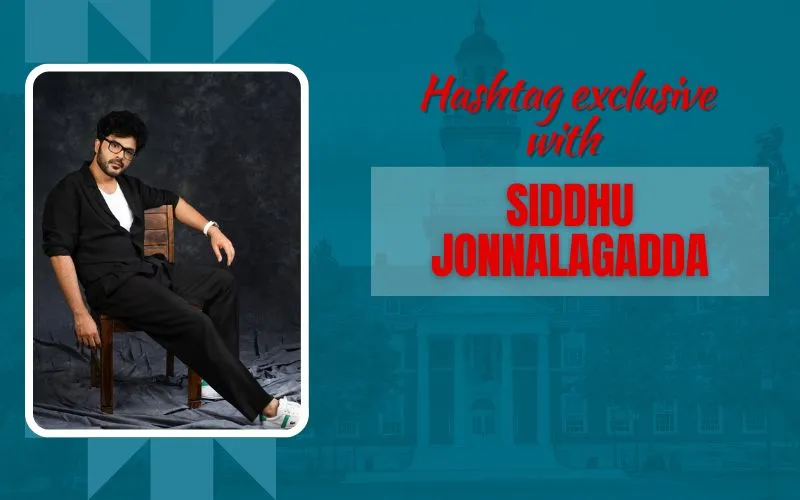
Siddhu Jonnalagadda Interview With Hashtag Magazine

Siddhu Jonnalagadda Interview

Siddhu Jonnalagadda on love, learning, and life beyond labels

Siddhu Jonnalagadda: “I want audiences to know me through my work, not my personal life.”
“Every role I play has a bit of Siddhu in it,” says Siddhu Jonnalagadda

With Telusu Kada currently running in theatres, Siddhu Jonnalagadda steps into new territory as a romantic lead, breaking away from his much-loved Tillu image. The romantic drama shows him as Varun a man caught in the web of emotions, relationships, family ties, and the search for his own identity. Directed by debutant Neeraja Kona and featuring Raashii Khanna and Srinidhi Shetty as the leading ladies, the film marks a refreshing shift for Siddhu. In a candid chat with Priyanka Goud, he opens up about shedding stereotypes, navigating success and failure, and staying deeply rooted in his craft.

On receiving mixed responses for his role in Telusu Kada

I’m glad that Telusu Kada is doing well. It’s my first time playing a full-fledged romantic hero, and there’s been a lot of talk about my role. Like you said, I did come across a few people calling my character a ‘walking red flag.’ But honestly, I don’t really look at that whole ‘red flag’ part. Everyone is entitled to their opinion, and that’s absolutely fine. For us, it was never about labelling the character  we just wanted to portray him truthfully, with all his layers and flaws, and we went with that.

On working with a debutant female director

I never looked at it as working with a woman filmmaker or compared it to working with a male director. For me, she was simply my director  that’s all that mattered. The thought of gender never even crossed my mind. Neeraja has always been very clear, confident, and straightforward about how she wanted things to be delivered. We share a great rapport, and I believe that chemistry translated beautifully on screen. I was also involved in the creative process as a writer  Neeraja genuinely valued my inputs and often took my suggestions, especially when it came to the humour or some of the radical thought processes the character had. We’d sit together, discuss, and figure things out as a team.

On women’s power and memorable moments from the sets

Telusu Kada was very much about women’s power  it had three incredible women at its core: Neeraja Kona, and the two leading ladies, Raashi Khanna, and Srinidhi Shetty, who made her Telugu debut. Every day on set was engaging and energetic; we genuinely had a lot of fun working together. One of my most memorable moments from the shoot was watching how people around me reacted to the way I delivered my dialogues or performed specific actions  those reactions stayed with me.

On shedding the image of Tillu and connecting with audiences

Compared to the comedy in the Tillu franchise, doing romance was actually quite challenging for me. I was aware of the other sides and dimensions of my work as an actor, and this film felt like an excellent opportunity to explore and showcase them. Of course, Tillu’s image had become so strongly etched in people’s minds, and I knew it would be challenging to step out of that and create another impression that’s just as impactful. But I didn’t let that pressure get to me, because I truly believe it all comes down to the writing. Just like Tillu was a brilliantly written character, I knew that another well-written role could do the same for me. Telusu Kada proved that  it made people stop seeing me only as Tillu and realise that there’s much more I can offer as an actor.

On dealing with success and failure

As an artist and a writer, I feel everything that happens in my life finds its way into my creative space. Whether it’s a high or a low, I channel it through my art and cinema. After Jack’s failure, I started to take everything with a pinch of salt each experience helps me understand the world and the business a little better. I genuinely believe that everything in life is a learning, and for me, the best way to process and express those emotions is through my art, my writing, and my craft.

On connecting with audiences through his uniqueness

I believe my dialect and body language have been tremendous assets in helping me connect with the audience. What you see on screen whether it’s Tillu Square, Krishna and His Leela, Jack, or Telusu Kada  there’s always a bit of Siddhu in each of them. I feel every time you play a character; you have to meet the role halfway. There’s a lot of culture in me  and by that, I mean a strong sense of nativity and rootedness. I think that very essence, that cultural connection, is what resonates with people.

On his journey from side artist to leading hero

From doing side roles in films like Josh and Orange to playing the lead in Life Before Wedding, and now to where I am today, the one thing that has kept me going is perseverance and patience. Coming from a non-filmy background and staying consistent in this industry hasn’t been easy. But I’ve always been very stubborn that way  if I want something, I have to go after it until I get it. My parents have been my biggest supporters throughout; they’ve always encouraged me to dream big.

On keeping his personal life private

It’s a very conscious decision for me to keep my personal life private and use social media purely for work. I understand that, as a public figure, people are naturally curious to know more about my life, but that’s just how I am. I’ve always believed that audiences should know me through my work. There are certain things I choose not to share, and that’s a personal choice I deeply value.

Rapid Fire:

One dialogue of yours that people quote to you the most? Atla untadi manathoni from DJ Tillu
A recent film that blew your mind? F1
Guilty pleasure food you can never say no to? Biryani
If you had to choose acting or writing? Acting, it’s my first love.


Leave a comment

Your email address will not be published. Required fields are marked *

Between Film Sets and Mountain Escapes: Kayadu Lohar’s Journey

Long before the Tamil film Dragon became a cultural moment, Kayadu Lohar was quietly building her career across industries. A winner of the Everyuth Fresh Face, Kayadu stepped into cinema in her teens and gradually explored Kannada, Malayalam, Telugu, and Tamil industries with projects like Mugilpete, Pathonpatham Noottandu, Alluri, and Funky. But it was Dragon, opposite Pradeep Ranganathan, that turned her into a viral sensation, bringing widespread recognition and positioning her as one of the emerging pan-South talents to watch. In a candid conversation with Priyanka Goud, Kayadu opens up about sudden fame, navigating multiple film industries, and finding peace away from the spotlight through travel. Acting Was Always the Plan For Kayadu, acting wasn’t a coincidence; it was always the goal. “I always knew I wanted to be an actor,” she says. Winning the Fresh Face title during college became the first big push. “It gave me visibility, auditions, and belief. At just 18, I found myself travelling across cities for auditions, sometimes attending three to four in a single day. As a newcomer, you don’t always get full narrations. Many times, you say yes based on the production house or the hero attached.” Navigating Languages and Cultures Born into a North Indian family, speaking Nepali at home, fluent in Hindi and Marathi, and raised in Pune, entering South Indian cinema came with its own challenges. “South Indian languages aren’t my first language, so understanding the rhythm and culture initially took time,” she says. But over the years, she developed her own process. For Kayadu, learning a language goes beyond memorising lines. “If I’m doing a Malayalam film, I’ll only listen to Malayalam songs during that phase. Music helps me understand the emotion and culture behind the language.” The Dragon Effect Her performance as Pallavi in Dragon proved to

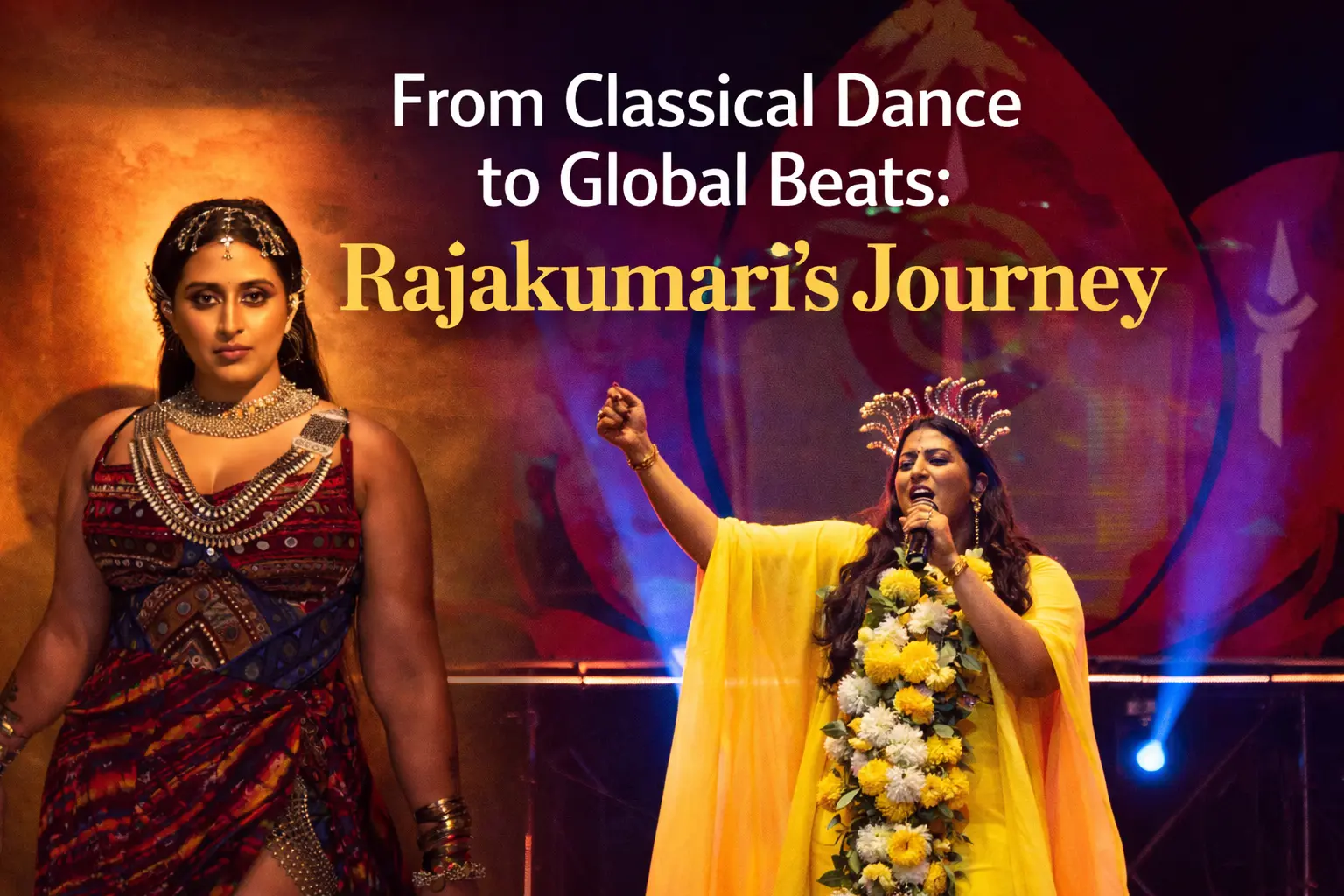
Rajakumari: The Artist Bridging Classical Heritage and Rap

Svetha Yallapragada Rao, professionally known as Rajakumari, is based in Mumbai. She holds a BA in Religious Studies and comes from a family of doctors, where education and discipline were deeply valued. However, it was Indian classical dance that shaped her most profoundly. She began training at a very young age, immersing herself in tradition, mythology, and devotion. Reflecting on those formative years, she says, “Classical dance didn’t just teach me technique, it taught me reverence, storytelling, and the sacred power of the stage.” The discipline of classical arts instilled in her both artistic rigour and spiritual grounding, foundations that continue to define her creative expression. Art with Cultural Responsibility Rajakumari chose her stage name intentionally. “I chose the identity of ‘Rajakumari’ as a vision, almost like embodying the energy of a goddess,” she explains. Having grown up inspired by Devi through classical dance, the divine feminine became central to her artistic identity. While growing up in America, she noticed the absence of Indian artists in mainstream spaces. “I wanted to become the artist I needed when I was younger, someone unapologetically Indian, modern, powerful, and visible.” Breaking into the American record label system in 2016 came with significant challenges. There were battles, resistance, and moments that demanded persistence. Yet, witnessing the cultural shift today validates that journey. “When I meet fans who proudly wear their bindis or celebrate their culture boldly, I understand the weight of the journey. We are all connected, and cultural pride is powerful.” THE RAJAKUMARI CODE Rajakumari believes authenticity is her defining strength. “Trends shift, genres evolve, and paths change, but I have always remained true to my vision and message.” She emphasises manifestation and cultural pride as pillars of her philosophy. “You don’t have to abandon any part of yourself to succeed.” Her work

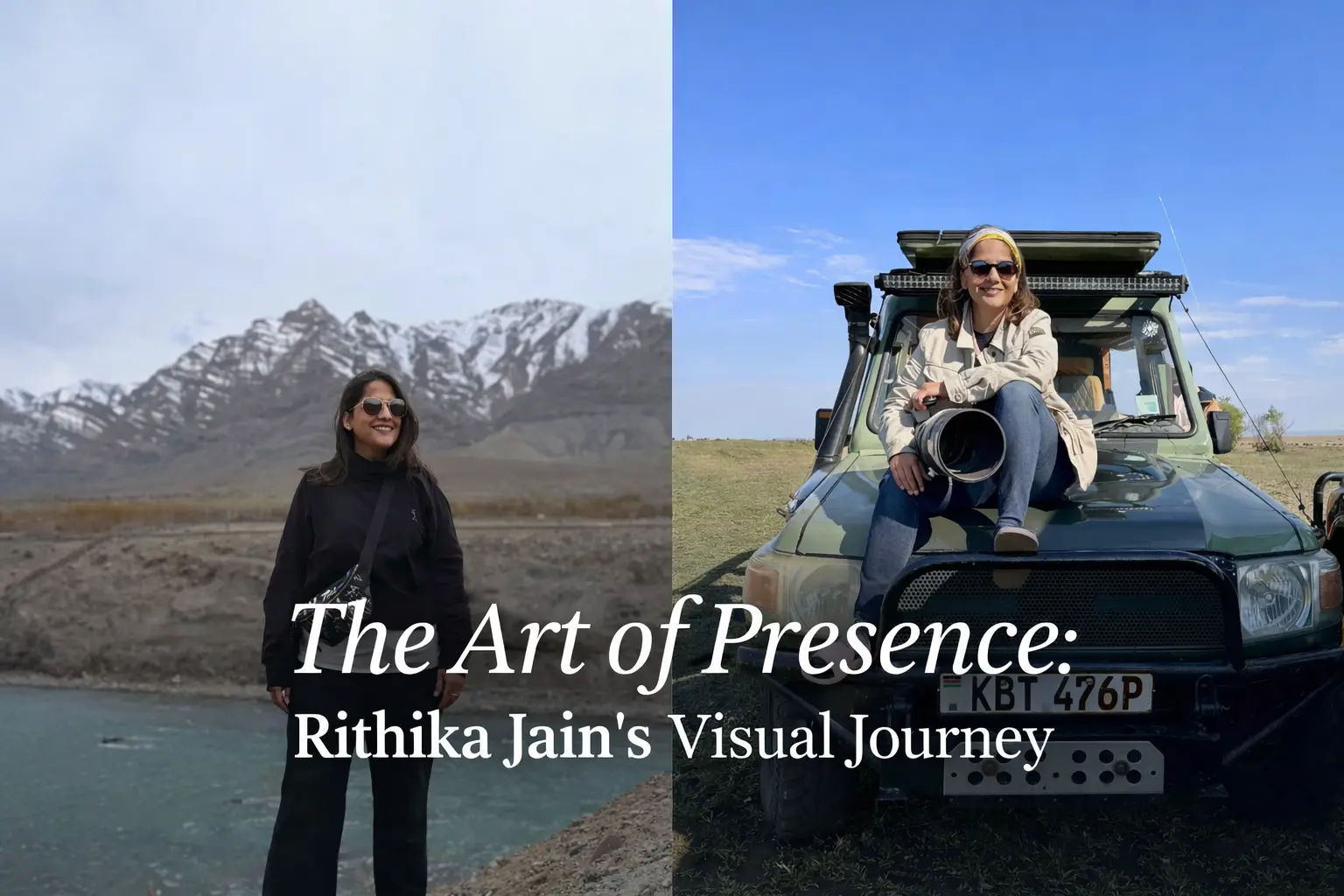
Rithika Jain: Wildlife & Architectural Photographer from Hyderabad

Rithika Jain is a wildlife and architectural photographer based in Hyderabad. She studied filmmaking at the London Film Academy, specialising in cinematography, a discipline that profoundly shaped her understanding of light, composition, and visual storytelling. Architecture taught her structure and discipline. The wild taught her presence. “The jungle became a space where I felt most attentive, stripped of noise, expectation, and vanity,” she reflects. Photography gradually evolved into her language, a way to translate emotion, observation, and stillness into something enduring. Over time, the landscapes she has worked in have shaped more than her portfolio. “They’ve shaped my way of seeing life, with more humility, patience, and respect for coexistence.” Creating Emotional Bridges Rithika describes herself as a visual storyteller focused on emotion, conservation, and presence. Her wildlife work centres on connection, capturing moments that reveal intelligence, care, and vulnerability within the natural world. “This path matters to me because images have the power to create empathy,” she says. A single photograph, she believes, can make someone pause long enough to care about something beyond their immediate reality. “That emotional bridge is my purpose.” Her work is not simply about documentation; it is about evoking feeling, because feeling is what ultimately drives awareness and conservation. The Quiet Side of the Wild Rithika is drawn to subtleties, fleeting expressions, nuanced behaviour, and the quieter emotional currents within the wild. “It’s less about capturing an event and more about preserving a feeling,” she explains. Her process is rooted in patience and observation, often requiring extensive travel through extreme conditions to reach remote environments. These expeditions inform not just what she photographs, but how she responds to a scene. The goal is immersion, allowing the viewer to step into a moment that might otherwise pass unnoticed. From Structure to Stillness Her journey began

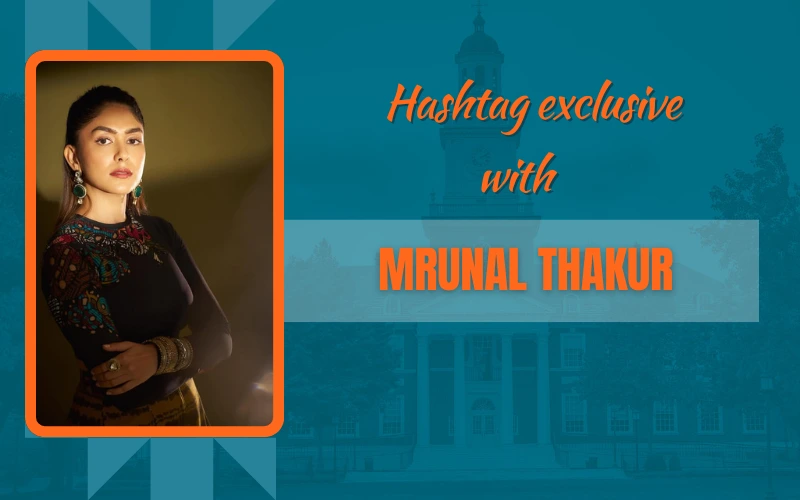
Mrunal Thakur on Do Deewane Seher Mein: Love, Insecurities and Finding Peace

With Do Deewane Seher Mein now released, Mrunal Thakur steps into a romance that celebrates vulnerability, emotional honesty and modern companionship. Produced under Sanjay Leela Bhansali’s banner, the film explores relationships through a lens of hope and self-discovery. In an exclusive conversation with Lipika Varma, the actor opens up about insecurities, beauty stereotypes, marriage, and the quiet confidence she has grown into over the years. You’ve spoken about insecurities before. What were your early struggles? Even after moving to Mumbai, I struggled with confidence. I couldn’t answer questions in class because I was insecure about my English and my Marathi accent. My name is unisex, and boys would make fun of it. When I entered the industry, I felt I needed to sound “elite.” I thought accent and diction defined you. Today, I realise insecurities only matter when you give them importance. I’m comfortable in my own skin now. I feel good the way I am. Have you ever faced challenges because of being considered “too beautiful”? Yes, sometimes people think that if you’re beautiful and successful, life must be easy. It’s not! There are moments when I wish I could just be normal. For Love Sonia, my audition was literally placed in a folder marked “Do Not Open.” Fortunately, the director opened it and felt I was right for the role. I had to convince the team that with prosthetics and makeup, we could make it work. People assume beauty makes everything easy. It doesn’t. Everyone struggles. Beauty alone cannot carry you forward. There are a lot of things that have to fall in place. I also remember attending a funeral and not being able to grieve freely because cameras were around. Sometimes you just want to be a daughter or sister, not an actor. How was it working

You May Also Like

Connect with us