
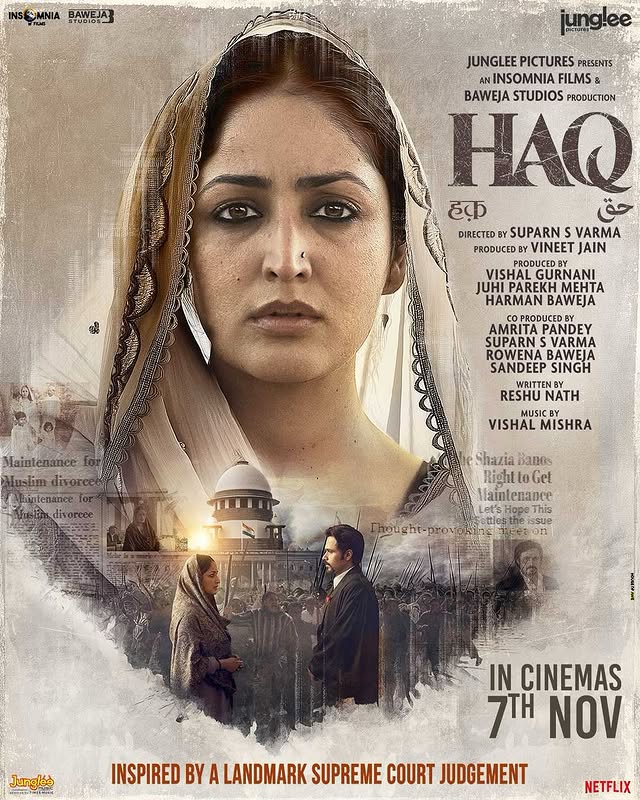
Yami Gautam’s latest film Haq has struck a powerful chord with audiences for its bold storytelling and emotional honesty. In a candid conversation with Lipika Varma, Yami reflects on what drew her to the film, her collaboration with Emraan Hashmi, the responsibility of portraying a character inspired by real struggles, and how motherhood and support have shaped her personal and professional life.
On working with Emraan Hashmi: “When the film was first offered to me, and I learned I’d be cast opposite Emraan, I couldn’t imagine anyone else in the role,” Yami shares. “I’ve always admired him his grace, dignity, the music, the performances, the aura. He has a legacy that spans generations.” She adds, “When you watch the film, you’ll see the incredible energy he brings to his character. Emraan is a brilliant actor respectful, secure, and inspiring. It was a joy to work with him.”
Why She Chose a Hard-Hitting Role in Haq: “I go by instinct and this story needed to be told,” Yami says. “This character reflects courage, truth, and resilience. I haven’t met the real woman it draws inspiration from, but her journey deeply moved me. It captures the true meaning of a woman’s power.”
She clarifies that the film is not a biopic but a blend of facts and fiction. “As an artist, I had to understand why this case became so important. I wasn’t representing one woman I was representing many.”
On Taking Up Socially Sensitive Subjects: “As actors, we have only one lens the tone of the film,” she explains. “Is it made to create controversy or to start a discussion? There’s a difference. I don’t believe in controversies. I do my work and go home.”
She adds, “A film must create discussion or debate. There is no scope for being ‘average’. My first instinct is always pure if I feel I must do it, I do it without fear.”
Preparing for Emotionally Intense Roles: “For this film, emotional strength was more important than physicality,” Yami says. “I imagined the courage a woman in the ’70s or ’80s would need to stand up for herself and her children. Every emotion betrayal, pain, tears, strength had to be real.”
Her preparation also included learning stitching and crochet to inhabit the character naturally.
“For Article 370, the journey was different there was physical training, MMA, weapons. Here, the emotional graph dictated everything else.”
Training in Urdu: “Yes, I trained extensively,” she says. “Our diction coach from Indore helped me with pronunciation, flow, and emotional delivery. Even English words had to sit naturally in Urdu. Urdu is such a beautiful language to perform naturally, you must make the words your own.”
She also credits dialogue writer Reshu Nath for giving the film its poetic strength.
Raising Her Voice — On Screen and Off
On whether she has ever raised her voice for something in real life, Yami reflects: “Using actions is better than words. Earlier, actresses couldn’t openly speak about marriage. Today, I’m a mother, and it hasn’t affected my work that itself is a big change. Education and women’s safety are the areas where I feel change is most needed.”
What Made Her Say Yes to This Story“There were two aspects,” she explains. “My instinct, and the writing. I always ask for a hard copy of the script. When I finished reading it, I took a moment and the answer was clear: yes.”
Having read about the real case in newspapers during school, Yami felt a deeper connection. “It felt surreal to take on a story inspired by something I once studied.”

What an Artist looks for in a Script: “Three things matter most the story, the role, and the director,” Yami says. “Originality is always exciting. Look at Kantara rooted in local folklore yet universal. Heartland stories have a unique power.”
A Responsible Character and the Weight of Representation: “If anyone feels inspired by my performance, that would be my personal victory,” she says softly. “During the climax, I felt I was representing many people at once. If even one person feels courage after watching it that’s enough.”
Understanding Urdu deeply, she says, allowed the performance to feel instinctive.
“To perform naturally, you must speak without thinking that’s when cinema feels real.”
Life after Marriage and Motherhood “My parents would be surprised! Tension exists everywhere Mumbai or Leh. But yes, marriage adds stability. Support from family helps you stay grounded.”

She speaks warmly about her husband, Aditya Dhar: “The support was always there. Both of us can work only because our parents stand behind us. Their contribution can never be repaid.”
She recalls flying from Chandigarh early morning just to be with her son before returning to set. “My producers and director trusted me completely. When crores are invested, dedication matters.”
Balancing Work and Motherhood “Everyone’s journey is subjective some take a break, some continue working. Both choices are valid. I’m grateful I could manage both because of my mother’s help,” she says.
A Message Through the Film “It’s hard for me to give a ‘message’,” she says. “But I’ve always chosen strong, meaningful roles. Yes, times have changed since the 1980s Nikah, but change takes time. Everyone has their own battles.” “I hope that when people watch Haq, they feel something courage, hope, strength. Anything positive.”