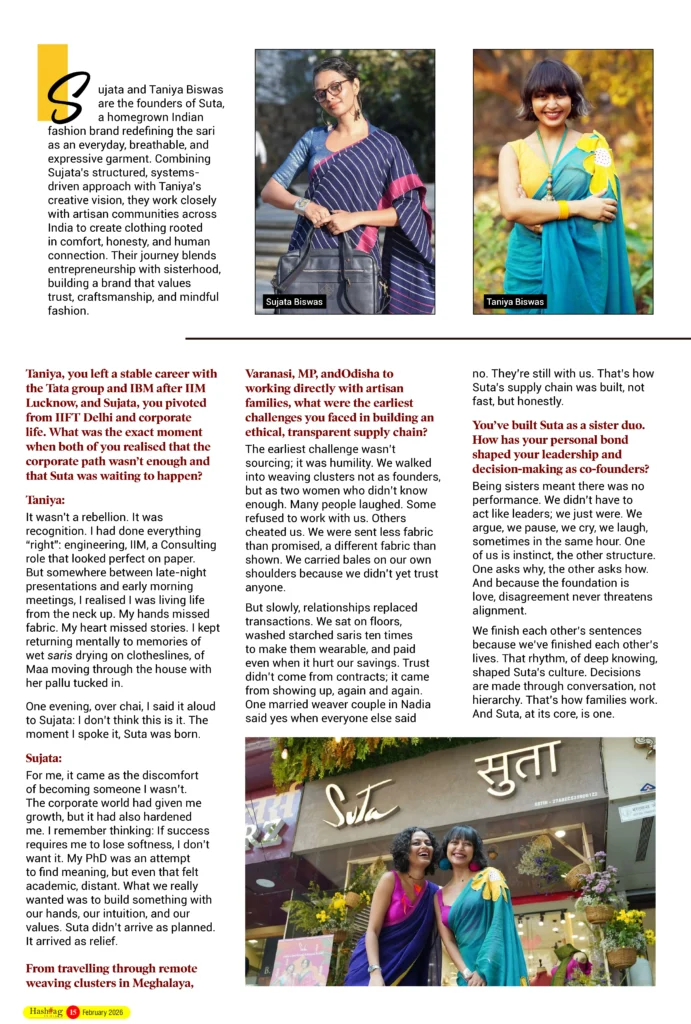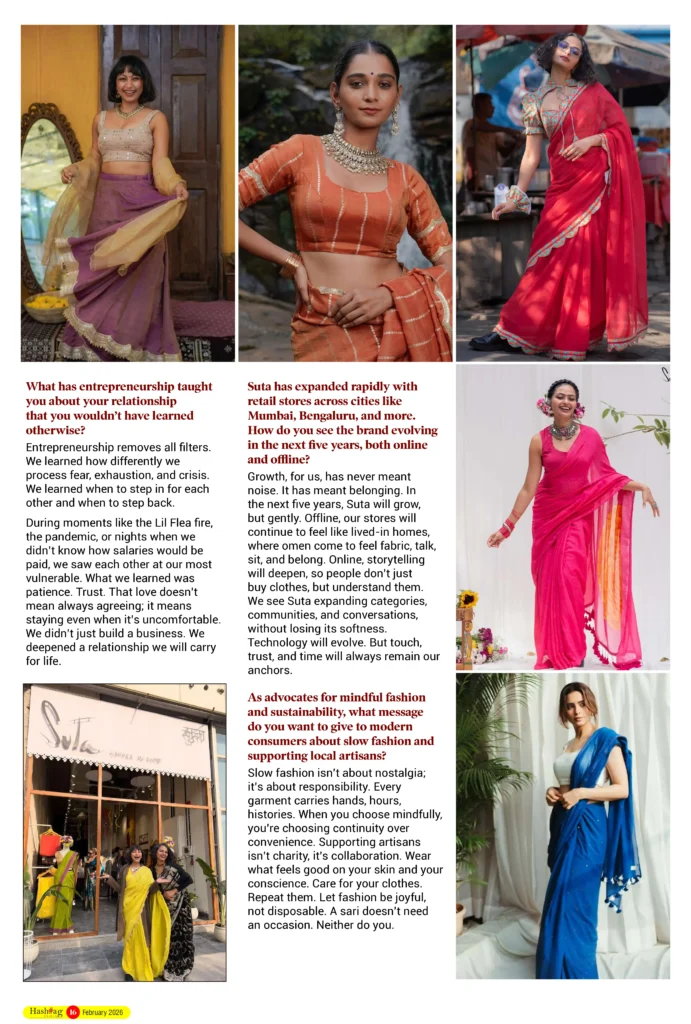
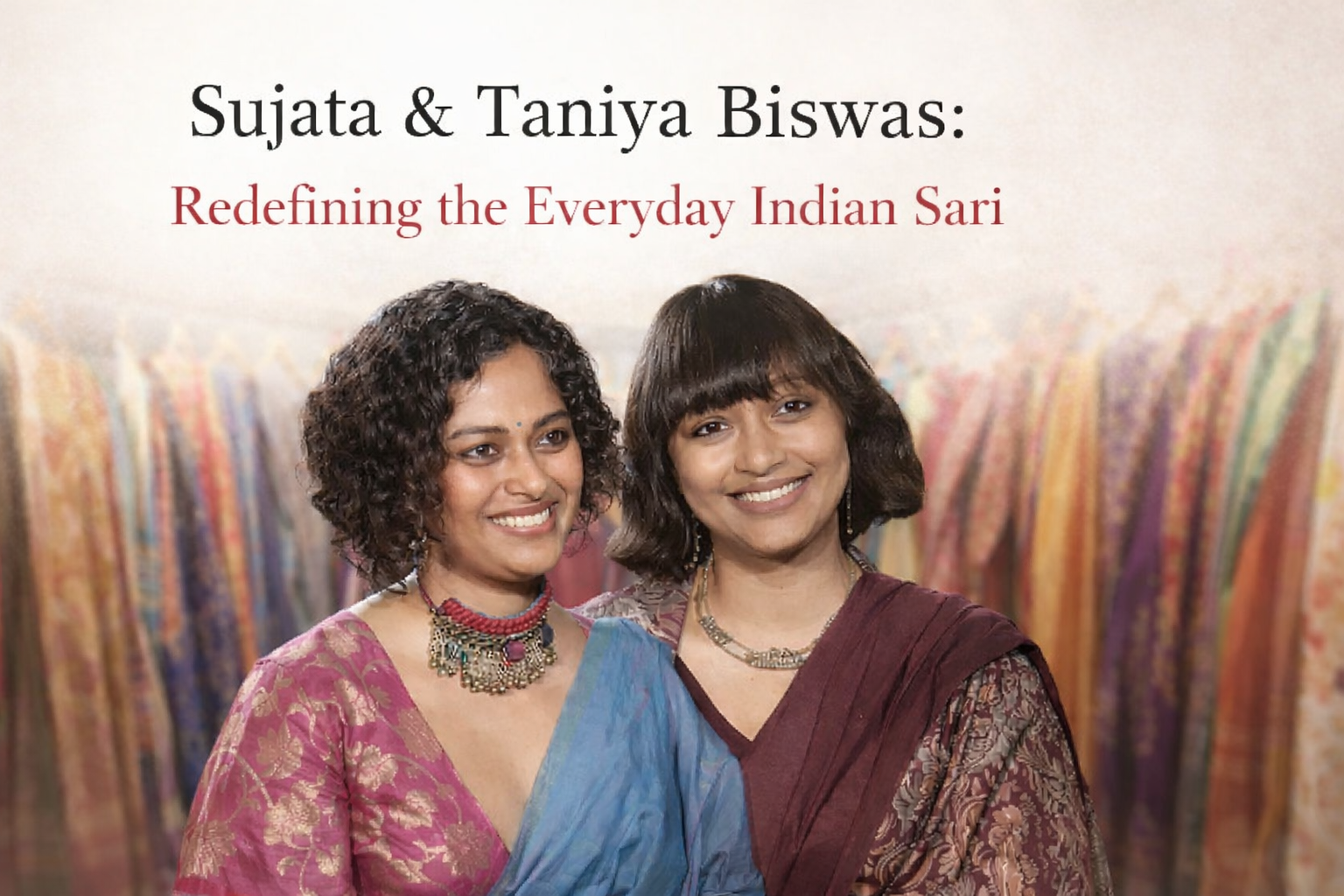
A homegrown Indian fashion brand redefining the sari as an everyday, breathable, and expressive garment. Combining Sujata’s structured, systems-driven approach with Taniya’s creative vision, they work closely with artisan communities across India to create clothing rooted in comfort, honesty, and human connection. Their journey blends entrepreneurship with sisterhood, building a brand that values trust, craftsmanship, and mindful fashion.
Taniya, you left a stable career with the Tata group and IBM after IIM Lucknow, and Sujata, you pivoted from IIFT Delhi and corporate life. What was the exact moment when both of you realised that the corporate path wasn’t enough and that Suta was waiting to happen?
Taniya: It wasn’t a rebellion. It was recognition. I had done everything “right”: engineering, IIM, a Consulting role that looked perfect on paper. But somewhere between late-night presentations and early morning meetings, I realised I was living life from the neck up. My hands missed fabric. My heart missed stories. I kept returning mentally to memories of wet saris drying on clotheslines, of Maa moving through the house with her pallu tucked in. One evening, over chai, I said it aloud to Sujata: I don’t think this is it. The moment I spoke it, Suta was born.
Sujata: For me, it came as the discomfort of becoming someone I wasn’t. The corporate world had given me growth, but it had also hardened me. I remember thinking: If success requires me to lose softness, I don’t want it. My PhD was an attempt to find meaning, but even that felt academic, distant. What we really wanted was to build something with our hands, our intuition, and our values. Suta didn’t arrive as planned. It arrived as relief.
From travelling through remote weaving clusters in Meghalaya, Varanasi, MP, and Odisha to working directly with artisan families, what were the earliest challenges you faced in building an ethical, transparent supply chain?
The earliest challenge wasn’t sourcing; it was humility. We walked into weaving clusters not as founders, but as two women who didn’t know enough. Many people laughed. Some refused to work with us. Others cheated us. We were sent less fabric than promised, a different fabric than shown. We carried bales on our own shoulders because we didn’t yet trust anyone.
But slowly, relationships replaced transactions. We sat on floors, washed starched saris ten times to make them wearable, and paid even when it hurt our savings. Trust didn’t come from contracts; it came from showing up, again and again. One married weaver couple in Nadia said yes when everyone else said no. They’re still with us. That’s how Suta’s supply chain was built, not fast, but honestly.
You’ve built Suta as a sister duo. How has your personal bond shaped your leadership and decision-making as co-founders?
Being sisters meant there was no performance. We didn’t have to act like leaders; we just were. We argue, we pause, we cry, we laugh, sometimes in the same hour. One of us is instinct, the other structure. One asks why, the other asks how. And because the foundation is love, disagreement never threatens alignment.
We finish each other’s sentences because we’ve finished each other’s lives. That rhythm, of deep knowing, shaped Suta’s culture. Decisions are made through conversation, not hierarchy. That’s how families work. And Suta, at its core, is one.
What has entrepreneurship taught you about your relationship that you wouldn’t have learned otherwise?
Entrepreneurship removes all filters. We learned how differently we process fear, exhaustion, and crisis. We learned when to step in for each other and when to step back. During moments like the Lil Flea fire, the pandemic, or nights when we didn’t know how salaries would be paid, we saw each other at our most vulnerable.
What we learned was patience. Trust. That love doesn’t mean always agreeing; it means staying even when it’s uncomfortable. We didn’t just build a business. We deepened a relationship we will carry for life.
Suta has expanded rapidly with retail stores across cities like Mumbai, Bengaluru, and more. How do you see the brand evolving in the next five years, both online and offline?
Growth, for us, has never meant noise. It has meant belonging. In the next five years, Suta will grow, but gently. Offline, our stores will continue to feel like lived-in homes, where women come to feel fabric, talk, sit, and belong. Online, storytelling will deepen, so people don’t just buy clothes, but understand them. We see Suta expanding categories, communities, and conversations, without losing its softness. Technology will evolve. But touch, trust, and time will always remain our anchors.
As advocates for mindful fashion and sustainability, what message do you want to give to modern consumers about slow fashion and supporting local artisans?
Slow fashion isn’t about nostalgia; it’s about responsibility. Every garment carries hands, hours, histories. When you choose mindfully, you’re choosing continuity over convenience. Supporting artisans isn’t charity, it’s collaboration. Wear what feels good on your skin and your conscience. Care for your clothes. Repeat them. Let fashion be joyful, not disposable. A sari doesn’t need an occasion. Neither do you.