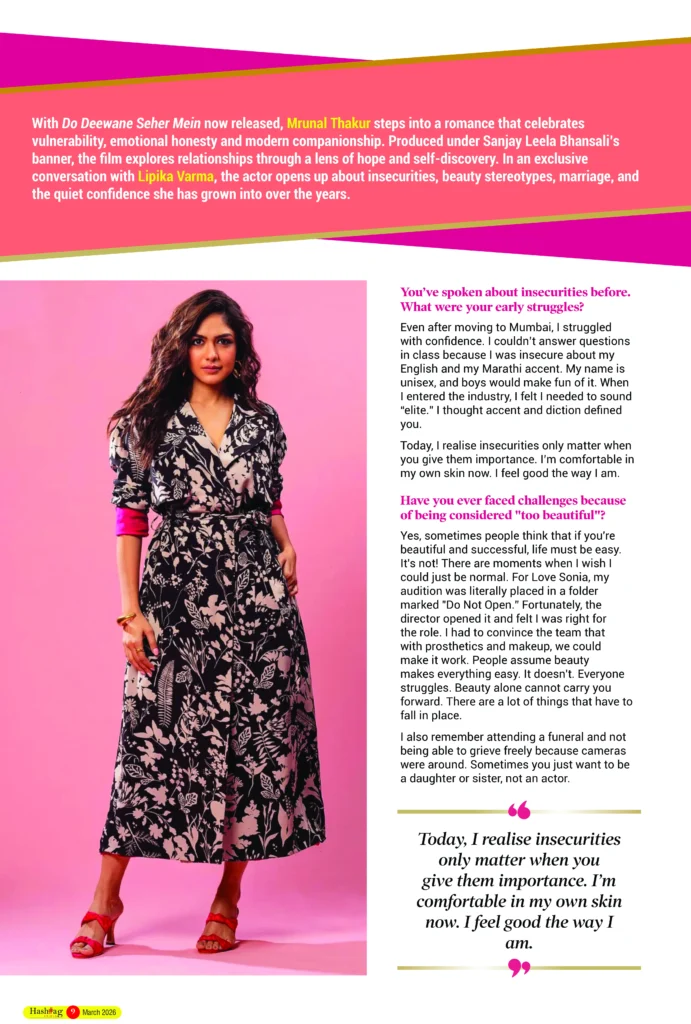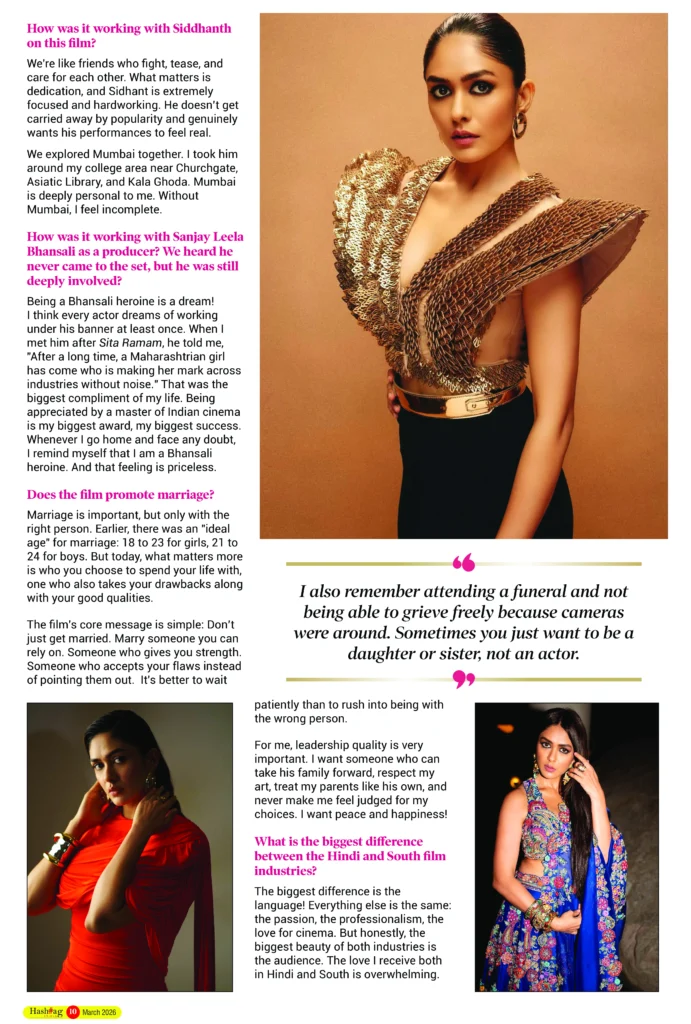

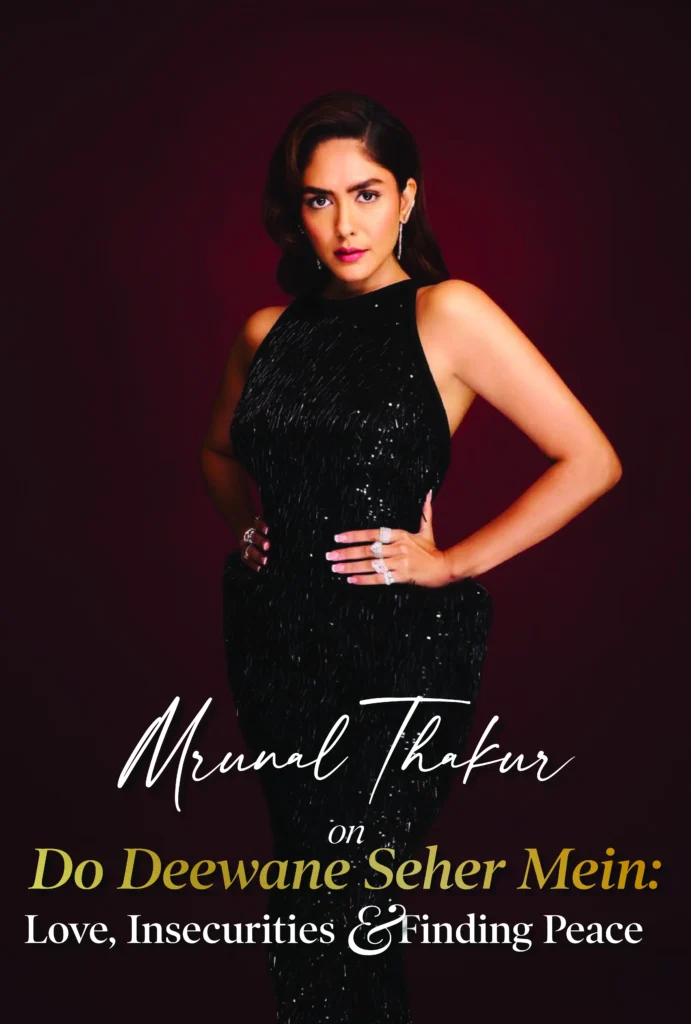
With Do Deewane Seher Mein now released, Mrunal Thakur steps into a romance that celebrates vulnerability, emotional honesty and modern companionship. Produced under Sanjay Leela Bhansali’s banner, the film explores relationships through a lens of hope and self-discovery. In an exclusive conversation with Lipika Varma, the actor opens up about insecurities, beauty stereotypes, marriage, and the quiet confidence she has grown into over the years.
You’ve spoken about insecurities before. What were your early struggles?
Even after moving to Mumbai, I struggled with confidence. I couldn’t answer questions in class because I was insecure about my English and my Marathi accent. My name is unisex, and boys would make fun of it. When I entered the industry, I felt I needed to sound “elite.” I thought accent and diction defined you.
Today, I realise insecurities only matter when you give them importance. I’m comfortable in my own skin now. I feel good the way I am.
Have you ever faced challenges because of being considered “too beautiful”?
Yes, sometimes people think that if you’re beautiful and successful, life must be easy. It’s not! There are moments when I wish I could just be normal. For Love Sonia, my audition was literally placed in a folder marked “Do Not Open.” Fortunately, the director opened it and felt I was right for the role. I had to convince the team that with prosthetics and makeup, we could make it work. People assume beauty makes everything easy. It doesn’t. Everyone struggles. Beauty alone cannot carry you forward. There are a lot of things that have to fall in place.
I also remember attending a funeral and not being able to grieve freely because cameras were around. Sometimes you just want to be a daughter or sister, not an actor.
How was it working with Siddhanth on this film?
We’re like friends who fight, tease, and care for each other. What matters is dedication, and Sidhant is extremely focused and hardworking. He doesn’t get carried away by popularity and genuinely wants his performances to feel real.
We explored Mumbai together. I took him around my college area near Churchgate, Asiatic Library, and Kala Ghoda. Mumbai is deeply personal to me. Without Mumbai, I feel incomplete.
How was it working with Sanjay Leela Bhansali as a producer? We heard he never came to the set, but he was still deeply involved?
Being a Bhansali heroine is a dream! I think every actor dreams of working under his banner at least once. When I met him after Sita Ramam, he told me, “After a long time, a Maharashtrian girl has come who is making her mark across industries without noise.” That was the biggest compliment of my life. Being appreciated by a master of Indian cinema is my biggest award, my biggest success. Whenever I go home and face any doubt, I remind myself that I am a Bhansali heroine. And that feeling is priceless.
Does the film promote marriage?
Marriage is important, but only with the right person. Earlier, there was an “ideal age” for marriage: 18 to 23 for girls, 21 to 24 for boys. But today, what matters more is who you choose to spend your life with, one who also takes your drawbacks along with your good qualities.
The film’s core message is simple: Don’t just get married. Marry someone you can rely on. Someone who gives you strength. Someone who accepts your flaws instead of pointing them out. It’s better to wait patiently than to rush into being with the wrong person.
For me, leadership quality is very important. I want someone who can take his family forward, respect my art, treat my parents like his own, and never make me feel judged for my choices. I want peace and happiness!
What is the biggest difference between the Hindi and South film industries?
The biggest difference is the language! Everything else is the same: the passion, the professionalism, the love for cinema. But honestly, the biggest beauty of both industries is the audience. The love I receive both in Hindi and South is overwhelming.