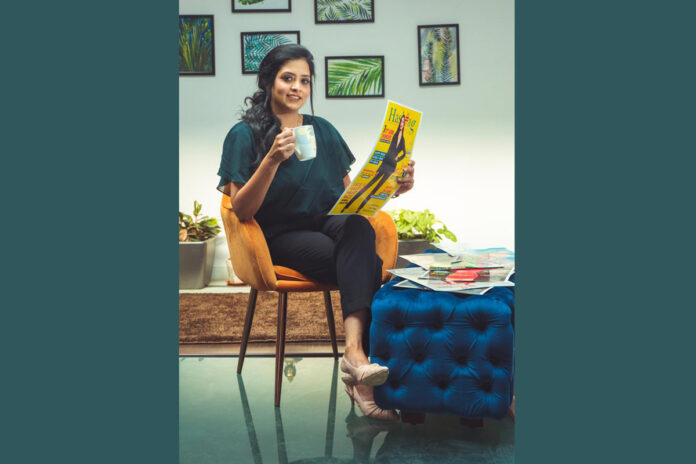
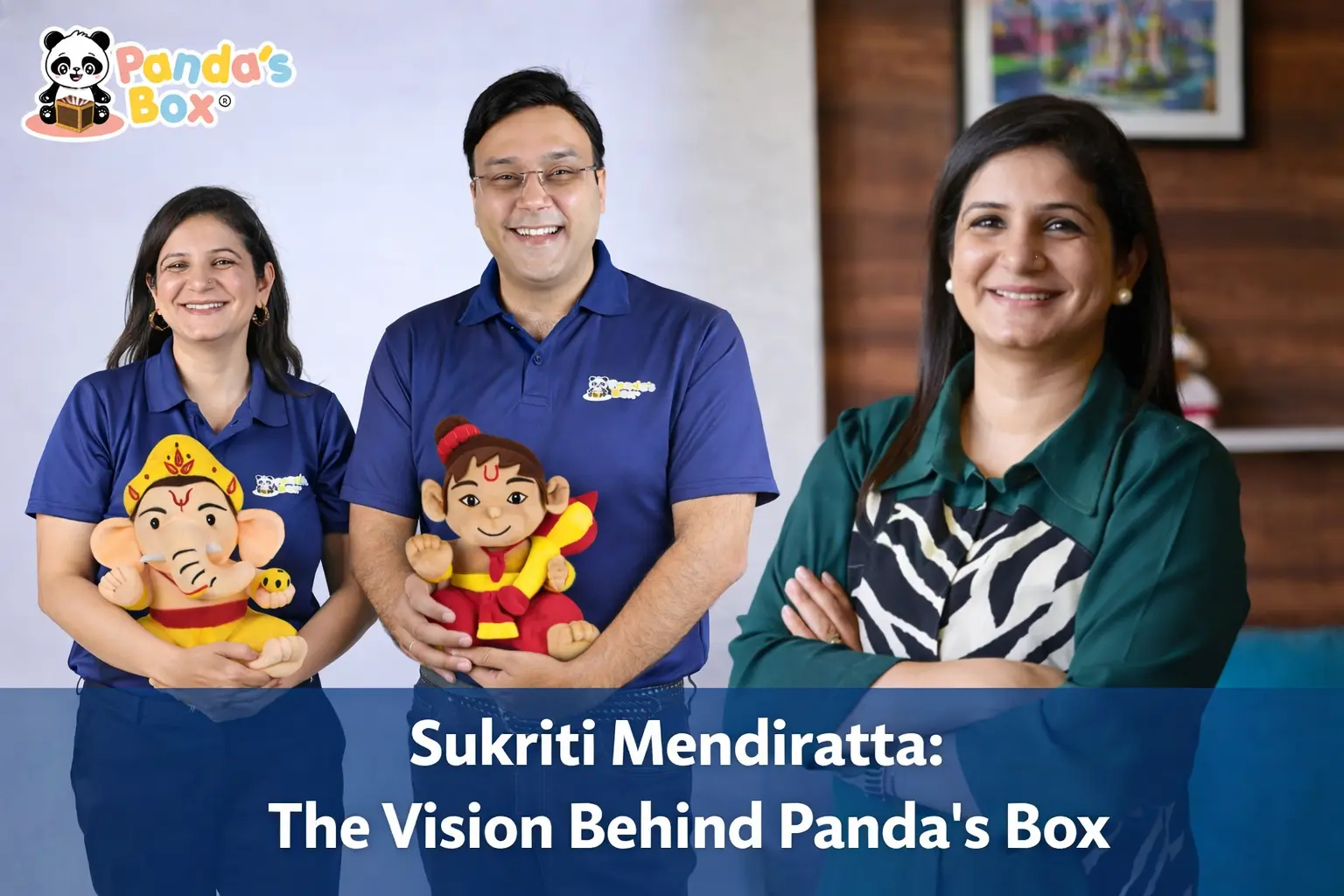
Sukriti Mendiratta: Founder of Panda’s Box

Sukriti Mendiratta: Founder of Panda’s Box

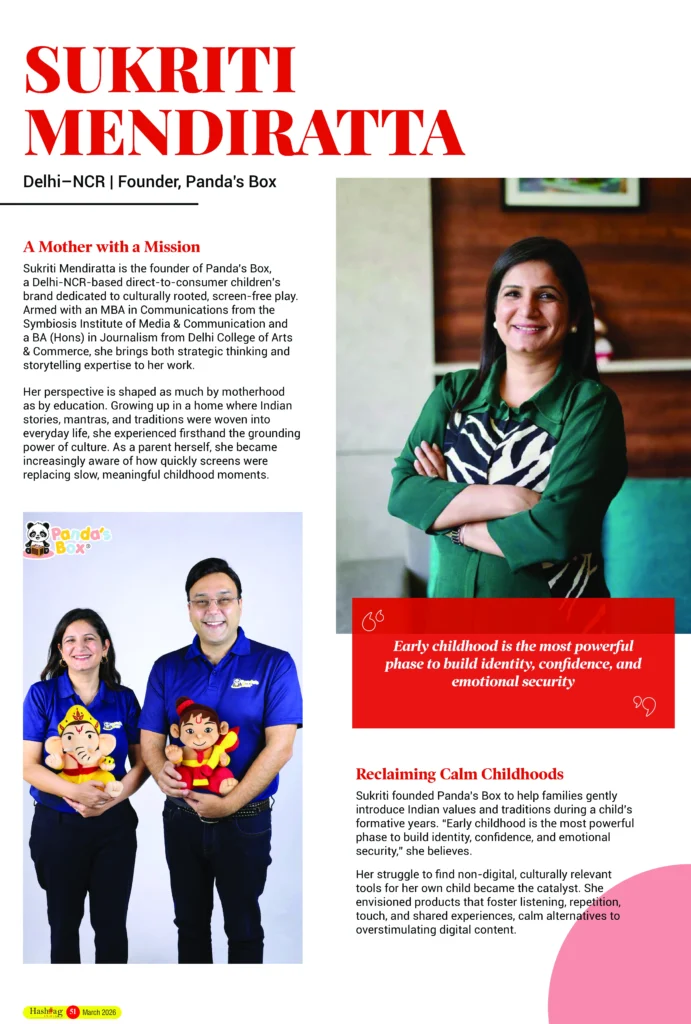
Sukriti Mendiratta is the founder of Panda’s Box, a Delhi-NCR-based direct-to-consumer children’s brand dedicated to culturally rooted, screen-free play. Armed with an MBA in Communications from the Symbiosis Institute of Media & Communication and a BA (Hons) in Journalism from Delhi College of Arts & Commerce, she brings both strategic thinking and storytelling expertise to her work.

Her perspective is shaped as much by motherhood as by education. Growing up in a home where Indian stories, mantras, and traditions were woven into everyday life, she experienced firsthand the grounding power of culture. As a parent herself, she became increasingly aware of how quickly screens were replacing slow, meaningful childhood moments.

Reclaiming Calm Childhoods

Sukriti founded Panda’s Box to help families gently introduce Indian values and traditions during a child’s formative years. “Early childhood is the most powerful phase to build identity, confidence, and emotional security,” she believes.

Her struggle to find non-digital, culturally relevant tools for her own child became the catalyst. She envisioned products that foster listening, repetition, touch, and shared experiences, calm alternatives to overstimulating digital content.

Experience Over Stimulation

With over 15 years of experience across brands like Cosmo First, Hyundai, Revlon, and Zydus Wellness, Sukriti combines corporate precision with maternal intuition.

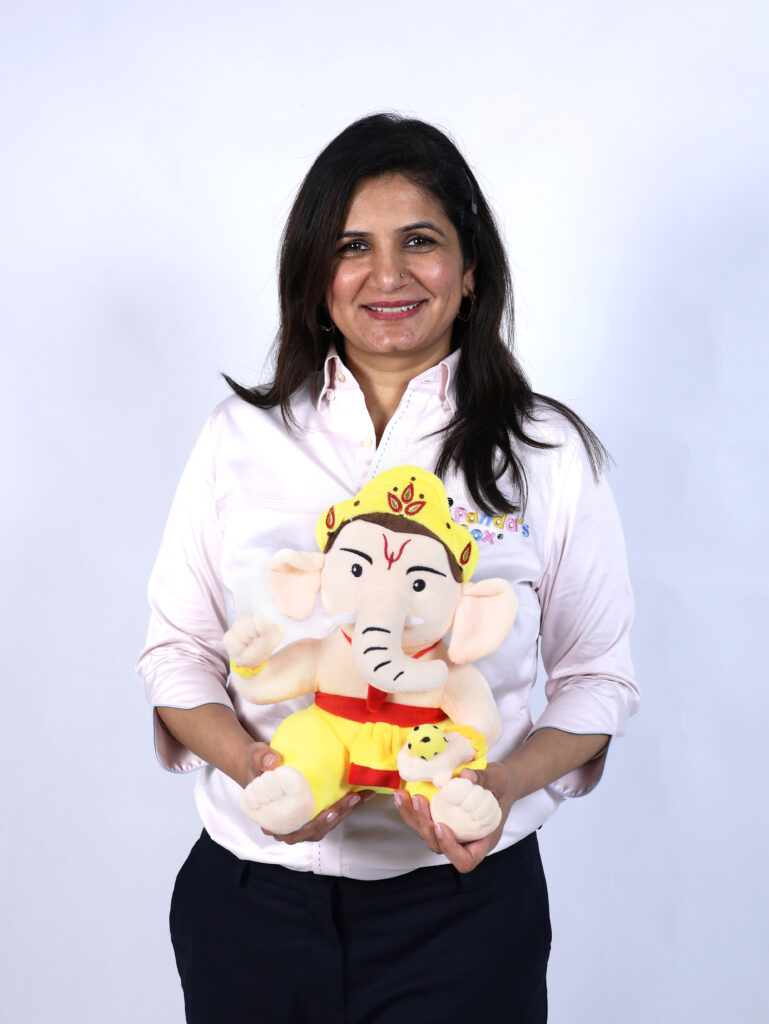
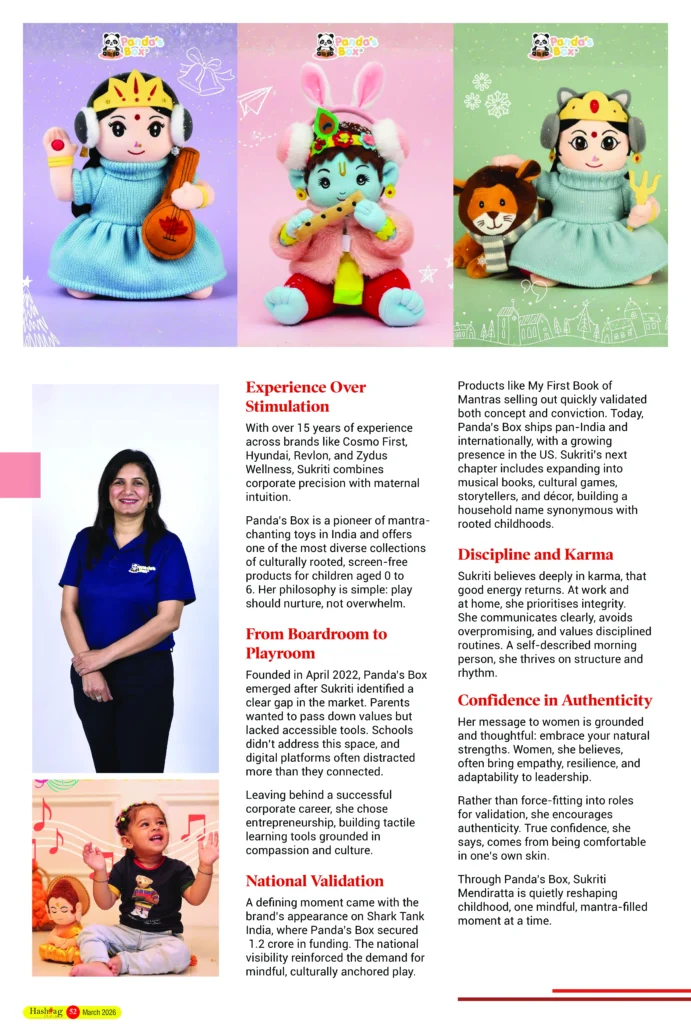
Panda’s Box is a pioneer of mantra-chanting toys in India and offers one of the most diverse collections of culturally rooted, screen-free products for children aged 0 to 6. Her philosophy is simple: play should nurture, not overwhelm.
From Boardroom to Playroom

Founded in April 2022, Panda’s Box emerged after Sukriti identified a clear gap in the market. Parents wanted to pass down values but lacked accessible tools. Schools didn’t address this space, and digital platforms often distracted more than they connected.

Leaving behind a successful corporate career, she chose entrepreneurship, building tactile learning tools grounded in compassion and culture.

National Validation

A defining moment came with the brand’s appearance on Shark Tank India, where Panda’s Box secured ₹1.2 crore in funding. The national visibility reinforced the demand for mindful, culturally anchored play.

Products like My First Book of Mantras selling out quickly validated both concept and conviction. Today, Panda’s Box ships pan-India and internationally, with a growing presence in the US. Sukriti’s next chapter includes expanding into musical books, cultural games, storytellers, and décor, building a household name synonymous with rooted childhoods.

Discipline and Karma

Sukriti believes deeply in karma, that good energy returns. At work and at home, she prioritises integrity. She communicates clearly, avoids overpromising, and values disciplined routines. A self-described morning person, she thrives on structure and rhythm.

Confidence in Authenticity

Her message to women is grounded and thoughtful: embrace your natural strengths. Women, she believes, often bring empathy, resilience, and adaptability to leadership.

Rather than force-fitting into roles for validation, she encourages authenticity. True confidence, she says, comes from being comfortable in one’s own skin.

Through Panda’s Box, Sukriti Mendiratta is quietly reshaping childhood, one mindful, mantra-filled moment at a time.
Leave a comment

Your email address will not be published. Required fields are marked *

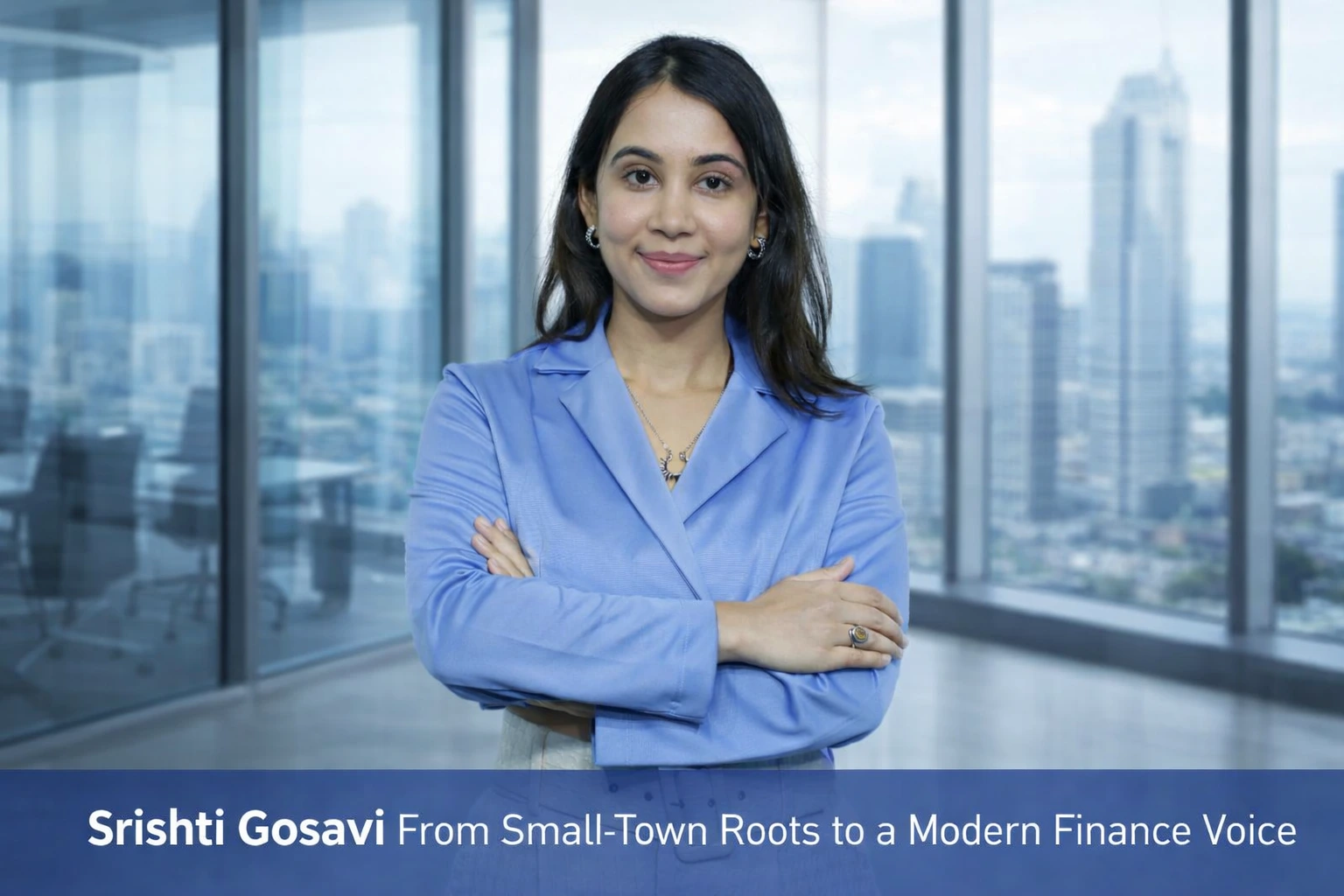
Srishti Gosavi: From Small-Town Roots to a Modern Voice in Finance

Srishti Gosavi’s story begins in a small town in Bihar and unfolds in Mumbai, where her father relocated as a first-generation businessman to secure better opportunities for his children. “I grew up watching my father take risks most people wouldn’t,” she says. While he built the business, her mother ensured stability at home, an equilibrium of courage and grounding that shaped Srishti’s worldview. Money, in her household, was never about indulgence. “It was always discussed in terms of responsibility, not luxury.” That framing became the foundation of her relationship with finance. Academically driven, she studied commerce at Narsee Monjee College and qualified as a Chartered Accountant. Yet, she credits her parents’ entrepreneurial grit more than her degrees for shaping her mindset. “Watching them build everything from scratch influenced how I think about security, risk, and independence.” Educator Before Influencer Srishti began her career in investment banking before moving into infrastructure finance, often finding herself the only woman in the room. She worked on large-scale debt deals and high-stakes transactions, but one realisation lingered: “Even highly educated people didn’t understand their own personal finances.” That gap unsettled her. In April 2023, she left her corporate role to translate complex financial systems into practical knowledge for everyday individuals. “Money affects everything, your peace, your choices, your confidence,” she explains. For her, financial literacy is not optional; it is foundational. “I’m a finance educator first. The influencer tag came later,” she states clearly. Making Finance Less Intimidating “In simple words, I make finance less scary,” she says. From home loans and credit scores to insurance, investing, and real estate, she simplifies concepts without overselling them. Her popular series, Dimaag Ka Dahi, focuses on untangling confusing financial jargon in relatable language. “I don’t glamorise money. I don’t sell shortcuts,” she emphasises. Instead, her advice

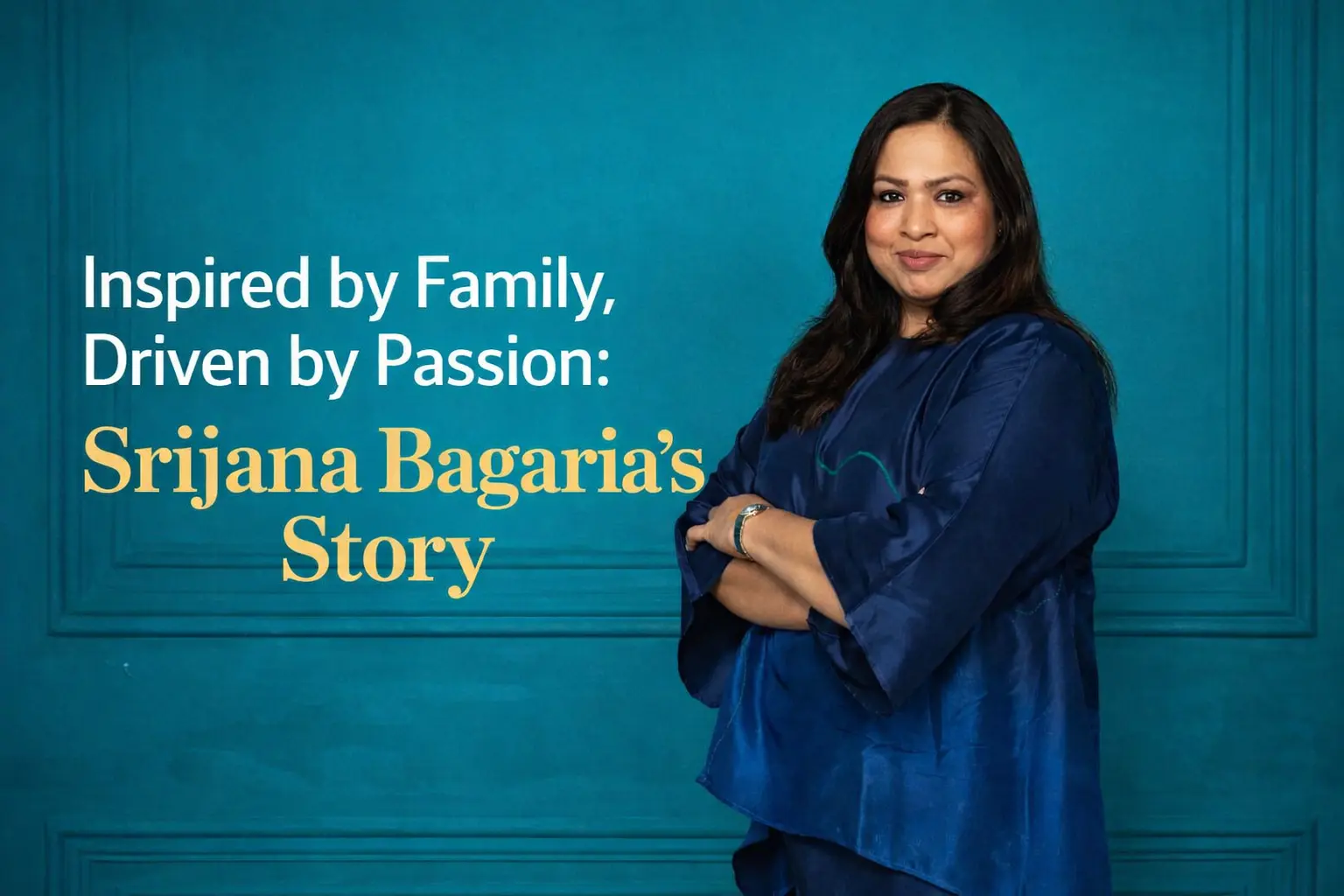
Inspired by Family, Driven by Passion: Srijana Bagaria’s Story

An Arts graduate from Calcutta, Srijana Bagaria was born into a family of entrepreneurs, where building and nurturing ideas was second nature. “Entrepreneurship has always felt instinctive to me,” she shares. Deeply inspired by her mother’s love for culinary arts, Srijana cultivated her own passion for food, eventually becoming a home chef and conducting sessions globally, a creative pursuit she continues to cherish. When her family moved to Delhi, she became closely involved in operational roles across ventures, supporting everything from daily management to international buyer meetings under SRV. “I’ve always believed in building from the ground up,” she says. A defining emotional shift came after the Nirbhaya incident. “It deeply moved us. It pushed us to think seriously about women’s safety and dignity.” That reflection laid the foundation for SafetyKart, and eventually, Pee Safe, blending empathy with enterprise. From Personal Pain to Public Solution “I see myself as an entrepreneur, but a chef at heart,” Srijana reflects. Creativity drives her, whether in the kitchen or in business. The idea for Pee Safe was born from lived experience. After suffering from a UTI, she and her partner realised how widespread yet under-addressed preventive hygiene was, particularly in public spaces. “We didn’t just see a business opportunity. We saw a real, everyday problem women had quietly accepted.” What stood out was the global nature of the gap; accessible, stigma-free hygiene solutions were missing across markets. For Srijana, building Pee Safe became about “comfort, confidence, and dignity in small but meaningful ways.” Entrepreneurship, she believes, must solve real problems, with empathy and purpose at its core. Women-First Innovation Srijana describes her role simply: “I build women-first solutions with a team that shares the same vision.” At Pee Safe, the focus spans life stages, from puberty to menopause, while normalising conversations around menstrual

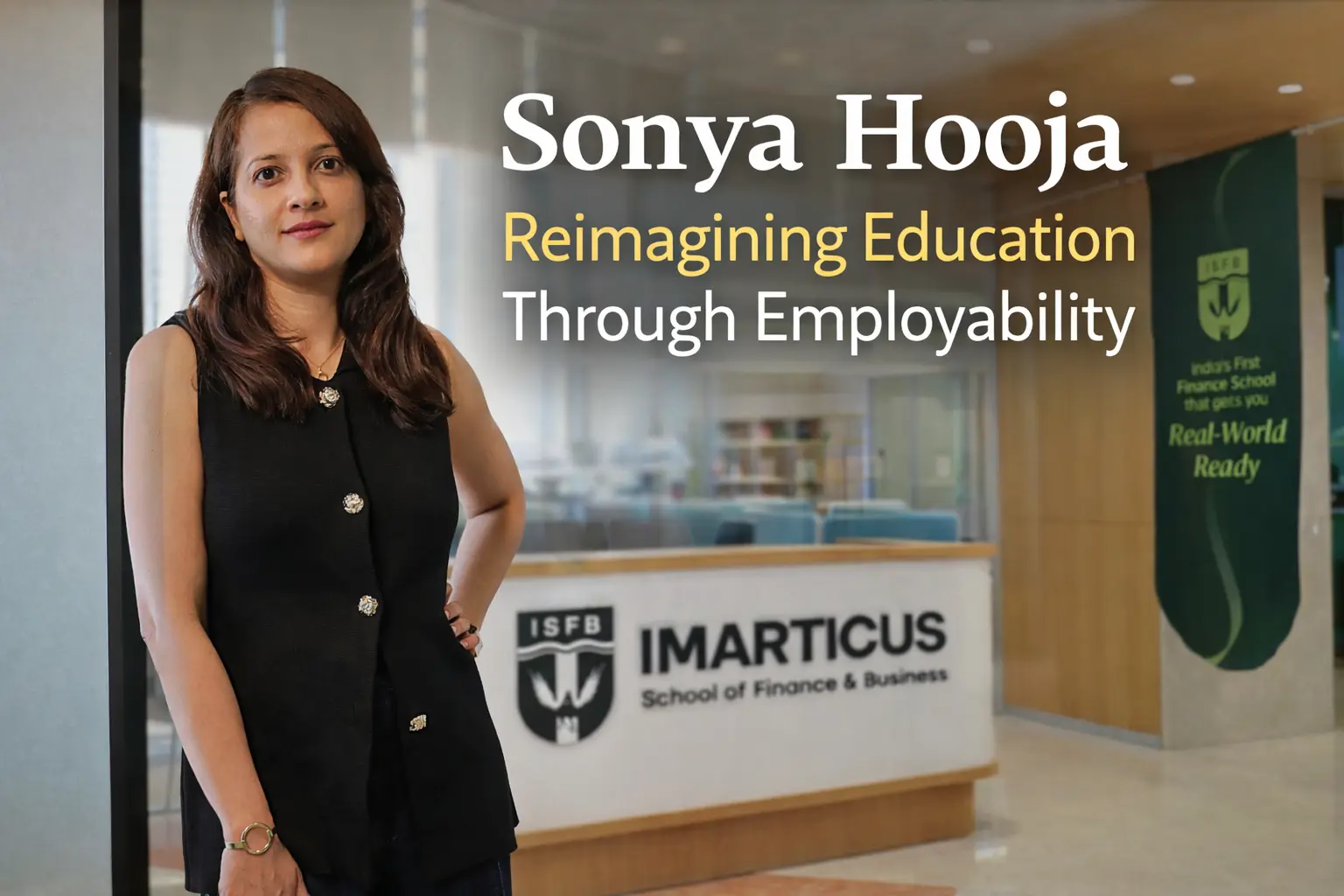
Sonya Hooja of Imarticus Learning | Education Meets Employability

Sonya Hooja brings a rare blend of global academic rigour and hands-on strategic consulting experience to India’s professional education ecosystem. A graduate of Rutgers University with an MBA from INSEAD, she spent nearly a decade as a strategy consultant with Accenture, Affiliated Computer Services, and Lehman Brothers across India, Southeast Asia, and the United States. During these years, she observed a persistent and costly disconnect. “Organizations were struggling to find workplace-ready professionals despite an abundance of qualified graduates,” she notes. The gap between academic credentials and job readiness was not incidental; it was systemic. That insight became the foundation of her entrepreneurial journey. Education Designed for Employability In 2012, Sonya co-founded Imarticus Learning with a fundamental question: “What if education started with employment needs rather than academic tradition?” Her conviction stemmed from firsthand experience of how traditional systems lagged behind rapidly evolving industries, particularly finance, analytics, and technology. For her, education is not about certificates alone. “It’s about giving people the tools to change their economic trajectory,” she says. Today, having impacted over 10,00,000 learners, she remains focused on career mobility at scale, whether that means enabling a Tier-2 city graduate to enter a Big Four firm or helping a mid-career professional transition into leadership. Outcome Ownership What distinguishes Sonya’s leadership philosophy is what she calls “outcome ownership.” “We don’t start with ‘what should people learn?’” she explains. “We start with ‘what do employers actually need, and how do we build that capability?’” This backward design model has translated into measurable outcomes, approximately one learner placed every hour, and certification pass rates that exceed industry benchmarks: CPA: 92% | ACCA: 72% | CFA: 57% | CMA: 51% Under her operational stewardship, Imarticus Learning has built what she describes as “the full learning arc.” Through initiatives like Imarticus Kickstarter, learners are

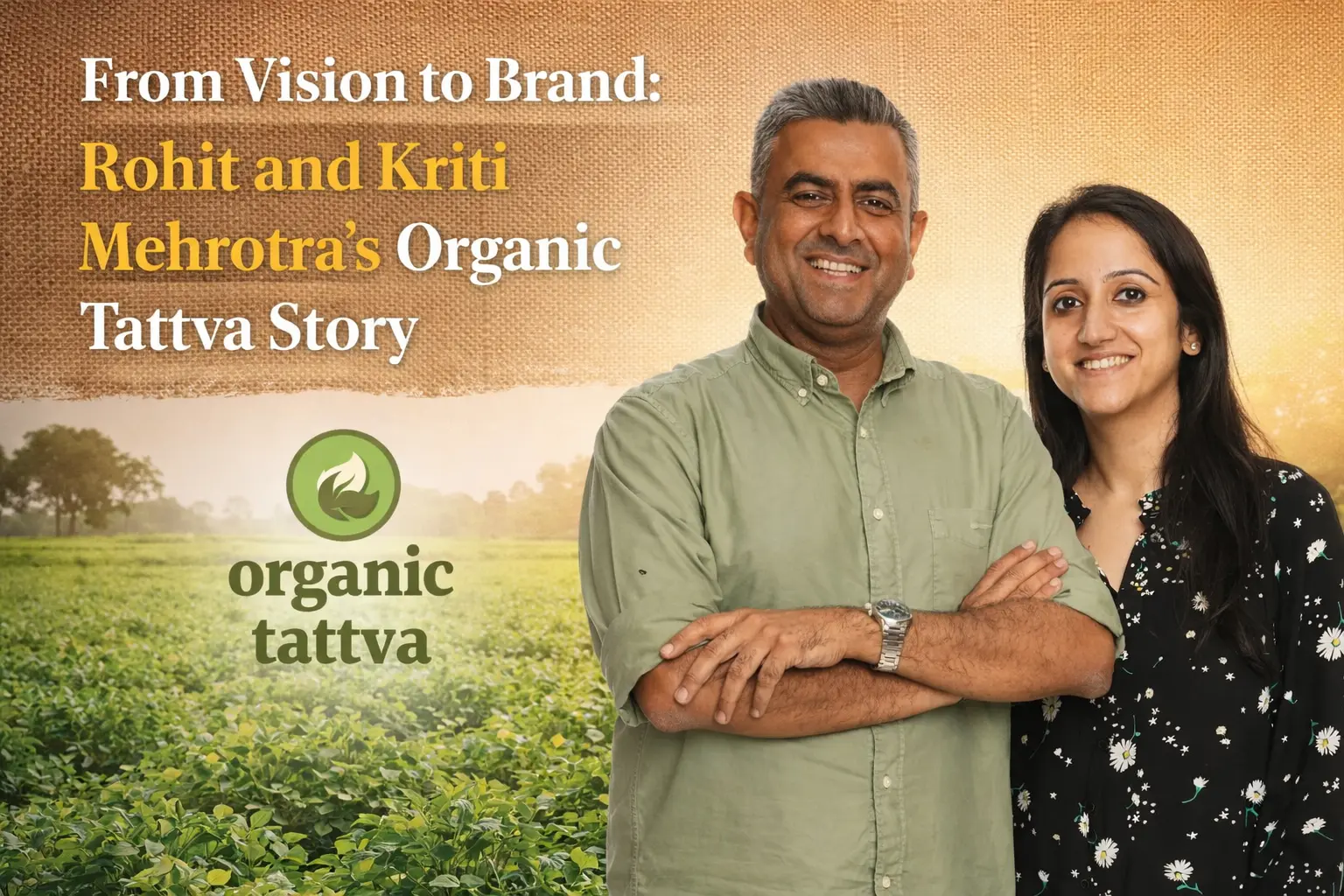
From Vision to Brand: Rohit and Kriti Mehrotra’s Organic Tattva Story

Rohit and Kriti Mehrotra, co-founders of Organic Tattva, combine entrepreneurial discipline and brand intuition to make organic living accessible and trustworthy. Their journey reflects a shared commitment to conscious choices, family health, and building a transparent, responsible food brand. Tell us a little about yourselves. What were each of you doing professionally before Organic Tattva came into the picture? Rohit Mehrotra: I come from an entrepreneurial background. Before Organic Tattva, I was involved in the business of exporting housewares and kitchenware. In 2012, I felt a strong pull towards the FMCG space and identified a clear gap in the organic food sector, particularly the need for a robust backend-to-front-end integration. That led to the inception of Organic Tattva. I’m a University of Sheffield alumnus, and I have been part of the management and operations for a while now. Kriti Mehrotra: I come from a Corporate Finance background with a diverse work portfolio and experience in the IT industry. I believe it’s my expertise in Finance and Export Management which has contributed significantly to the company’s growth, especially in expanding into international markets. I feel really committed to excellence and integrity, and to drive meaningful growth while establishing Organic Tattva as a trusted leader in its category. You come from different backgrounds. How did your journeys converge into creating an organic food brand together? Our differences have actually broadened our perspectives and strengthened our partnership. What truly brought us together was a shared set of values. Despite coming from different professional backgrounds, we both grew increasingly concerned about food safety, rising lifestyle-related health issues, and the declining trust in everyday food choices. Our complementary strengths and shared purpose naturally aligned, leading to the birth of Organic Tattva. Was there a single trigger moment or a gradual realisation that convinced you to

You May Also Like

Connect with us