
On the Rise : Sheena Chohan

On the Rise Sheena Chohan - Hashtag Magazine

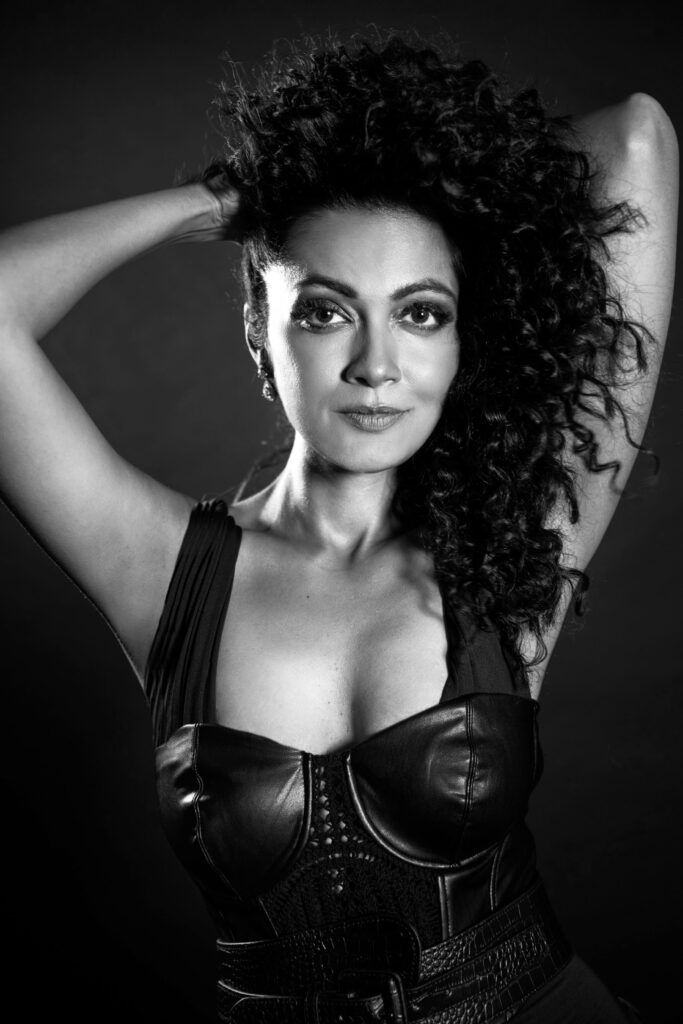
From Hollywood movies to web series, Sheena Chohan is a versatile actress on the rise. Most recently she was seen alongside Madhuri Dixit in Netflix’s Fame Game, and Disney Hotstar’s City of Dreams, directed by Nagesh Kukunoor. Her latest feature film Justice is also being released at various international film festivals this year. In conversation with Hashtag India, she talks about her journey from being crowned Miss Kolkata to her rise in the industry…

From being a versatile actor, and doing humanitarian work, to running a podcast, you are multifaceted; tell us a little about your journey…

I was born in Punjab, but we moved to Kolkata when I was very young. My mother always encouraged me to take part in various activities like swimming, karate, violin, sculpture, and theatre, but it was acting–the creation of characters, that always struck a chord with me. I had a lot of success in Kolkata as a model and while I was still in school, I used the money I made to fund my move to Delhi where I did five years theatre course with experimental director Arvind Gaur. I won a crown under Miss Universe and because of that the South megastar Mammootty cast me as the lead in National Award Winner, Jayaraj’s The Train, which was my launch into feature films. 

Your comedy series ExMates is out now, tell us a little about your role in the series…

My character was fun to create because my role in the series is like so many modern Indian women–ambitious, intelligent and hard-working, but yet trapped in a relationship with a man who is just her opposite. I love to research for a role and for this one I spent time talking to friends who had that kind of situation–where they were being held back by the man in their life. Of course, once I do the research I then take it to my director and we integrate it with his vision. ExMates is a comedy-drama and we had a lot of fun delivering it. 

What’s the biggest takeaway from the two web series–The Fame Game and City of Dreams that you have been a part of recently? How different is working in Hollywood, as compared to working in India?

In my movie, The Ant Story (Sheena was nominated as Best Actress at the Dubai and Shanghai film festivals) I played a superstar actress who gets in a lot of trouble, so it was interesting for me to watch Madhuri Dixit ma’am, playing a similar character. When I shot The Fame Game I was just back from shooting a Hollywood feature. It was new for me to see how Netflix and Disney were operating in India. No matter how big or small the production company is, it’s the filmmakers’ passion and commitment that makes a film, and nowhere in the world are the crews and directors as passionate as in India.

We spread awareness of basic rights and equality to 100 million Indians in a year, by working with stars like Preity Zinta, Sonakshi Sinha, Raveena Tandon, Sonu Sood and many more.

You made your debut with the Malayalam megastar, Mammootty. Are you open to doing South projects as well? 

Definitely, the South has been teaching the entire industry some lessons in movie-making. They love telling big stories and are not afraid to do so as Indians. South movies are packed with culture and that is what we love about films. So, yes, I would love to work in the South again.

Tell us a little about your feature film Justice, it has managed to grab international attention as well. 

This was a special one, the late Bappaditya Bandopadhyay directed it and in the film, I play a ghost looking for its coffin. Bappaditya Bandopadhyay wasn’t a typical director. We worked on this movie together; we would discuss ideas and even the storyline. We would have long conversations and he incorporated a lot of my traits into the character. I’m glad the movie is now trending in international circles.

No matter how big or small the production company is, it’s the filmmakers’ passion and commitment that makes a film, and nowhere in the world are the crews and directors as passionate as in India.

Tell us about your work as a Human Rights South Asian Ambassador and podcast, Born Free and Equal, where you brought together 30 of Hindi cinema’s biggest names on one platform to communicate the 30 rights from the United Nations Universal Declaration on Human Rights.

We spread awareness of basic rights and equality to 100 million Indians in a year, by working with stars like Preity Zinta, Sonakshi Sinha, Raveena Tandon, Sonu Sood and many more. Each artist we worked with discussed the human right that they found most important and gave us insights from their own life. I along with my co-host would further use this information to educate the audiences on human rights laws, their application in our day-to-day life and more.
What are the next projects on which you are working?

I just got back from shooting, where I played the wife of Sant Tukaram, directed by the talented director Aditya Om, alongside the Marathi star Subodh Bhave. It’s a biopic set in the 18th Century, just after the famine, and the Sant is so beloved in Maharashtra, so Aditya Sir had to be very sensitive, consulting priests and professors to make sure that my character was portrayed correctly both in terms of realism and also with respect to his followers. For my part, I was up at 6 am working in the fields with the villagers to get in character! It was a lot of hard work and a joyful experience.

I love to research for a role and once I do the research, I then take it to my director and we integrate it with his vision.

Quick Takes:
The show I am currently watching.
Trial by Fire


Favourite series of 2023?
The Wheels of Power


One series you watched and wished you were a part of?
Same as above – what production values – they spent a billion dollars on it!


One thing people don’t know about you.
I’m extremely open and honest. In reality, I’m very emotional and sentimental; I feel everything on a very deep level.


Three must-watch recommendations for the readers? 
Avatar: The Way of Water, Ex Mates (my comedy-drama series) and Sant Tukaram (my upcoming Hindi film).


Message to readers:
Be True to Your Own Goals!!

Leave a comment

Your email address will not be published. Required fields are marked *

Exclusive Interview: Nikhil Siddhartha on Swayambhu, Family and Politics

After the pan-India success of Karthikeya 2, Nikhil Siddhartha finds himself at a pivotal phase in his career. The actor is currently gearing up for the release of Swayambhu, one of the most ambitious projects he has undertaken to date, a historical action drama that demanded nearly two-and-a-half years of dedication, extensive physical transformation, and months of post-production work. In a candid conversation with Priyanka Goud, Nikhil opens up about the challenges of mounting a large-scale period film, why he prioritises quality over quantity, how fatherhood has changed his outlook on life, and his belief in using cinema as a tool for social awareness. A Two-and-a-Half-Year Commitment Describing Swayambhu as a project unlike any other in his career, Nikhil revealed that he dedicated nearly two and a half years exclusively to the film.“Some films are easy to make, and some are difficult. Swayambhu falls into the category of films that demand complete commitment. I underwent a significant transformation for the role, growing my hair long, maintaining a specific physique, and immersing myself in the character and story throughout the production period,” he said. A Historical Story with Universal Appeal One of the aspects that attracted Nikhil to Swayambhu was its historical backdrop. Nikhil plays Krishnan Raman, a historical figure whose name appears on ancient copper plate inscriptions that have recently gained attention. “This story is rooted in history, but its themes are universal,” he said. “It’s not confined to one region; audiences across India will be able to connect with it.” The actor also highlighted the growing importance of visual effects in modern filmmaking. Swayambhu reportedly contains nearly 2,700 VFX shots, making post-production one of the most demanding phases of the project. “We completed principal photography in December 2025, but for the last five to six months it has been

Preity Zinta on Batwara 1947, Motherhood and Finding Her Way Back to Cinema

For Preity Zinta, returning to the screen with Batwara 1947 is about more than making a comeback. The period drama allowed her to explore a chapter of India’s history, work with director Rajkumar Santoshi for the first time, and step into a world far removed from her own. But the film also made her reflect on how much life has changed since she began her career, from the freedoms available to women today to the perspective that comes with becoming a mother. For Zinta, Batwara 1947 is ultimately a story about family, resilience and hope, as she tells Lipika Varma in an exclusive conversation. Why did you say yes to doing this film? What touched you the most? There were a couple of things. First, I really wanted to work with Raj ji. I had never worked with him before, so working with him was always on my bucket list. I had also always wanted to do a period film. Beyond that, I genuinely loved the story. What touched me most was that even in the darkest of times, there is always a ray of hope. People may see this as a story about two countries, but for me, it is essentially about a family. I was also deeply affected by stories of families who believed they were leaving their homes temporarily, even burying their jewellery and valuables, thinking they would return. They never imagined they would lose everything forever. Since this is my first period film, I spent time researching and understanding that era. After such a long break from films, why did you choose this project? I was enjoying my personal life, focusing on my family and raising my children. Professionally, I had always wanted to work with Raj ji and also wanted to do a period film.

Exclusive Interview with Sunny Deol: Life Beyond Bollywood

Sunny Deol: “Every Film Leaves Some Kind of Impact” With Batwara 1947, Sunny Deol returns to a story rooted in Partition, family and the human cost of one of the most defining moments in Indian history. The actor reflects on why he sees the film as fundamentally different from Gadar, his long-standing association with director Rajkumar Santoshi, his father Dharmendra’s connection to their shared cinematic history, and the responsibility actors carry when their work leaves a lasting impact on audiences. In conversation with Lipika Varma, Sunny Deol also opens up about playing a character outside the action-driven image audiences often associate with him and working alongside his son Karan. How did you approach the character in this film? For me, it was the subject, the story and the character that I had heard about, and I approached it accordingly. I don’t know exactly what was tweaked. I didn’t read the original play or see it. Vivek Raj had read it, and we had been working on this story since 2010. Unfortunately, we couldn’t make it back then, so we had been waiting all these years. As soon as we got the opportunity, we jumped into it. Sunny, are you happy that your fans, including those in Pakistan, will get to see you in a completely different kind of role this time, without the iconic hand-pump moment or typical action scenes? Actually, I don’t think it’s about that. Fans are always there, and they love you no matter what. Sometimes journalism and politics come into the picture and change the colours of things. But the actual viewer, the person sitting in the theatre and watching the film, doesn’t necessarily look at things that way. They simply watch the film. I’ve met a lot of fans across the country and around the

Akshay Kumar: “The Craft Has Changed, But Hard Work Never Goes Out of Style”

With a career spanning over three decades, Akshay Kumar continues to reinvent himself across genres, from action and comedy to social dramas and entertainers. As he looks ahead to his upcoming projects, including the action-thriller Haiwaan and a lineup of comedy entertainers, the actor reflects on his journey, his approach to cinema, discipline, and why staying connected to the craft remains his biggest priority. In conversation with Lipika Varma, Akshay opens up about his evolving approach to cinema, the importance of teamwork, and the values that guide him both on and off screen. You have played action heroes, comedians, romantic leads, and intense characters. What kind of roles excite you the most today? I enjoy all kinds of roles. When I entered the industry, people mostly saw me as an action hero. After that, I consciously chose to explore different genres and keep discovering myself as an actor. I have done comedy, romance, social dramas, and action films. Every genre brings a different challenge, and that is what keeps the journey interesting. Comedy has been one of your strongest genres. What makes it so special for you? Comedy is definitely one of the hardest genres. Making someone emotional can sometimes be supported by the situation or background music, but making someone genuinely laugh requires precision, timing, and a lot of hard work. Comedy often looks effortless on screen, but there is a lot of discipline behind creating that moment. That challenge is what makes it exciting for me. You have been part of several ensemble films. What is your view on multi-starrers? Everyone has their own approach. Some actors prefer solo films, while others enjoy working in ensemble projects. There is no fixed formula for success. A film works because of its content, storytelling, and execution, not simply because of