
MADHURIMA CHAKRABORTY delves into the myths and legends of pujo and highlights some of Kolkata’s grand mansions and their annual celebrations.
The thakurdalans of old palatial buildings of North Kolkata count days till the Kolkata sky turns azure with cotton clouds floating aimlessly, indicating the slow but steady advent of Sharat season. It is the season of homecoming and rejoicing. “Maa Asche!” – Mother is coming.
Goddess Durga hailed as one of the most powerful of the Indian pantheon holds a special place in the hearts of Bengalis, who worship her as a mother and a daughter. She is family, coming home.

Undoubtedly then, Durga pujo is one of the most auspicious times in West Bengal, filled with pomp and grandeur all around. The daughter returns, now a mother herself, accompanied by her four children to her paternal home. The lore carries obvious parallels to the real-life duties of a married Indian woman common married Indian woman. A community unites as a family to celebrate her short homecoming, ready to adorn her with gifts and love galore.

In The Beginning…
Much of the beautiful spirit of the festival can be attributed to the erstwhile Zamindar families of Bengal who initiated Akaal bodhon, or the worship of Maa Durga. Historical documents trace the first recorded celebration to Raja Nabakrishna Deb, who celebrated after winning the Battle of Plassey, having sided with the British and ousted the reign of Nawab Sirajuddin in the late 18th century.
This would later set the stones for the mansions of the aristocrats; known now for the fantastic pandals they uphold. The British would go on to procure three villages of Bengal, on of them being the Sutanuti village. Trade would change its landscape, with Bengali Zamindars negotiating for themselves a free rule over the land in exchange for an annual tax. These Zamindars would soon move to Kolkata, and start building their palatial complexes to house family, servants, relatives, dependants and more.
The Bonedi Baris of North Kolkata
Three hundred and some more years later, those mansions stand, despite the gnaw of time and tell the tale of a historic time! Called Bonedi bari, it stands for a colloquial expression for the primary. Even after all these years, the grandeur and opulence of the interiors, the imported discerning decorative pieces, the ornate details of high standing ceilings and the massive chandeliers of these houses would evoke reverence among the visitors.

Today, there are about thirty old Zamindar houses in North and central Kolkata where Durga pujo is celebrated. In the greater parts of Bengal, the number reaches up to 100. Kolkata is well-known for its pujo celebrations, with funded pandals long crossing the opulence and grandeur of the baris. Yet, the pujo at these baris is flocked by those who revere experiencing a still moment in time, ensconced in these palatial mansions of the British Rule.
Although celebrations now do not run for months on end like they used to, the tradition of inviting people in continues. This is the only opportunity for a person to enter these houses and witness the massive thakurdalans, their elaborate and distinct style of worshipping, the humongous preparation of bhog and all in all, take in the royal air around. We survey just eight of these numerous houses to provide you with a short guide for travel.

The Sabarna Roy Choudhury House
It is said that Sabarna Roy Choudhury celebrated Durga pujo in Kolkata for the first time, back in 1610. He owned Kalikata, one of the three villages sold to the East India Company and moved to the suburbs, or modern-day Kolkata. This pujo dates to the era of Mughal empire Jehangir, when Maharaja Man Singh was the subedar of Bengal. The house now hosts two pujos simultaneously, one held on each floor.
A pronounced Aatchala stands by the Shiv Mandir where the idol artisans come and stay for months, giving life to the idol. Painting the eyes, also known as Chokkhudan, one of the most prominent parts of making the Durga Pratima (idol) takes place on the day of Mahalaya.
Pujo tidbit: On the day of farewell (visarjan) the womenfolk of the family come to the Thakur dalan and celebrate sindur khela.


Shobhabazar Rajbari
In many ways, the Shobhabazar Rajbari paved the way for pujo to be a social celebration amongst the Bengali community. They were the first to invite the British to witness pujo, breaking many shackles of the old society.
The Durga pujo of Shovabazar Rajbari dates to 260 years in the past. The lion, Maa Durga’s loyal stead, here has the face of a horse and is green in colour. However, the lion at the entrance to Shobhabazar Rajbari remains prominent. Instead of a goat, a catfish is sacrificed on the day of Sandhi Pujo on Ashtami.

Shobhabazar Rajbari too hosts more than one celebration. The Durga idol of chototorof is the prettiest in my opinion. Ornate Belgium glass, gothic architecture, European decor, and marbled floor renders the natmancha a signature identity. The idol dazzles in Sabeki gold jewels and garlands prepared with lotus flowers. The natmancha is painted in white while the house is painted in red hue.
Pujo tidbit: At the entrance, an artist of the family has painted a beautiful mural of Ganesh.
The Rani Rashmoni House
It is quite an experience visiting the house of Rani Rashmoni at Janbazar. Located at the heart of central Kolkata, this Zamindar house belonged to Rani Rashmoni, who is otherwise famous for establishing the Dakshineswar temple. It was under her patronage that the Ramakrishna ideology flourished in Bengal.

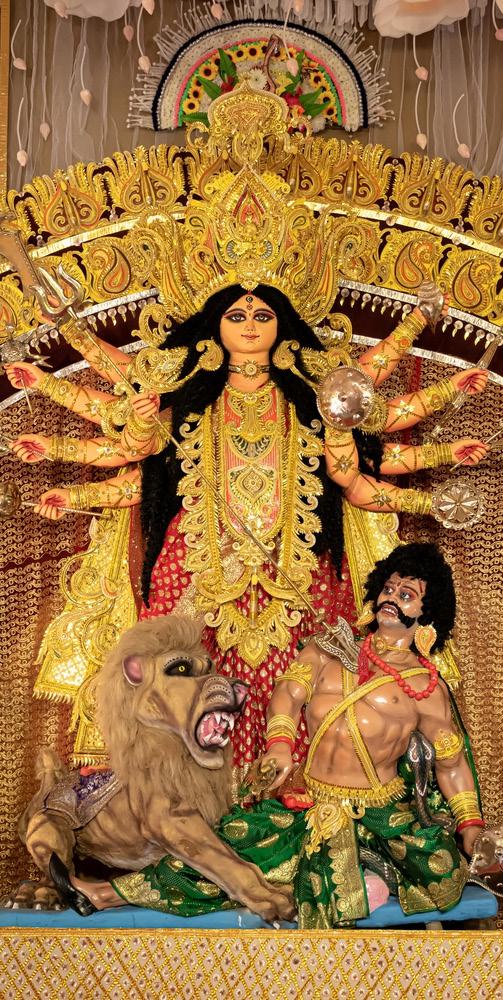
One of her sons-in laws inherited the palace of Janbazar. The Durga idols of Janbazar are painted inside the thakurdalan. The idol is crafted in the ekchala style, covered in beautiful daker saaj and almost 13 feet tall. It is an ekchala murti with beautiful white daker saaj and 13 feet in height.
Pujo tidbit: Kumari Pujo takes place here in Nabami.

Jorasanko Shib Krishna Daw Bari
The Daw family of Jorasanko is known for their business of gunmaking. On the last day of Durga pujo, also known as Bijaya Dashami, they perform a gun salute as the idol is prepared for immersion in the waters of river Ganga.

Once again split into two festivities, the choto Daw bari decks up the idol ii the prettiest of gold ornaments, for which the Daw family is well-known. Add to this the chandeliers, the glass work, the old mansion, and antique home decor, a surreal experience is born.
Head towards the elder brother’s house of the Daw family, a few meters away from the main road and you will come upon a house structure resembling that of lotus petals. The ekchala Durga idol is mesmerising in beauty.
Khelat Ghosh Bari
The Martin and Bern Company from Germany had originally planned and executed the palatial building of Khelat Ghosh, known as Pathuriaghata Palace. The long corridors stretching over 80 feet made of marble have several classic antique decorative pieces which were imported directly from Europe. Imported silver foil for daker saaj and elaborate flower decoration remain as highlights of the pujo here. The Khelat Ghosh Mansion is an architectural wonder and hosts a second pujo at a much smaller scale, although silver is the common theme!

The Dutta Bari
Located near Girish Park metro station, the Dutta Bari Durga Pujo of Balaram Dutta lane dates to 200 years. Staying true to the tradition, the idol is taken away from the thakurdalan on the shoulders of the men of the family and not any truck. The Durga idol is prepared at the natmandir, has beautiful large eyes, and a lemon-yellow hue on her sombre face. You may spot the earthen jars used to store water which is used for every ritual performed in the pujo.

Pujo tidbit: The dorbesh, a type of sweetmeat offered to the Goddess, is most famous of Dutta Bari.
Chatu Babu Latu Babu Rajbari (Ramdulal Mansion)
This pujo, celebrated for over 250 years, is one of the oldest and most revered of them all. The story behind this mansion is intriguing. Ram Dulal Dey, an orphan from Dumdum, rose to prominence and made a fortune by establishing India’s first maritime trade route with the newly independent USA.
He had two sons, known as Chatu Babu and Latu Babu. They did not excel in business but maintained a luxurious lifestyle. Legends has it, to light a cigar they would burn a 100 rupee note. The Ramdulal Mansion was built in the Victorian style, with bright red bricks and thick columns. Durga pujo here takes place in the covered courtyard. The idol is ekchala, adorned with gold jewellery and fresh lotus flowers.
Pujo tidbit: Lakshmi and Saraswati, two of Maa Durga’s four children, are known as Jaya and Bijaya in this house.
Thanthania Dutta Bari
Located near Pathuriaghata, the Thanthania bari has a stunningly beautiful courtyard where time stands still. This is a piece of Europe tucked away in the old narrow lanes of North Kolkata. This pujo is perhaps one of the most unique of them all. Maa Durga’s stead, for example, is extremely tiny in the ekchala. The vanquished demon does not appear, and instead the goddess is accompanied by her husband. Thus, Durga is seated next to Shiva in her Gauri form, and is shown with only two hands, showering blessing aplenty. There is no weapon seen. Daughters Lakshmi and Saraswati appear on either side as the goddess’ sakhis.
Pujo tidbit: The ritual of Dhuno Purono is observed by the women of the family, who sit with a clay pot filled with fire on their head during Ashtami Pujo!

The Bonedi Bari’r Durga Pujo are distinct in their styles and manners of celebration. What unites pujo celebrations from anywhere in the world is the call to Maa Durga to return the next year. An experience at the pujos of these royal houses will only prove to devotees the reverence and love with which the goddess is considered.