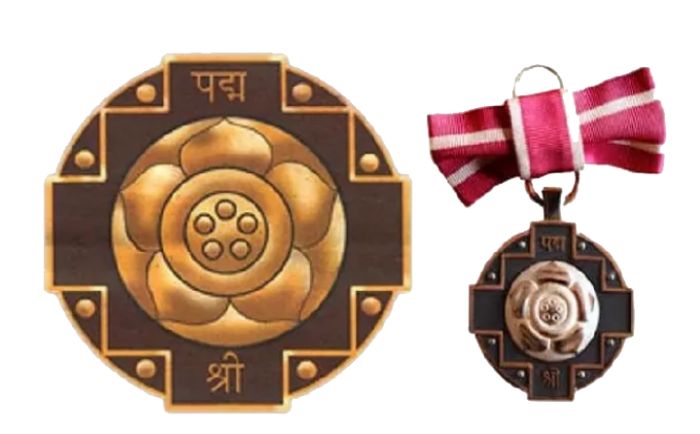
The 2021 Padma Shri Awards

Padma Shri Awards 2021

The nation’s fourth highest civilian award was recently conferred in a much-awaited ceremony. Aditi Paul presents a brief review.

The Padma Awards were conferred by President Ram Nath Kovind in a two-day ceremony at the Rashtrapati Bhavan this week. The Padma Awards are three of the highest civilian awards the Government of India elects to bestow. The ceremony is traditionally held on Republic Day, with the list of awardees released earlier in the year. The rampant and violent COVID-19 pandemic, however, led to the 2020 and 2021 ceremonies being deferred until a suitable time. In a two-day ceremony, awardees for both years were honoured, in the presence of Prime Minister Narendra Modi and other dignitaries. 

The 2021 List of Awardees

The 2021 list includes seven Padma Vibhushan, 10 Padma Bhushan, and 102 Padma Shri awardees. Of these, 29 are women, 16 are posthumous awardees, and there is 1 transgender awardee. The Padma Shri, the fourth highest civilian award in the country, is awarded for distinguished service. Although the awards are not usually conferred posthumously, some cases are considered exceptions. 

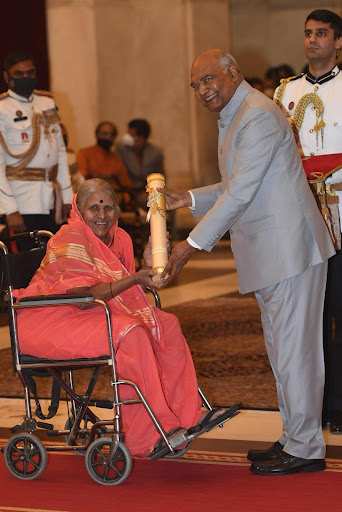
President Kovind presents Padma Shri to Matha B. Manjamma Jogati for Art :
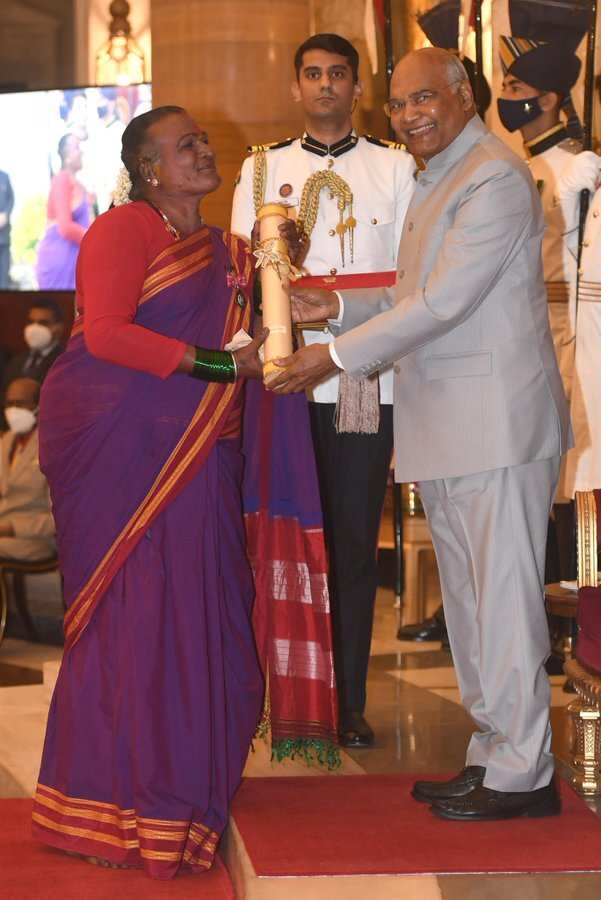
Previously, the awards have faced criticism for being granted in a partial manner. 2018 saw the creation of an online platform where people can now vote to elect those individuals they feel are deserving of the nomination. Over the two-day ceremony, netizens trended the tag #PeoplesPadma while commenting on the coverage of the event. 

The Padma Shri

This year’s Padma Shri was awarded across a diverse range of categories such as art, literature and education, medicine, agriculture, public affairs, social work, sports, trade and industry etc. 

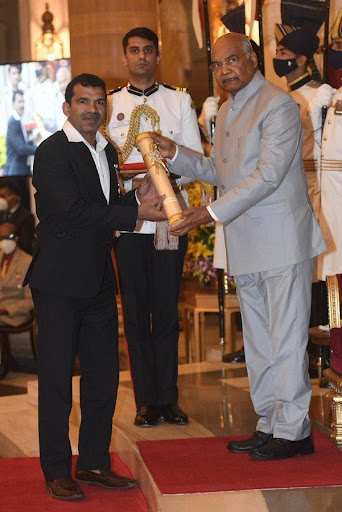
President Kovind presents Padma Shri to Smt Usha Yadav for Literature and Education :
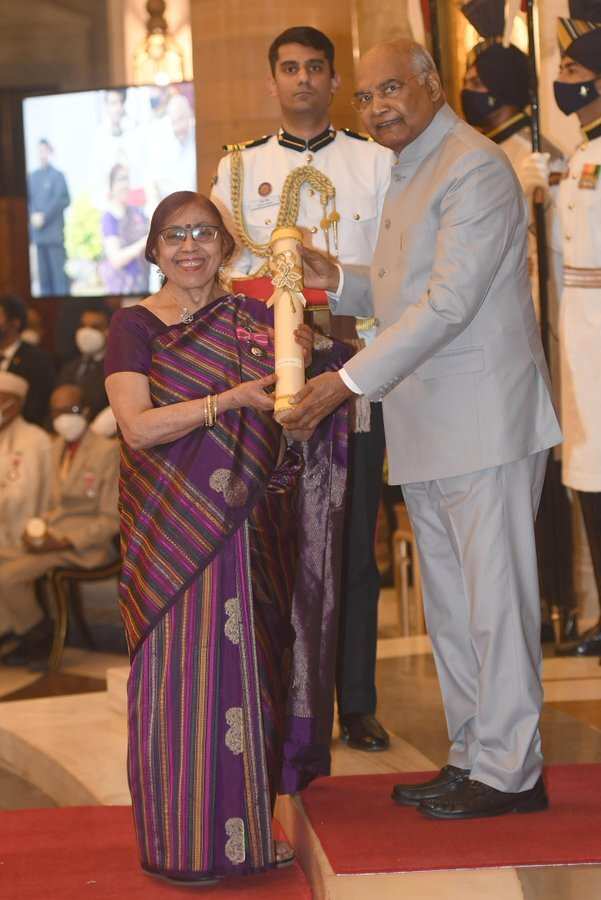
Following is the list of Padma Shri awardees for 2021, across all categories. 

ART

1.Matha B. Manjamma JogatiKarnataka
2.Ms Bhuri BaiMadhya Pradesh
3.Ms Bombay Jayashri RamnathTamil Nadu
4.Ms Dulari DeviBihar
5.Ms LajwantiPunjab
6.Ms Nidumolu SumathiAndhra Pradesh
7.Ms. Purnamasi JaniOdisha
8.Ms Radhe DeviManipur
9.Ms Sanjida KhatunBangladesh
10.Shri Biren Kumar BasakWest Bengal
11.Shri Damodaran KaithapramKerala
12.Shri Dulal MankiAssam
13.Shri Ghulam Rasool KhanJammu and Kashmir
14.Shri Gopiram Bargayn BurabhakatAssam
15.Shri Gulfam AhmedUttar Pradesh
16.Shri K C Sivasankar (Posthumous)Tamil Nadu
17.Shri K K Ramachandra PulavarKerala
18.Shri K KesavasamyPuducherry
19.Shri Kanaka RajuTelangana
20.Shri Kartar Paras Ram SinghHimachal Pradesh
21.Shri Kartar SinghPunjab
22.Shri Lakha KhanRajasthan
23.Shri Maheshbhai & Shri Nareshbhai Kanodia (Duo)
(Posthumous)
Gujarat
24.Shri Narayan DebnathWest Bengal
25.Shri Parshuram Atmaram GangavaneMaharashtra
26.Shri Peter BrookUnited Kingdom
27.Shri Radhe Shyam BarleChhattisgarh
28.Shri Rama Swamy AnnavarapuAndhra Pradesh
29.Shri Ramachandra ManjhiBihar
30.Shri Rewben MashangvaManipur
31.Shri Satyaram ReangTripura
32.Shri Subbu ArumugamTamil Nadu
33.Shri Vinayak Vishnu KhedekarGoa
34.Shri Wayan DibiaIndonesia

LITERATURE AND EDUCATION

35.Father Vallés (Posthumous)Spain
36.Ms Mridula Sinha (Posthumous)Bihar
37.Ms Usha YadavUttar Pradesh
38.Shri Arjun Singh ShekhawatRajasthan
39.Shri Balan PutheriKerala
40.Shri Chaman Lal Sapru (Posthumous)Jammu and Kashmir
41.Shri Chandrakant MehtaGujarat
42.Shri Dadudan GadhaviGujarat
43.Shri Dharma Narayan BarmaWest Bengal
44.Shri Imran ShahAssam
45.Shri Jagadish Chandra HalderWest Bengal
46.Shri Jai Bhagwan GoyalHaryana
47.Shri Kapil TiwariMadhya Pradesh
48.Shri Mangal Singh HazowaryAssam
49.Shri Namdeo C KambleMaharashtra
50.Shri Nanda PrustyOdisha
51.Shri Nicholas KazanasGreece
52.Shri Prakasarao AsavadiAndhra Pradesh
53.Shri Rajat Kumar KarOdisha
54.Shri Ram Yatna ShuklaUttar Pradesh
55.Shri Rangasami Lakshminarayana KashyapKarnataka
56.Shri Srikant DatarUnited States of America
57.Shri Sujit ChattopadhyayWest Bengal

LITERATURE AND EDUCATION-JOURNALISM

58.Shri Roman SarmahAssam
59.Shri Solomon PappaiahTamil Nadu

MEDICINE

60.Dr Bhupendra Kumar Singh SanjayUttarakhand
61.Dr. Chandrakant Sambhaji PandavDelhi
62.Dr. Dhananjay Diwakar SagdeoKerala
63.Dr Dilip Kumar SinghBihar
64.Dr. J N Pande (Posthumous)Delhi
65.Dr Krishna Mohan PathiOdisha
66.Dr Rattan Lal MittalPunjab
67.Dr Thiruvengadam Veeraraghavan (Posthumous)Tamil Nadu
68.Shri Ashok Kumar SahuUttar Pradesh

AGRICULTURE

69.Ms PappammalTamil Nadu
70.Shri Chandra Shekhar SinghUttar Pradesh
71.Shri Nanadro B MarakMeghalaya
72.Shri Prem Chand SharmaUttarakhand

GRASSROOTS INNOVATION

73.Shri Ali ManikfanLakshadweep

PUBLIC AFFAIRS 

74.Ms Bijoya ChakravartyAssam
75.Col Quazi Sajjad Ali ZahirBangladesh

SCIENCE AND ENGINEERING 

76.Shri Rattan LalUnited States of America

SOCIAL WORK

77.Guru Maa Kamali SorenWest Bengal
78.Ms Birubala RabhaAssam
79.Ms Chutni DeviJharkhand
80.Ms Lakhimi BaruahAssam
81.Ms Niru KumarDelhi
82.Ms Prakash KaurPunjab
83.Ms Sangkhumi BualchhuakMizoram
84.Ms Shanti DeviOdisha
85.Ms Sindhutai SapkalMaharashtra
86.Shri Girish PrabhuneMaharashtra
87.Shri Jagdish Chaudhary (Posthumous)Uttar Pradesh
88.Shri Jitender Singh ShuntyDelhi
89.Shri Marachi SubburamanTamil Nadu
90.Shri Shyam Sundar PaliwalRajasthan
91.Shri Tsultrim ChonjorLadakh

SPORTS

92.Ms Anshu JamsenpaArunachal Pradesh
93.Ms Mouma DasWest Bengal
94.Ms P. AnithaTamil Nadu
95.Ms Sudha Hari Narayan SinghUttar Pradesh
96.Shri K Y VenkateshKarnataka
97.Shri Madhavan NambiarKerala
98.Shri Virender SinghHaryana

TRADE AND INDUSTRY

99.Ms Jaswantiben Jamnadas PopatMaharashtra
100.Ms Rajni BectorPunjab
101.Shri P Subramanian (Posthumous)Tamil Nadu
102.Shri Sridhar VembuTamil Nadu

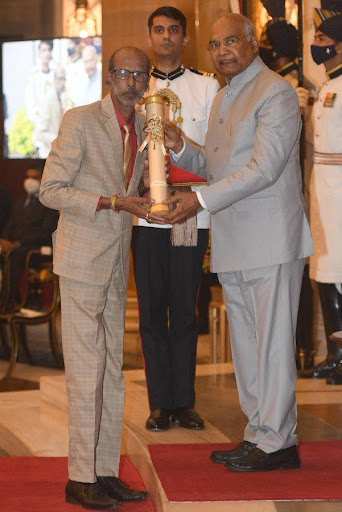
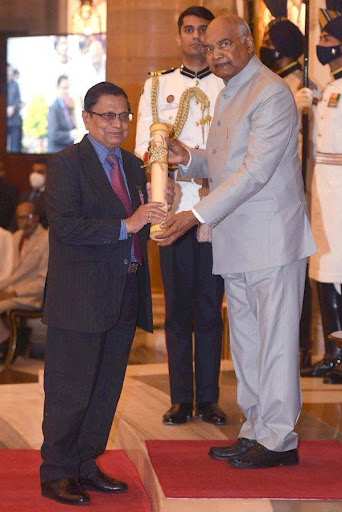
President Kovind presents Padma Shri to Dr. Roman Sarmah for Literature and Education (Journalism)

President Kovind presents Padma Shri to Prof. Krishna Mohan Pathi for Medicine.

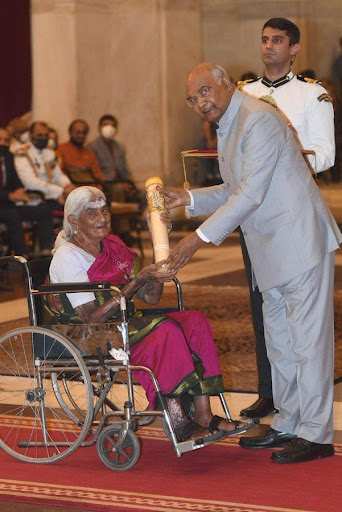
President Kovindpresents Padma Shri to Smt. Rangammal Alias Pappmmal for Agriculture.

President Kovind presents Padma Shri to Lt Col Quazi Sajjad Ali Zahir (Retd.) for Public Affairs

President Kovind presents Padma Shri to Dr Sindhutai Sapkal (Maai) for Social Work.
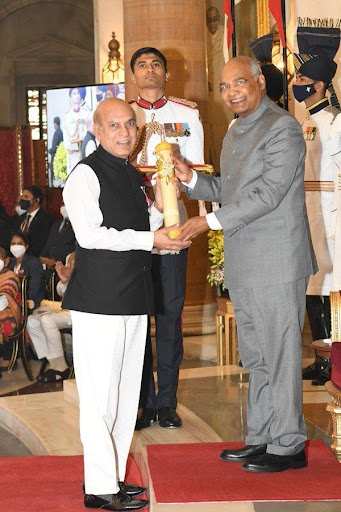
President Kovind presents Padma Shri to Shri Virender Singh for Sports.

President Kovindpresents Padma Shri to Smt. Rajni Bector for Trade and Industry.

Leave a comment

Your email address will not be published. Required fields are marked *

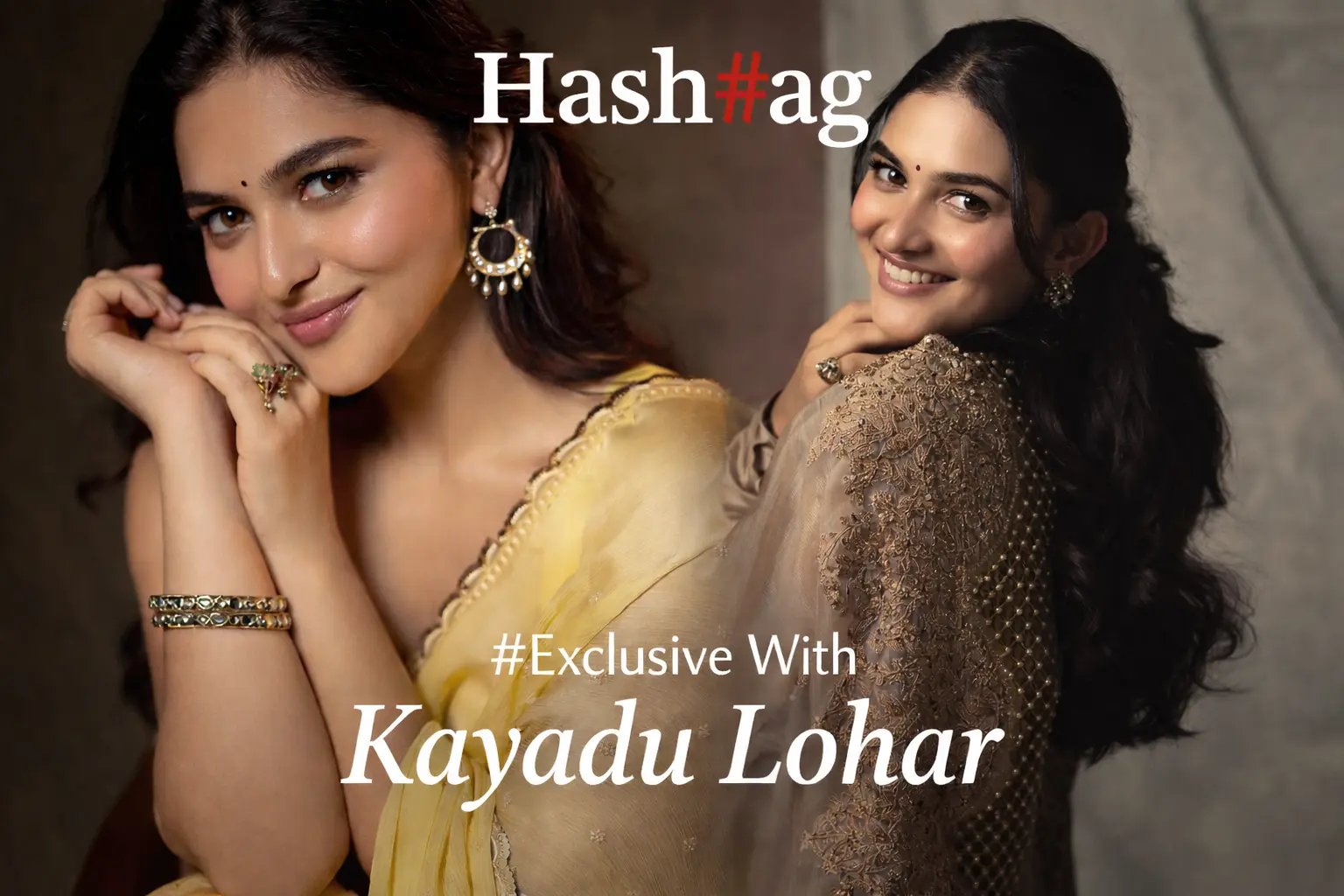
Between Film Sets and Mountain Escapes: Kayadu Lohar’s Journey

Long before the Tamil film Dragon became a cultural moment, Kayadu Lohar was quietly building her career across industries. A winner of the Everyuth Fresh Face, Kayadu stepped into cinema in her teens and gradually explored Kannada, Malayalam, Telugu, and Tamil industries with projects like Mugilpete, Pathonpatham Noottandu, Alluri, and Funky. But it was Dragon, opposite Pradeep Ranganathan, that turned her into a viral sensation, bringing widespread recognition and positioning her as one of the emerging pan-South talents to watch. In a candid conversation with Priyanka Goud, Kayadu opens up about sudden fame, navigating multiple film industries, and finding peace away from the spotlight through travel. Acting Was Always the Plan For Kayadu, acting wasn’t a coincidence; it was always the goal. “I always knew I wanted to be an actor,” she says. Winning the Fresh Face title during college became the first big push. “It gave me visibility, auditions, and belief. At just 18, I found myself travelling across cities for auditions, sometimes attending three to four in a single day. As a newcomer, you don’t always get full narrations. Many times, you say yes based on the production house or the hero attached.” Navigating Languages and Cultures Born into a North Indian family, speaking Nepali at home, fluent in Hindi and Marathi, and raised in Pune, entering South Indian cinema came with its own challenges. “South Indian languages aren’t my first language, so understanding the rhythm and culture initially took time,” she says. But over the years, she developed her own process. For Kayadu, learning a language goes beyond memorising lines. “If I’m doing a Malayalam film, I’ll only listen to Malayalam songs during that phase. Music helps me understand the emotion and culture behind the language.” The Dragon Effect Her performance as Pallavi in Dragon proved to

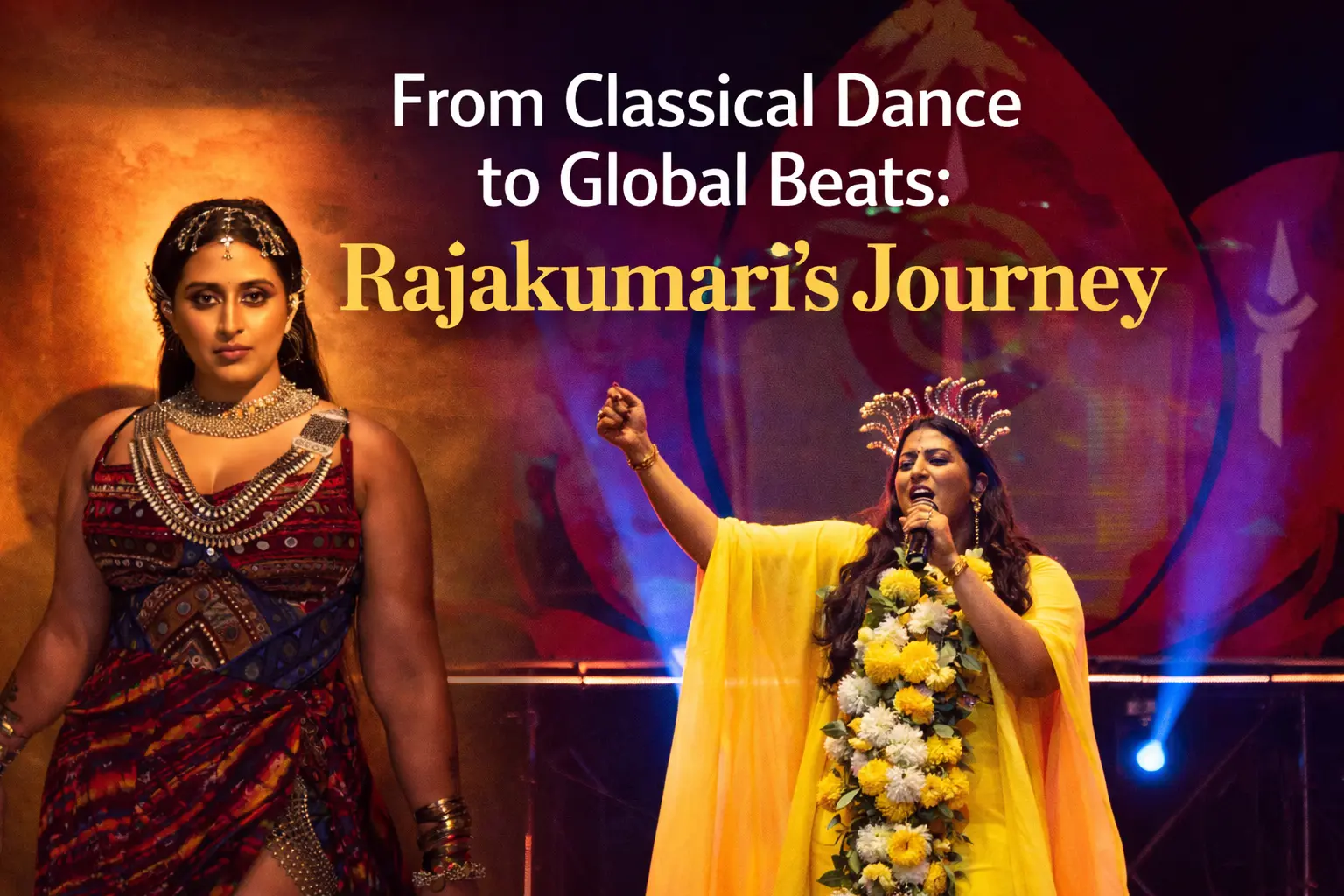
Rajakumari: The Artist Bridging Classical Heritage and Rap

Svetha Yallapragada Rao, professionally known as Rajakumari, is based in Mumbai. She holds a BA in Religious Studies and comes from a family of doctors, where education and discipline were deeply valued. However, it was Indian classical dance that shaped her most profoundly. She began training at a very young age, immersing herself in tradition, mythology, and devotion. Reflecting on those formative years, she says, “Classical dance didn’t just teach me technique, it taught me reverence, storytelling, and the sacred power of the stage.” The discipline of classical arts instilled in her both artistic rigour and spiritual grounding, foundations that continue to define her creative expression. Art with Cultural Responsibility Rajakumari chose her stage name intentionally. “I chose the identity of ‘Rajakumari’ as a vision, almost like embodying the energy of a goddess,” she explains. Having grown up inspired by Devi through classical dance, the divine feminine became central to her artistic identity. While growing up in America, she noticed the absence of Indian artists in mainstream spaces. “I wanted to become the artist I needed when I was younger, someone unapologetically Indian, modern, powerful, and visible.” Breaking into the American record label system in 2016 came with significant challenges. There were battles, resistance, and moments that demanded persistence. Yet, witnessing the cultural shift today validates that journey. “When I meet fans who proudly wear their bindis or celebrate their culture boldly, I understand the weight of the journey. We are all connected, and cultural pride is powerful.” THE RAJAKUMARI CODE Rajakumari believes authenticity is her defining strength. “Trends shift, genres evolve, and paths change, but I have always remained true to my vision and message.” She emphasises manifestation and cultural pride as pillars of her philosophy. “You don’t have to abandon any part of yourself to succeed.” Her work

Rithika Jain: Wildlife & Architectural Photographer from Hyderabad

Rithika Jain is a wildlife and architectural photographer based in Hyderabad. She studied filmmaking at the London Film Academy, specialising in cinematography, a discipline that profoundly shaped her understanding of light, composition, and visual storytelling. Architecture taught her structure and discipline. The wild taught her presence. “The jungle became a space where I felt most attentive, stripped of noise, expectation, and vanity,” she reflects. Photography gradually evolved into her language, a way to translate emotion, observation, and stillness into something enduring. Over time, the landscapes she has worked in have shaped more than her portfolio. “They’ve shaped my way of seeing life, with more humility, patience, and respect for coexistence.” Creating Emotional Bridges Rithika describes herself as a visual storyteller focused on emotion, conservation, and presence. Her wildlife work centres on connection, capturing moments that reveal intelligence, care, and vulnerability within the natural world. “This path matters to me because images have the power to create empathy,” she says. A single photograph, she believes, can make someone pause long enough to care about something beyond their immediate reality. “That emotional bridge is my purpose.” Her work is not simply about documentation; it is about evoking feeling, because feeling is what ultimately drives awareness and conservation. The Quiet Side of the Wild Rithika is drawn to subtleties, fleeting expressions, nuanced behaviour, and the quieter emotional currents within the wild. “It’s less about capturing an event and more about preserving a feeling,” she explains. Her process is rooted in patience and observation, often requiring extensive travel through extreme conditions to reach remote environments. These expeditions inform not just what she photographs, but how she responds to a scene. The goal is immersion, allowing the viewer to step into a moment that might otherwise pass unnoticed. From Structure to Stillness Her journey began

Mrunal Thakur on Do Deewane Seher Mein: Love, Insecurities and Finding Peace

With Do Deewane Seher Mein now released, Mrunal Thakur steps into a romance that celebrates vulnerability, emotional honesty and modern companionship. Produced under Sanjay Leela Bhansali’s banner, the film explores relationships through a lens of hope and self-discovery. In an exclusive conversation with Lipika Varma, the actor opens up about insecurities, beauty stereotypes, marriage, and the quiet confidence she has grown into over the years. You’ve spoken about insecurities before. What were your early struggles? Even after moving to Mumbai, I struggled with confidence. I couldn’t answer questions in class because I was insecure about my English and my Marathi accent. My name is unisex, and boys would make fun of it. When I entered the industry, I felt I needed to sound “elite.” I thought accent and diction defined you. Today, I realise insecurities only matter when you give them importance. I’m comfortable in my own skin now. I feel good the way I am. Have you ever faced challenges because of being considered “too beautiful”? Yes, sometimes people think that if you’re beautiful and successful, life must be easy. It’s not! There are moments when I wish I could just be normal. For Love Sonia, my audition was literally placed in a folder marked “Do Not Open.” Fortunately, the director opened it and felt I was right for the role. I had to convince the team that with prosthetics and makeup, we could make it work. People assume beauty makes everything easy. It doesn’t. Everyone struggles. Beauty alone cannot carry you forward. There are a lot of things that have to fall in place. I also remember attending a funeral and not being able to grieve freely because cameras were around. Sometimes you just want to be a daughter or sister, not an actor. How was it working

You May Also Like

Connect with us