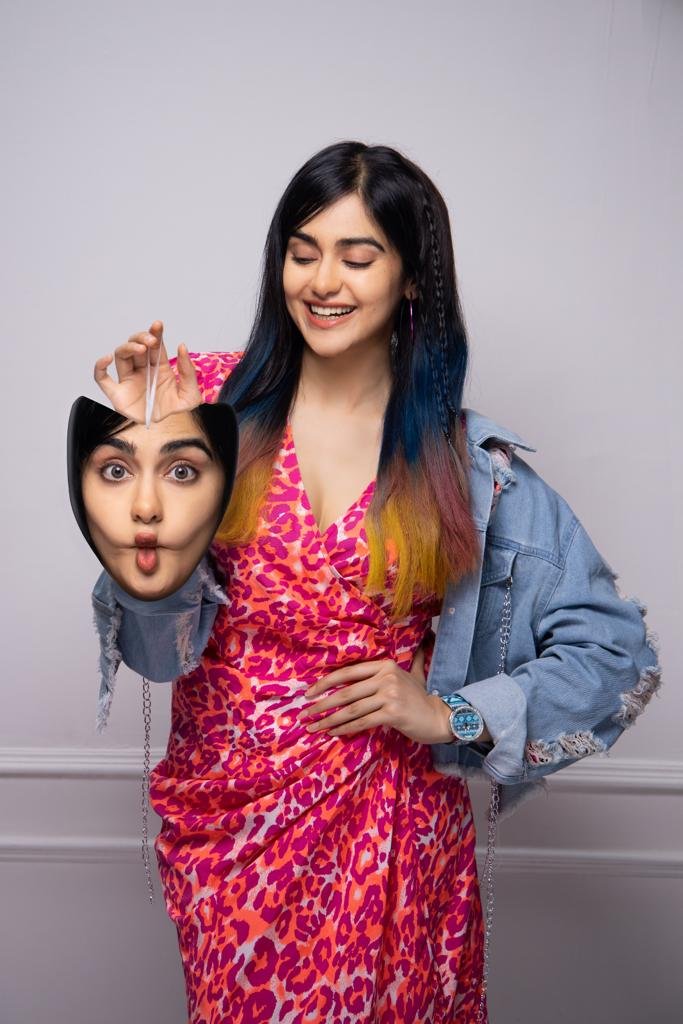
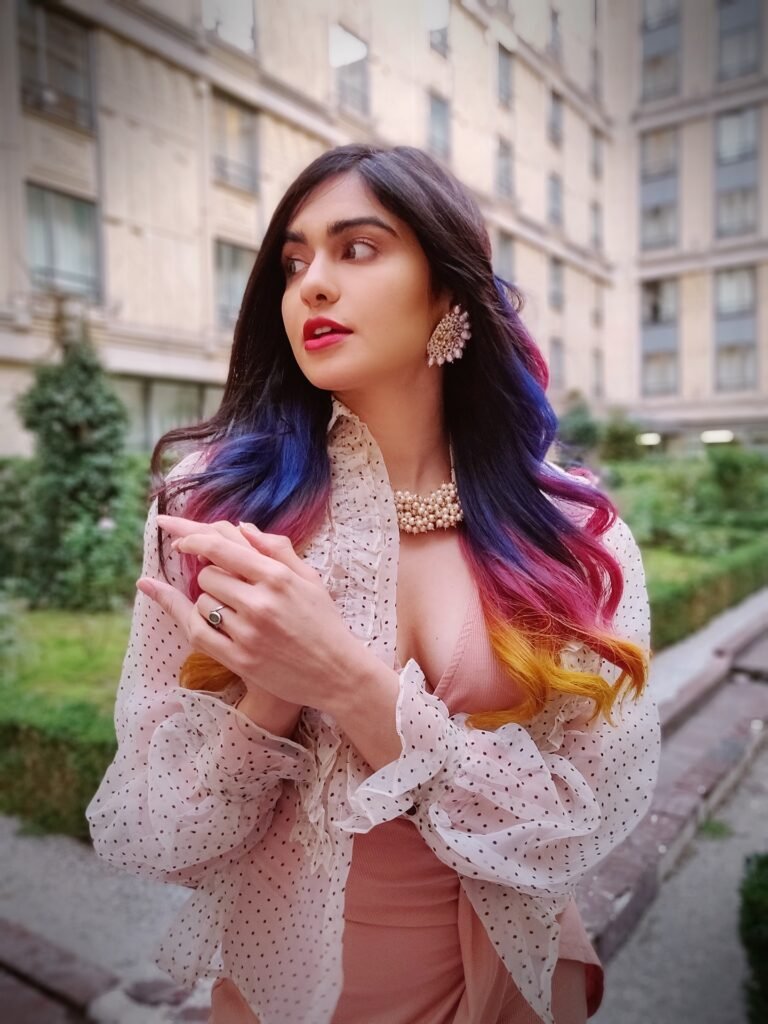
Treading the highs and lows: Adah Sharma

When the going gets tough, Adah gets going…

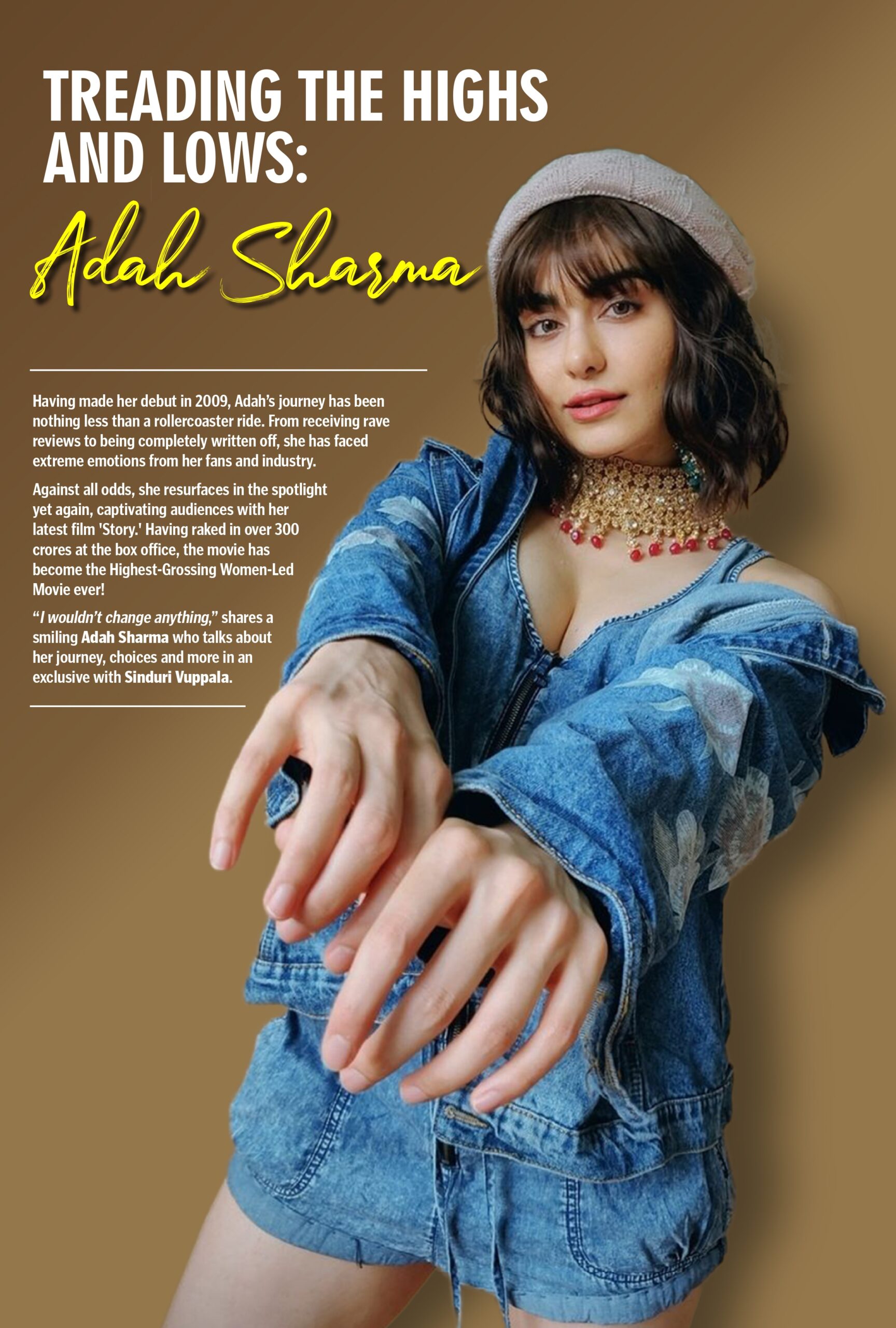
Having made her debut in 2009, Adah’s journey has been nothing less than a rollercoaster ride. From receiving rave reviews to being completely written off, she has faced extreme emotions from her fans and industry. Against all odds, she resurfaces in the spotlight yet again, captivating audiences with her latest film ‘Kerala Stories.’ In this film, witness her transformative portrayal as a protagonist radicalized and coerced into joining ISIS.

“I wouldn’t change anything,” shares a smiling Adah Sharma who talks about her journey, choices and more in an exclusive with Sinduri Vuppala.

Adah, your journey in the industry has been quite remarkable. You have experienced numerous successes as well as challenges, but you have persevered through it all. Tell us a little about your journey.

It’s been about 15 years, since my first film, ‘1920’. I love acting, I love working on all these cool skills. Low points or high points, it’s all been fun! I wouldn’t change anything!

In a recent interview, you mentioned how you feel that every film you do would be your last… does that change after Kerala Story?

No, that should never change! I can’t predict the future and I don’t wish to. I don’t know who will give me my next movie and trust me with a project that I would also be equally excited to do. But after Kerala Story, I’ve been offered some really exciting projects and scripts, so looks like I’ll be around for a bit.

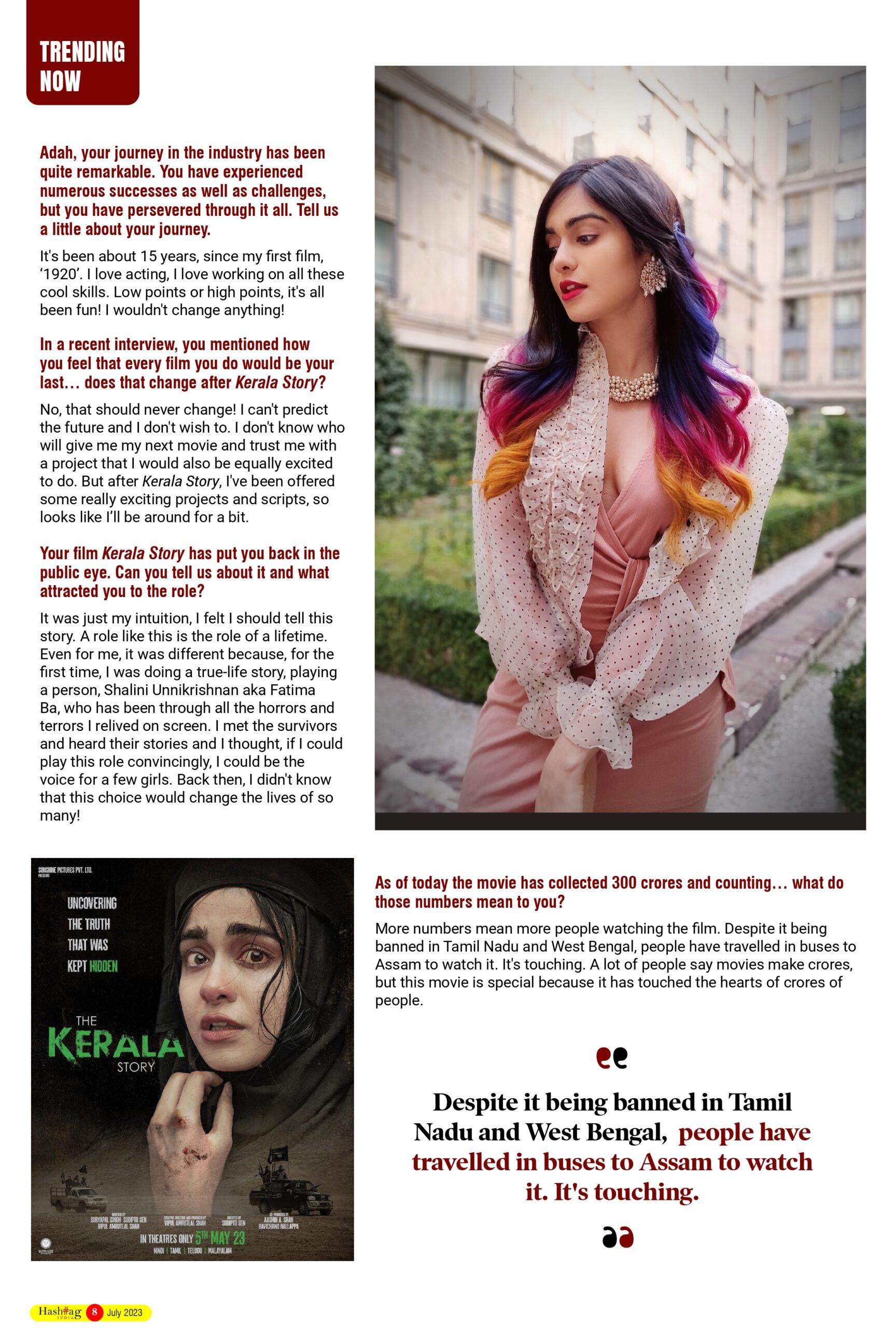
Your film Kerala Story has put you back in the public eye. Can you tell us about it and what attracted you to the role?

It was just my intuition, I felt I should tell this story. A role like this is the role of a lifetime. Even for me, it was different because, for the first time, I was doing a true-life story, playing a person, Shalini Unnikrishnan aka Fatima Ba, who has been through all the horrors and terrors I relived on screen. I met the survivors and heard their stories and I thought, if I could play this role convincingly, I could be the voice for a few girls. Back then, I didn’t know that this choice would change the lives of so many!

As of today the movie has collected 300 crores and counting… what do those numbers mean to you?

More numbers mean more people watching the film. Despite it being banned in Tamil Nadu and West Bengal, people have travelled in buses to Assam to watch it. It’s touching. A lot of people say movies make crores, but this movie is special because it has touched the hearts of crores of people.
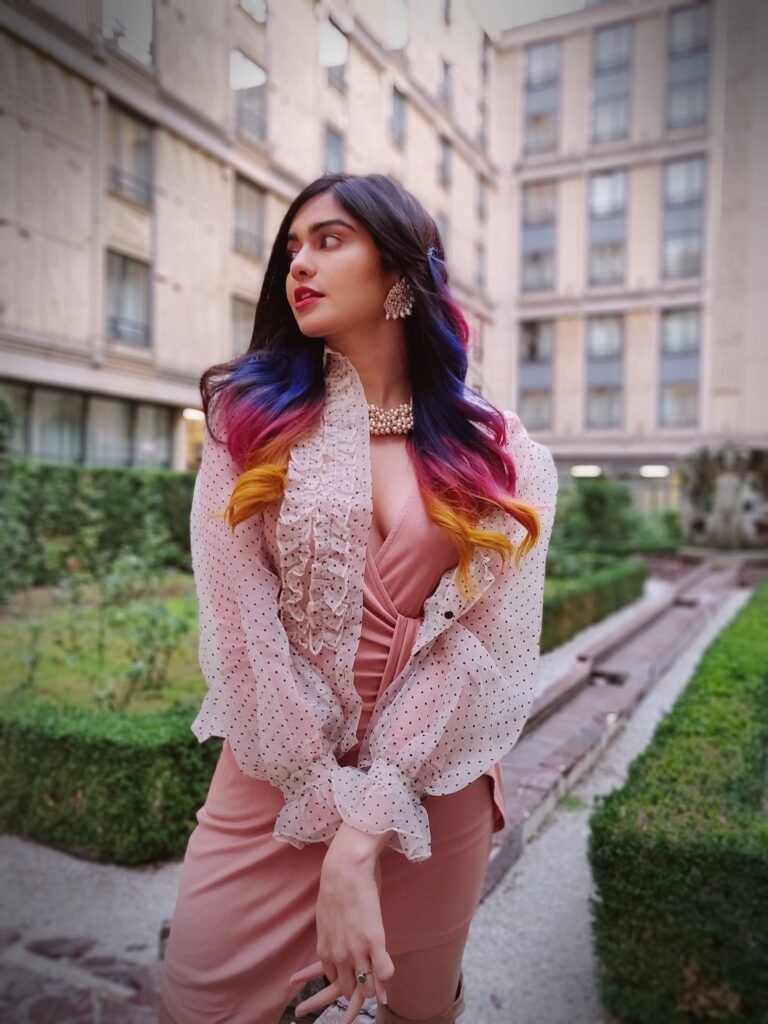
Even the success of this film has been a little bittersweet, while you were appreciated for your role; you were also doled out death threats. How does this make you feel?

I’ve made space in the hearts of millions of people around the world. Speaking the truth would anger a few, after all, we are exposing a huge terrorism nexus. A lot of the anger is from people who haven’t watched the film. For me actually, it isn’t bitter. I am overwhelmed by the incredible amount of respect and love I have received. I haven’t witnessed such immense support for a film in recent times. People have embraced this film as their own and actively promoted it. I am thrilled to be included in their celebration of success.

What’s next for you? Do you think the success of this film will get you the kind of roles you have been looking for? Is it true that you have been offered an international project where you play a superhero?

I wish to work with people who are charged to make great cinema.

Yes it is true, I am playing a superhero, and I like to talk about films when the trailer is out. It’s nicer that way, like we did for the Kerala Story or like I do for all my films. My next set of films is very different and I play very contrasting characters from what I did in Kerala Story. To know more you will simply have to wait a few more months.

Do you think being from a non-film background has set you back more than you would like to believe is true?

I think after debuting with a role like 1920 and doing some amazing stuff in the South too and now Kerala Story, it would be ungrateful for me to say I wish I were born in the womb of someone from the industry. The Kerala Story is the highest female-grosser film ever. That makes me one in….everyone ever!
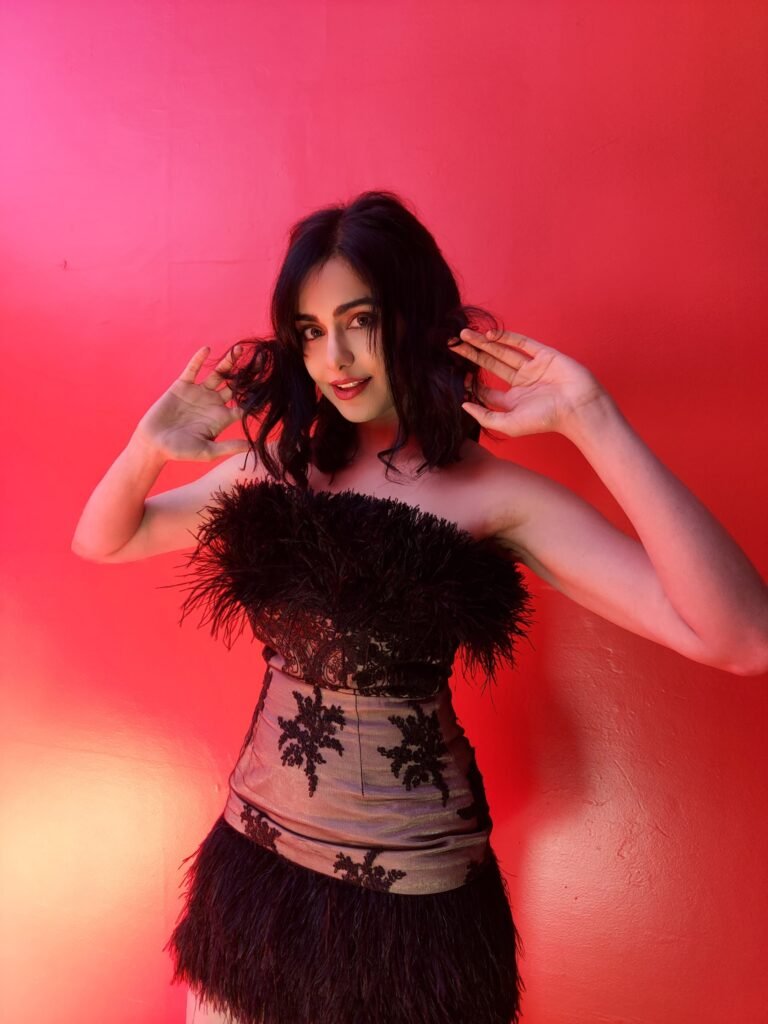

How do you approach choosing roles and projects? What factors do you consider?

Only intuition. I make sure I’m well fed, and my sugar levels are optimum, then I tap into my intuition and I know, Positively YES or Definitely NO! There’s never an in-between.

You have done a lot of films down South, any interesting projects in the pipeline?

Yes, several. I’m planning to clone myself first, want to do all of them and more.

What’s your take on OTT, OTT is now opening up opportunities for better roles and better performances…

I agree. With OTT more stuff is being made, and more actors are getting a chance. I’m very happy OTT exists; I hope all the talented actors get opportunities and raise the bar so high that mediocrity becomes obsolete.

In an industry where fates and people become obsolete every Friday, you have managed to ride the tide with your head held up high. Does the pressure ever get to you? What do you do to keep your mental health balanced?

To be honest I’m not sure one can be fully mentally balanced and stay around. I’m a little off and a little dead inside to stick around.  I like what I was doing over the past three years. I was getting to live roles that I enjoyed playing, all of them were so diverse. I like working without an end goal and plan that keeps me sane.

What advice would you give to aspiring actors who are just starting their journey in the industry?

For someone who isn’t from the industry, make sure your light shines so bright that they can’t help but notice you. You might get that one chance, so be ready for it. It sometimes might take a hundred years (for me from 1920 to 2023, literally a hundred) so keep at it, because when you get that one chance you should be ready to give it your all.

How do you stay motivated and inspired in your craft? Are there any specific sources or practices that fuel your creativity?

I try to keep my focus. If I’m peeling oranges, I do just that! If I’m solving puzzles, I don’t check my phone in between. If I’m playing the piano, it’s the piano alone. I’m not distracted; I’m listening to what they are saying. I think that keeps me inspired. I like learning new things that keep me fuelled too!

Finally, what keeps Adah going and what’s her biggest high?

The biggest high is being so real on screen that people don’t think it looks like an act. To make life and death real. And finally, to keep people entertained enough so they don’t have the urge to check their phones while watching what we have created on screen.

Blurbs:

I am overwhelmed by the incredible amount of respect and love I have received. I haven’t witnessed such immense support for a film in recent times. People have embraced this film as their own and actively promoted it. I am thrilled to be included in their celebration of success.

 I’m thrilled they have included me in their success think after debuting with a role like 1920 and doing some amazing stuff in the South too and now Kerala Story it would be really ungrateful for me to say I wish I were born in the womb of someone from the industry.

To be honest I’m not sure one can be fully mentally balanced and stay around in the film industry. I’m a little off and a little dead inside to stick around. 
Leave a comment

Your email address will not be published. Required fields are marked *

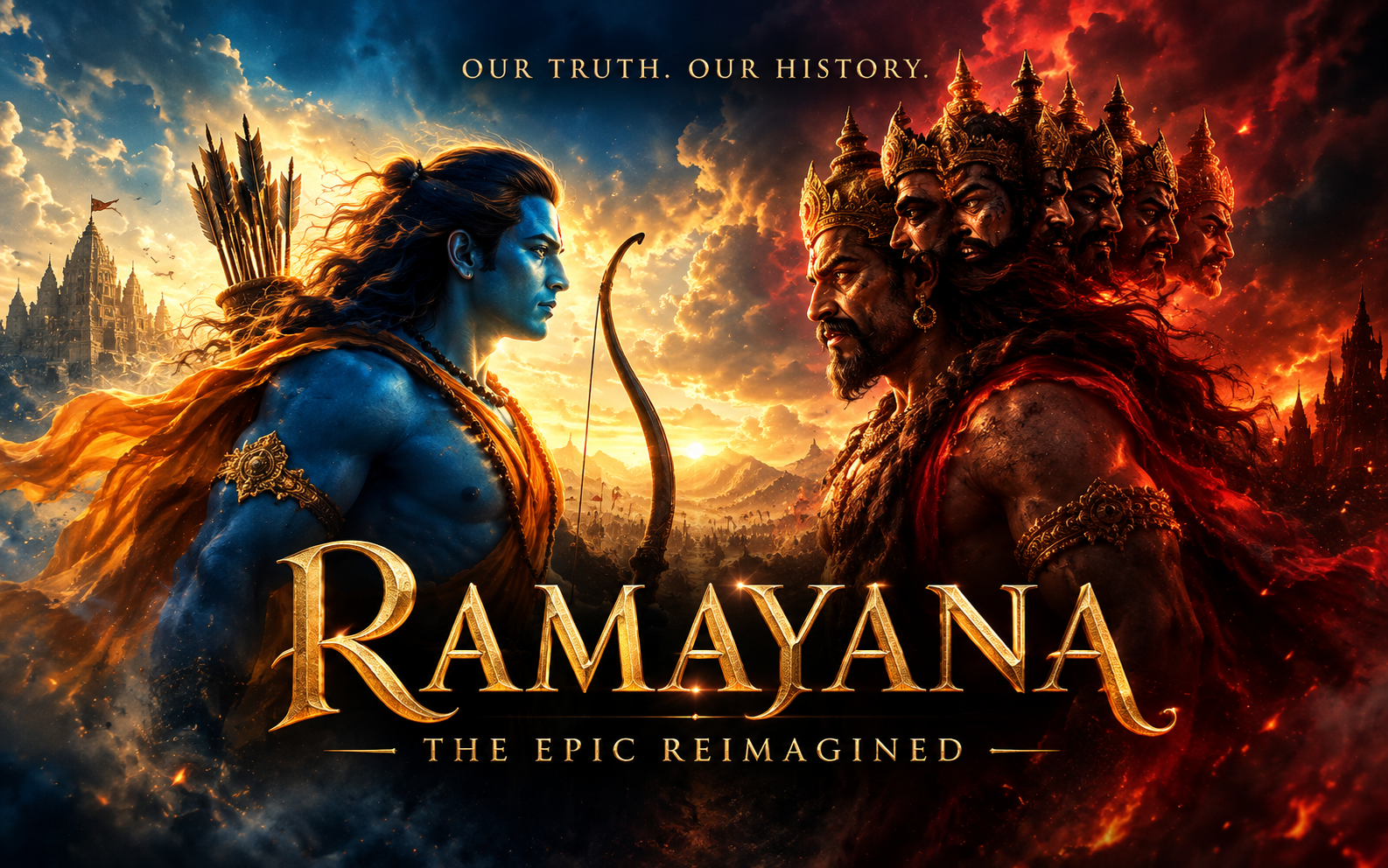
RAMAYANA: THE EPIC REIMAGINED

Ramayana: The Epic Reimagined is shaping up to be one of Indian cinema’s most ambitious productions, bringing together a star-studded cast and an international creative team. From its two-part format and reported ₹4,000-crore budget to its cutting-edge visual effects and global release plans, here are 10 things to know about the epic cinematic spectacle. 1.Two films, one epic Ramayana is planned as a two-part cinematic project. The first instalment is scheduled for release during Diwali 2026, with the second chapter planned for Diwali 2027. The films are directed by Nitesh Tiwari and produced by Namit Malhotra. Ranbir Kapoor has revealed that the team shot around six hours of footage for the first film before editing it down. A Chinese listing reportedly indicates a runtime of about 166 minutes for Part One. 2.Ranbir Kapoor as Rama: The first choice Ranbir Kapoor plays Lord Rama, amid years of speculation over other names. Mahesh Babu, Hrithik Roshan and Ram Charan were among the actors linked to various versions of the project. However, director Nitesh Tiwari and producer Namit Malhotra have clarified that Ranbir was always their first choice for their current Ramayana. Tiwari cited his physicality, screen presence and ability to convey emotion through his expressions. Interestingly, Yash, who plays Ravana, was also reportedly considered for Rama before taking on the antagonist. 3.Sai Pallavi is Sita Sai Pallavi plays Sita opposite Ranbir Kapoor’s Rama. The role marks a major Hindi-film project for the acclaimed South Indian actor and adds another prominent South Indian star to the cast alongside Yash. 4.A large ensemble cast An extensive ensemble supports the three leads. Sunny Deol plays Hanuman, Ravi Dubey plays Lakshman, Arun Govil plays Dasharath, Lara Dutta plays Kaikeyi, Indira Krishnan plays Kausalya, Kajal Aggarwal plays Mandodari, Rakul Preet Singh plays Shurpanakha, Kunal Kapoor plays Indra

Exclusive Interview: Nikhil Siddhartha on Swayambhu, Family and Politics

After the pan-India success of Karthikeya 2, Nikhil Siddhartha finds himself at a pivotal phase in his career. The actor is currently gearing up for the release of Swayambhu, one of the most ambitious projects he has undertaken to date, a historical action drama that demanded nearly two-and-a-half years of dedication, extensive physical transformation, and months of post-production work. In a candid conversation with Priyanka Goud, Nikhil opens up about the challenges of mounting a large-scale period film, why he prioritises quality over quantity, how fatherhood has changed his outlook on life, and his belief in using cinema as a tool for social awareness. A Two-and-a-Half-Year Commitment Describing Swayambhu as a project unlike any other in his career, Nikhil revealed that he dedicated nearly two and a half years exclusively to the film.“Some films are easy to make, and some are difficult. Swayambhu falls into the category of films that demand complete commitment. I underwent a significant transformation for the role, growing my hair long, maintaining a specific physique, and immersing myself in the character and story throughout the production period,” he said. A Historical Story with Universal Appeal One of the aspects that attracted Nikhil to Swayambhu was its historical backdrop. Nikhil plays Krishnan Raman, a historical figure whose name appears on ancient copper plate inscriptions that have recently gained attention. “This story is rooted in history, but its themes are universal,” he said. “It’s not confined to one region; audiences across India will be able to connect with it.” The actor also highlighted the growing importance of visual effects in modern filmmaking. Swayambhu reportedly contains nearly 2,700 VFX shots, making post-production one of the most demanding phases of the project. “We completed principal photography in December 2025, but for the last five to six months it has been

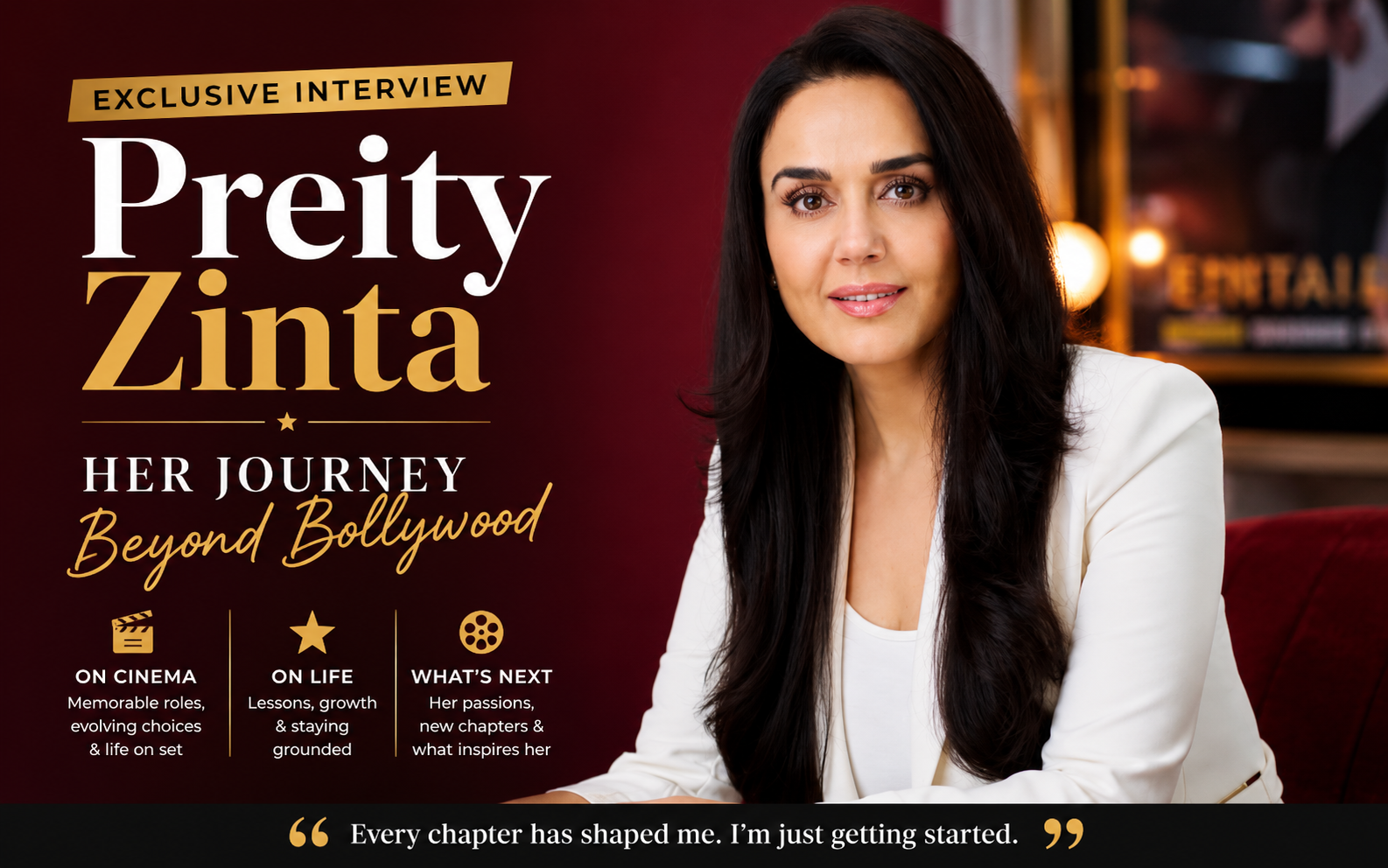
Preity Zinta on Batwara 1947, Motherhood and Finding Her Way Back to Cinema

For Preity Zinta, returning to the screen with Batwara 1947 is about more than making a comeback. The period drama allowed her to explore a chapter of India’s history, work with director Rajkumar Santoshi for the first time, and step into a world far removed from her own. But the film also made her reflect on how much life has changed since she began her career, from the freedoms available to women today to the perspective that comes with becoming a mother. For Zinta, Batwara 1947 is ultimately a story about family, resilience and hope, as she tells Lipika Varma in an exclusive conversation. Why did you say yes to doing this film? What touched you the most? There were a couple of things. First, I really wanted to work with Raj ji. I had never worked with him before, so working with him was always on my bucket list. I had also always wanted to do a period film. Beyond that, I genuinely loved the story. What touched me most was that even in the darkest of times, there is always a ray of hope. People may see this as a story about two countries, but for me, it is essentially about a family. I was also deeply affected by stories of families who believed they were leaving their homes temporarily, even burying their jewellery and valuables, thinking they would return. They never imagined they would lose everything forever. Since this is my first period film, I spent time researching and understanding that era. After such a long break from films, why did you choose this project? I was enjoying my personal life, focusing on my family and raising my children. Professionally, I had always wanted to work with Raj ji and also wanted to do a period film.

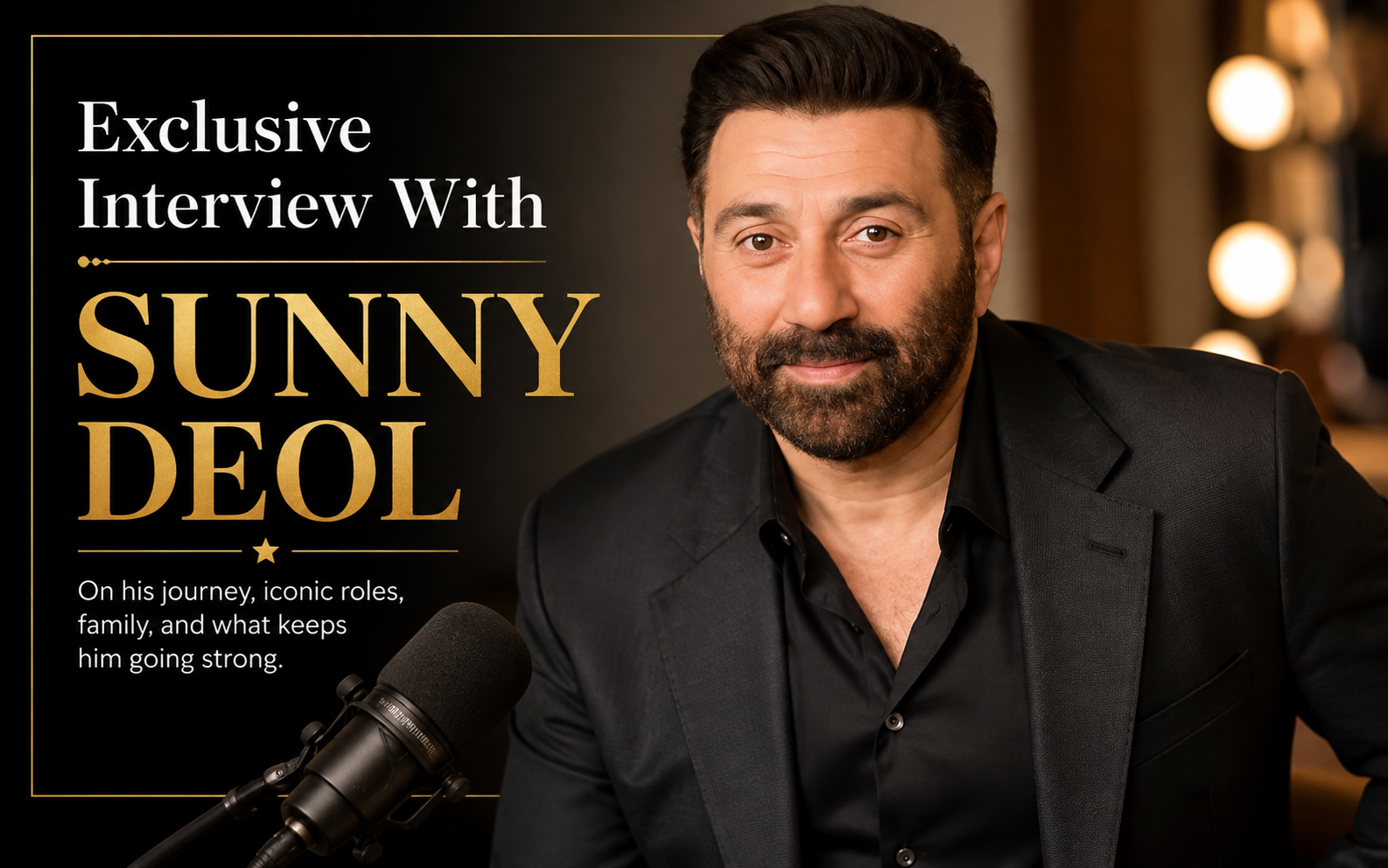
Exclusive Interview with Sunny Deol: Life Beyond Bollywood

Sunny Deol: “Every Film Leaves Some Kind of Impact” With Batwara 1947, Sunny Deol returns to a story rooted in Partition, family and the human cost of one of the most defining moments in Indian history. The actor reflects on why he sees the film as fundamentally different from Gadar, his long-standing association with director Rajkumar Santoshi, his father Dharmendra’s connection to their shared cinematic history, and the responsibility actors carry when their work leaves a lasting impact on audiences. In conversation with Lipika Varma, Sunny Deol also opens up about playing a character outside the action-driven image audiences often associate with him and working alongside his son Karan. How did you approach the character in this film? For me, it was the subject, the story and the character that I had heard about, and I approached it accordingly. I don’t know exactly what was tweaked. I didn’t read the original play or see it. Vivek Raj had read it, and we had been working on this story since 2010. Unfortunately, we couldn’t make it back then, so we had been waiting all these years. As soon as we got the opportunity, we jumped into it. Sunny, are you happy that your fans, including those in Pakistan, will get to see you in a completely different kind of role this time, without the iconic hand-pump moment or typical action scenes? Actually, I don’t think it’s about that. Fans are always there, and they love you no matter what. Sometimes journalism and politics come into the picture and change the colours of things. But the actual viewer, the person sitting in the theatre and watching the film, doesn’t necessarily look at things that way. They simply watch the film. I’ve met a lot of fans across the country and around the