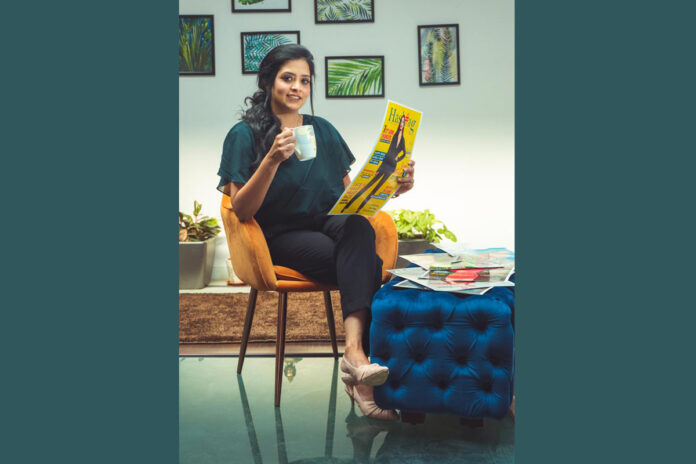
The lady behind India’s first digital magazine

How does a print journalist adapt and redefine digital journalism? A journalist, an Editor and now an entrepreneur, Sinduri Vuppala talks about redefining online reading with her venture, Hashtag Magazine and why digital is here to stay…

For a lifestyle journalist with over 16 years of experience with local and national magazines, where she decided the direction of the editorial slant, it was perhaps the next natural thing to start a magazine. But then, Sinduri Vuppala’s latest assignment is hardly everybody’s cup of chai. For one, Hashtag is India’s first and only digitally interactive magazine. Secondly, the images and stories are hyper realistic taking the reading experience to a hitherto unknown level, Harry Potter fans would be reminded of the newspaper of the wizarding world, The Daily Prophet.

Each time she heard of yet another big publication shut shop, she procrastinated on her idea. “I continued to persist on the idea that there were other people like me out there -people who still revelled in thick paper and sweet-smelling ink, not to mention thoughtful long-form journalism that take more than a couple of minutes and a smartphone camera to crank out…”

Enter 2020, and the whole world went upside down. Covid really was the final nail in the coffin for the print media, which was already dying a natural death.

“People stopped getting newspapers and overnight everything went digital, and information was all online. It also proves the speed with which digital works, you can reach about 60000 to a lakh people in a matter of hours (depending on your reach) in just a matter of minutes!” states Sinduri.

The founder who initially dabbled multiple ideas, hot upon the perfect combination via Hashtag. The magazine has both long-form and snippet-y kind of stories; it is pan-India in its scope and caters to a wide variety of audience. From arts to actors, dining out to travel and start-ups to hum interest stories, everything finds a place here. “We argued, we scoffed and after much trial and error we were proud to present Hashtag Magazine, India’s first Interactive Digital Magazine.”

The entrepreneur turned journalist agrees and adds, “We realized that people have a shorter attention span than we use to have. With a balance of video content and stories, we create an amalgamation that combines the exquisiteness, and perspective of a monthly print magazine with all the timeliness, approachability and interactivity of an online one. We are clear that we don’t want to be another Instagram page.”

The strategy is clearly working as within a year of its launch, the magazine has over lakh subscribers globally and over a million readers each month. With a target audience which is varied but is predominantly from the 18-45 years age band, the magazine has gotten its demographics right early on into the game.

Bringing out a magazine with no template for it involves a lot of trial and error.

Along with the technology part, everything else involved taking a gamble. Understanding content, figuring out a financial model and getting advertisers on board for what surely is a novel idea, wasn’t easy. But then, well begun is half done as they say, and Hashtag magazine is now firmly ensconced in the Indian media firmament. For someone from print media, is digital a completely different ball game? “Absolutely.” agrees the founder and adds, “It was like going back to college and learning a completely new gamut of things from keyword searches, SEO tools and other aspect of digital language. It’s not just designing a page and leaving at it.”

The digital world is extremely dynamic with things changing every minute but Sinduri says that though the job is difficult at the end of the day when the issue is signed off, there is a deep sense of content. “In print media, you understand your circulation and market but digital is a little different. However, when you see Salman Khan on the cover or a friend tagging you about a restaurant you raved and they loved, it all seems worthwhile.” 

Hashtag understands its audience clearly and has everything for someone. From food and shopping to travel and heritage, there is a wide gamut of stories, which are useful. With a team of 35 journalists across the country from the Himalayas to the Western Ghats and from Jaipur to Jabalpur, the content is brought by experienced and talented journalists who are passionate about their work.

“My copy editor sits in Delhi, journalists spread out all over the country and I’m in Hyderabad so it’s a completely virtual office. We just want to put out good and reliable content,” notes the founder. The focus currently is on improving their reach and reaching all corners of the country. “I think I’m a mix of an entrepreneur and a journalist. I possess the right mix of creativity and curiosity as a journalist and the determination of an entrepreneur. I have my fingers crossed,” she signs off.

This was originally first published on Republic News India.

Leave a comment

Your email address will not be published. Required fields are marked *

Srishti Gosavi: From Small-Town Roots to a Modern Voice in Finance

Srishti Gosavi’s story begins in a small town in Bihar and unfolds in Mumbai, where her father relocated as a first-generation businessman to secure better opportunities for his children. “I grew up watching my father take risks most people wouldn’t,” she says. While he built the business, her mother ensured stability at home, an equilibrium of courage and grounding that shaped Srishti’s worldview. Money, in her household, was never about indulgence. “It was always discussed in terms of responsibility, not luxury.” That framing became the foundation of her relationship with finance. Academically driven, she studied commerce at Narsee Monjee College and qualified as a Chartered Accountant. Yet, she credits her parents’ entrepreneurial grit more than her degrees for shaping her mindset. “Watching them build everything from scratch influenced how I think about security, risk, and independence.” Educator Before Influencer Srishti began her career in investment banking before moving into infrastructure finance, often finding herself the only woman in the room. She worked on large-scale debt deals and high-stakes transactions, but one realisation lingered: “Even highly educated people didn’t understand their own personal finances.” That gap unsettled her. In April 2023, she left her corporate role to translate complex financial systems into practical knowledge for everyday individuals. “Money affects everything, your peace, your choices, your confidence,” she explains. For her, financial literacy is not optional; it is foundational. “I’m a finance educator first. The influencer tag came later,” she states clearly. Making Finance Less Intimidating “In simple words, I make finance less scary,” she says. From home loans and credit scores to insurance, investing, and real estate, she simplifies concepts without overselling them. Her popular series, Dimaag Ka Dahi, focuses on untangling confusing financial jargon in relatable language. “I don’t glamorise money. I don’t sell shortcuts,” she emphasises. Instead, her advice

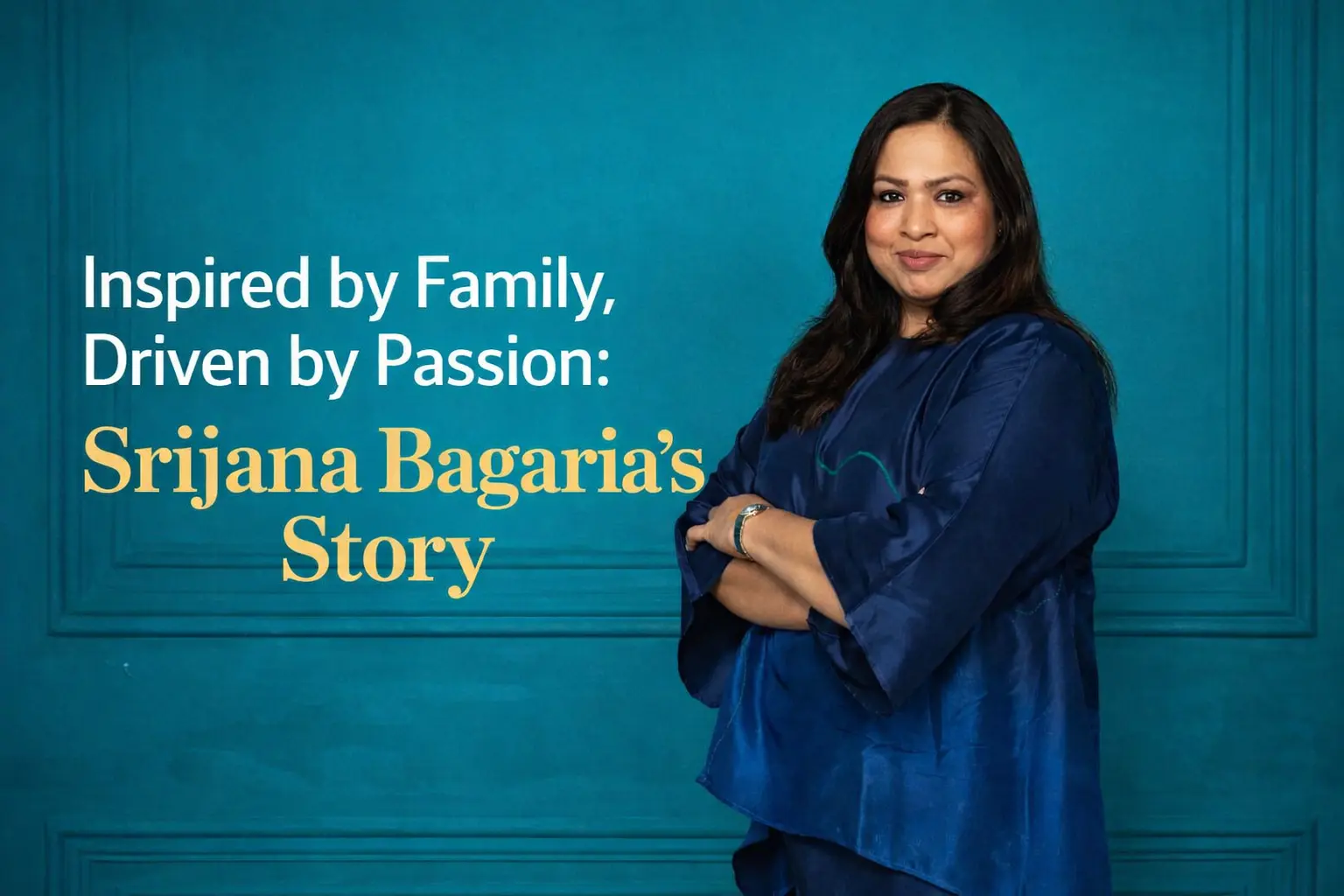
Inspired by Family, Driven by Passion: Srijana Bagaria’s Story

An Arts graduate from Calcutta, Srijana Bagaria was born into a family of entrepreneurs, where building and nurturing ideas was second nature. “Entrepreneurship has always felt instinctive to me,” she shares. Deeply inspired by her mother’s love for culinary arts, Srijana cultivated her own passion for food, eventually becoming a home chef and conducting sessions globally, a creative pursuit she continues to cherish. When her family moved to Delhi, she became closely involved in operational roles across ventures, supporting everything from daily management to international buyer meetings under SRV. “I’ve always believed in building from the ground up,” she says. A defining emotional shift came after the Nirbhaya incident. “It deeply moved us. It pushed us to think seriously about women’s safety and dignity.” That reflection laid the foundation for SafetyKart, and eventually, Pee Safe, blending empathy with enterprise. From Personal Pain to Public Solution “I see myself as an entrepreneur, but a chef at heart,” Srijana reflects. Creativity drives her, whether in the kitchen or in business. The idea for Pee Safe was born from lived experience. After suffering from a UTI, she and her partner realised how widespread yet under-addressed preventive hygiene was, particularly in public spaces. “We didn’t just see a business opportunity. We saw a real, everyday problem women had quietly accepted.” What stood out was the global nature of the gap; accessible, stigma-free hygiene solutions were missing across markets. For Srijana, building Pee Safe became about “comfort, confidence, and dignity in small but meaningful ways.” Entrepreneurship, she believes, must solve real problems, with empathy and purpose at its core. Women-First Innovation Srijana describes her role simply: “I build women-first solutions with a team that shares the same vision.” At Pee Safe, the focus spans life stages, from puberty to menopause, while normalising conversations around menstrual

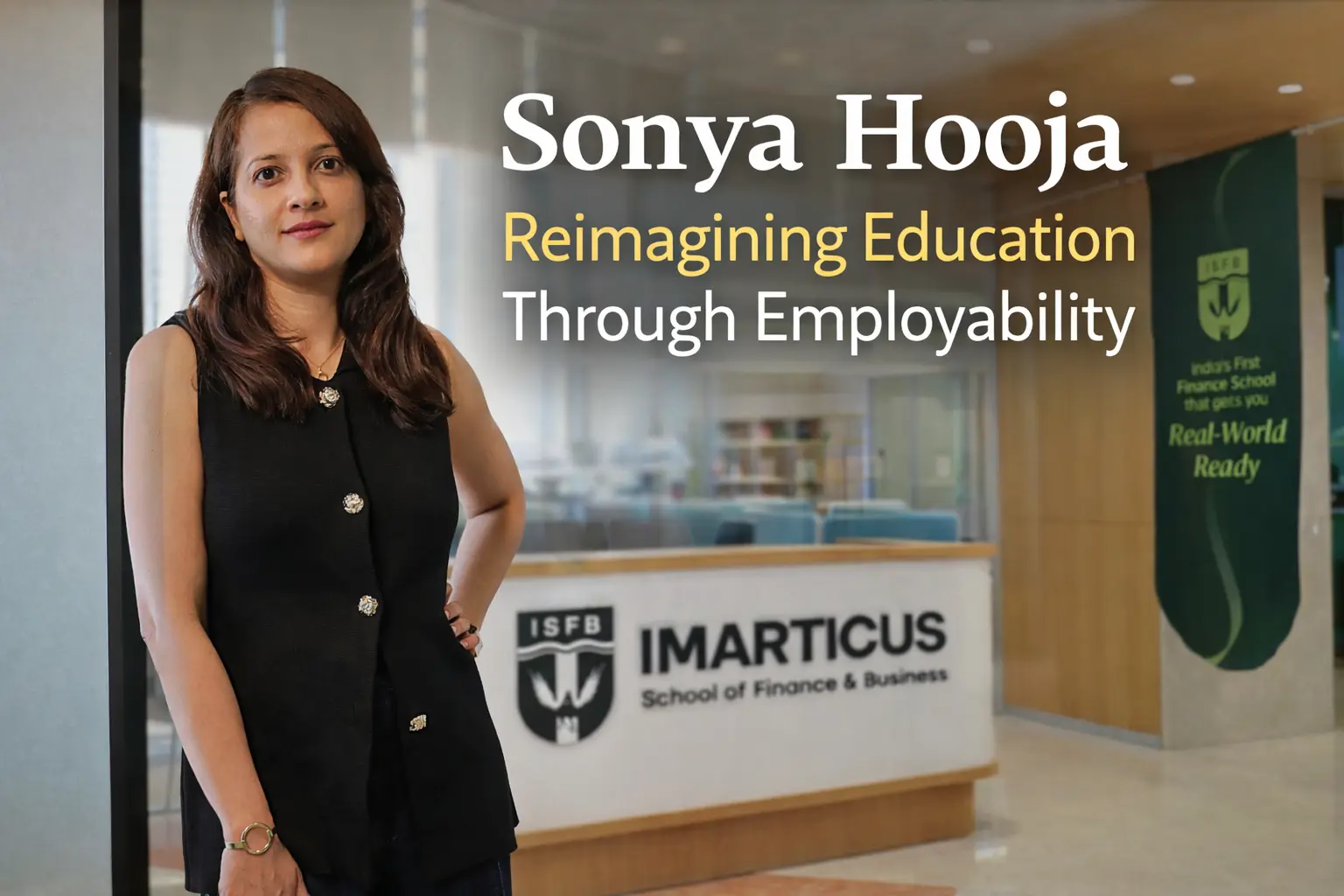
Sonya Hooja of Imarticus Learning | Education Meets Employability

Sonya Hooja brings a rare blend of global academic rigour and hands-on strategic consulting experience to India’s professional education ecosystem. A graduate of Rutgers University with an MBA from INSEAD, she spent nearly a decade as a strategy consultant with Accenture, Affiliated Computer Services, and Lehman Brothers across India, Southeast Asia, and the United States. During these years, she observed a persistent and costly disconnect. “Organizations were struggling to find workplace-ready professionals despite an abundance of qualified graduates,” she notes. The gap between academic credentials and job readiness was not incidental; it was systemic. That insight became the foundation of her entrepreneurial journey. Education Designed for Employability In 2012, Sonya co-founded Imarticus Learning with a fundamental question: “What if education started with employment needs rather than academic tradition?” Her conviction stemmed from firsthand experience of how traditional systems lagged behind rapidly evolving industries, particularly finance, analytics, and technology. For her, education is not about certificates alone. “It’s about giving people the tools to change their economic trajectory,” she says. Today, having impacted over 10,00,000 learners, she remains focused on career mobility at scale, whether that means enabling a Tier-2 city graduate to enter a Big Four firm or helping a mid-career professional transition into leadership. Outcome Ownership What distinguishes Sonya’s leadership philosophy is what she calls “outcome ownership.” “We don’t start with ‘what should people learn?’” she explains. “We start with ‘what do employers actually need, and how do we build that capability?’” This backward design model has translated into measurable outcomes, approximately one learner placed every hour, and certification pass rates that exceed industry benchmarks: CPA: 92% | ACCA: 72% | CFA: 57% | CMA: 51% Under her operational stewardship, Imarticus Learning has built what she describes as “the full learning arc.” Through initiatives like Imarticus Kickstarter, learners are

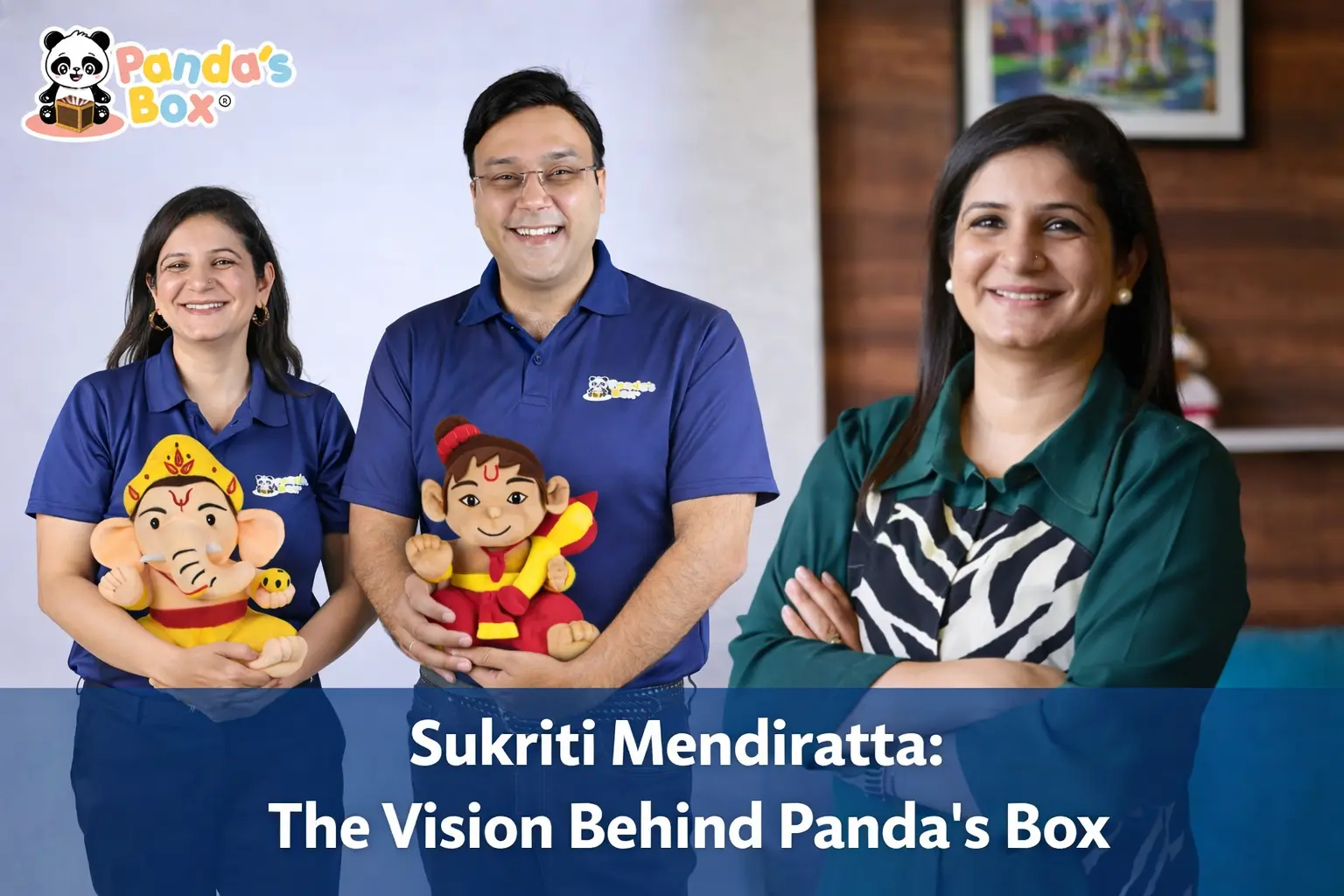
Sukriti Mendiratta: Founder of Panda’s Box

Sukriti Mendiratta is the founder of Panda’s Box, a Delhi-NCR-based direct-to-consumer children’s brand dedicated to culturally rooted, screen-free play. Armed with an MBA in Communications from the Symbiosis Institute of Media & Communication and a BA (Hons) in Journalism from Delhi College of Arts & Commerce, she brings both strategic thinking and storytelling expertise to her work. Her perspective is shaped as much by motherhood as by education. Growing up in a home where Indian stories, mantras, and traditions were woven into everyday life, she experienced firsthand the grounding power of culture. As a parent herself, she became increasingly aware of how quickly screens were replacing slow, meaningful childhood moments. Reclaiming Calm Childhoods Sukriti founded Panda’s Box to help families gently introduce Indian values and traditions during a child’s formative years. “Early childhood is the most powerful phase to build identity, confidence, and emotional security,” she believes. Her struggle to find non-digital, culturally relevant tools for her own child became the catalyst. She envisioned products that foster listening, repetition, touch, and shared experiences, calm alternatives to overstimulating digital content. Experience Over Stimulation With over 15 years of experience across brands like Cosmo First, Hyundai, Revlon, and Zydus Wellness, Sukriti combines corporate precision with maternal intuition. Panda’s Box is a pioneer of mantra-chanting toys in India and offers one of the most diverse collections of culturally rooted, screen-free products for children aged 0 to 6. Her philosophy is simple: play should nurture, not overwhelm. From Boardroom to Playroom Founded in April 2022, Panda’s Box emerged after Sukriti identified a clear gap in the market. Parents wanted to pass down values but lacked accessible tools. Schools didn’t address this space, and digital platforms often distracted more than they connected. Leaving behind a successful corporate career, she chose entrepreneurship, building tactile learning tools

You May Also Like

Connect with us