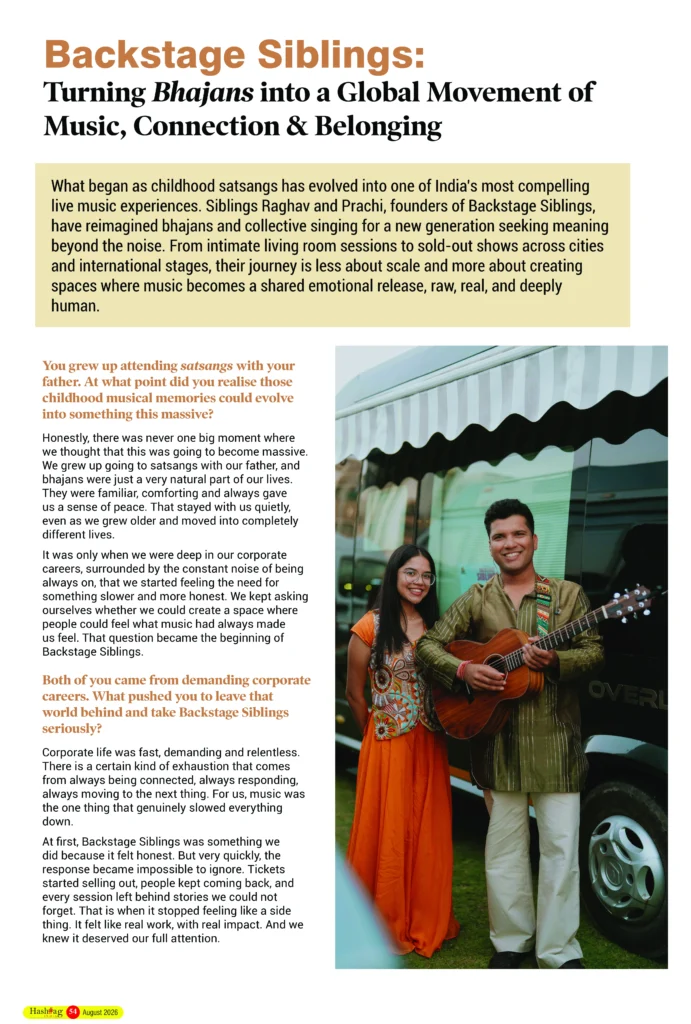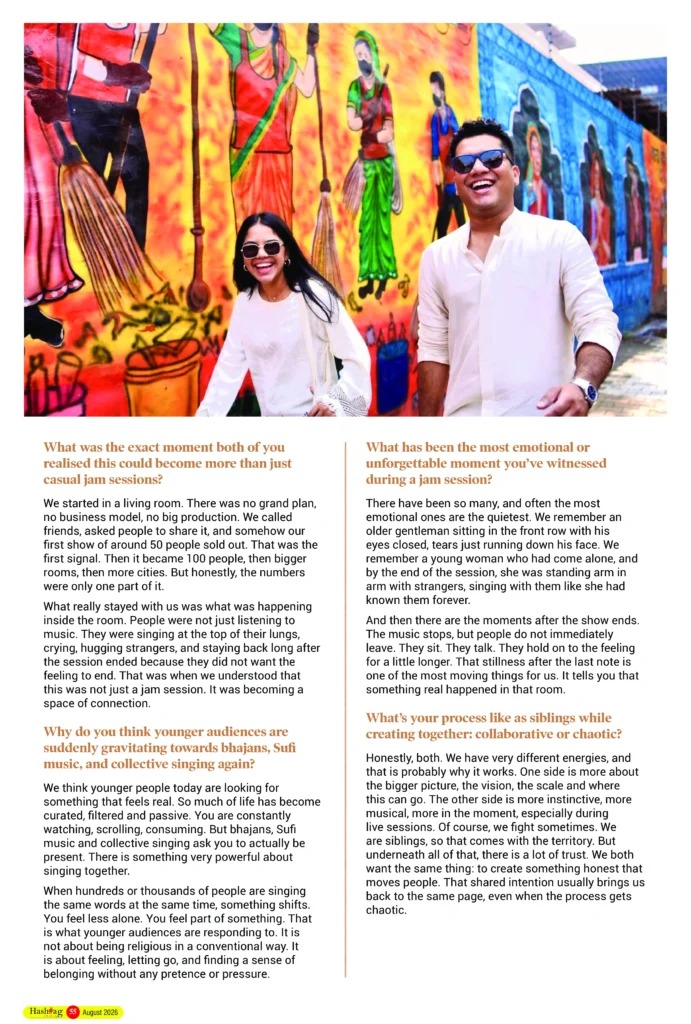
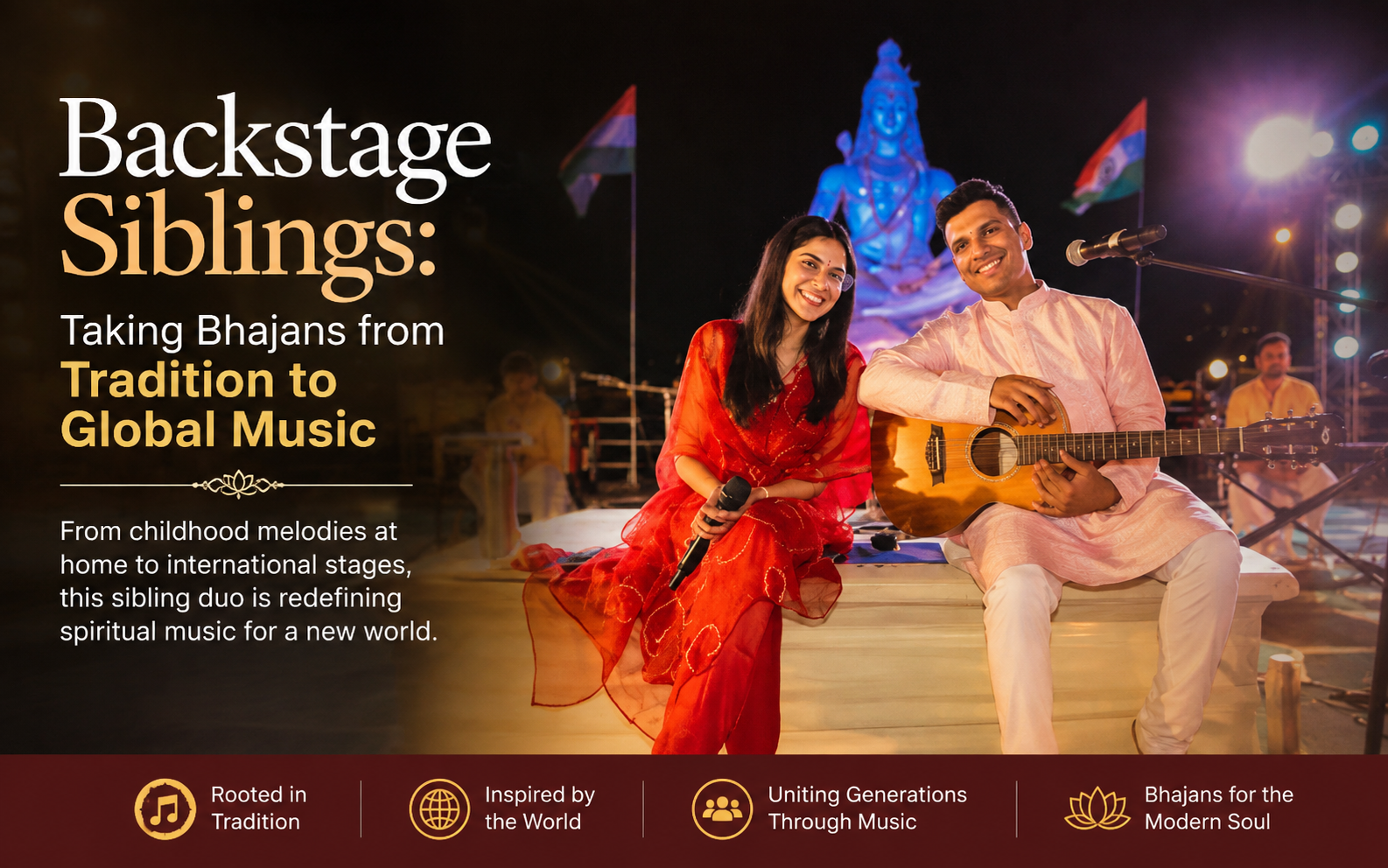
What began as childhood satsangs has evolved into one of India’s most compelling live music experiences. Siblings Raghav and Prachi, founders of Backstage Siblings, have reimagined bhajans and collective singing for a new generation seeking meaning beyond the noise. From intimate living room sessions to sold-out shows across cities and international stages, their journey is less about scale and more about creating spaces where music becomes a shared emotional release, raw, real, and deeply human.
You grew up attending satsangs with your father. At what point did you realise those childhood musical memories could evolve into something this massive?
Honestly, there was never one big moment where we thought that this was going to become massive. We grew up going to satsangs with our father, and bhajans were just a very natural part of our lives. They were familiar, comforting and always gave us a sense of peace. That stayed with us quietly, even as we grew older and moved into completely different lives.
It was only when we were deep in our corporate careers, surrounded by the constant noise of being always on, that we started feeling the need for something slower and more honest. We kept asking ourselves whether we could create a space where people could feel what music had always made us feel. That question became the beginning of Backstage Siblings.
Both of you came from demanding corporate careers. What pushed you to leave that world behind and take Backstage Siblings seriously?
Corporate life was fast, demanding and relentless. There is a certain kind of exhaustion that comes from always being connected, always responding, always moving to the next thing. For us, music was the one thing that genuinely slowed everything down.
At first, Backstage Siblings was something we did because it felt honest. But very quickly, the response became impossible to ignore. Tickets started selling out, people kept coming back, and every session left behind stories we could not forget. That is when it stopped feeling like a side thing. It felt like real work, with real impact. And we knew it deserved our full attention.
What was the exact moment both of you realised this could become more than just casual jam sessions?
We started in a living room. There was no grand plan, no business model, no big production. We called friends, asked people to share it, and somehow our first show of around 50 people sold out. That was the first signal. Then it became 100 people, then bigger rooms, then more cities. But honestly, the numbers were only one part of it.
What really stayed with us was what was happening inside the room. People were not just listening to music. They were singing at the top of their lungs, crying, hugging strangers, and staying back long after the session ended because they did not want the feeling to end. That was when we understood that this was not just a jam session. It was becoming a space of connection.
Why do you think younger audiences are suddenly gravitating towards bhajans, Sufi music, and collective singing again?
We think younger people today are looking for something that feels real. So much of life has become curated, filtered and passive. You are constantly watching, scrolling, consuming. But bhajans, Sufi music and collective singing ask you to actually be present. There is something very powerful about singing together.
When hundreds or thousands of people are singing the same words at the same time, something shifts. You feel less alone. You feel part of something. That is what younger audiences are responding to. It is not about being religious in a conventional way. It is about feeling, letting go, and finding a sense of belonging without any pretence or pressure.
What has been the most emotional or unforgettable moment you’ve witnessed during a jam session?
There have been so many, and often the most emotional ones are the quietest. We remember an older gentleman sitting in the front row with his eyes closed, tears just running down his face. We remember a young woman who had come alone, and by the end of the session, she was standing arm in arm with strangers, singing with them like she had known them forever.
And then there are the moments after the show ends. The music stops, but people do not immediately leave. They sit. They talk. They hold on to the feeling for a little longer. That stillness after the last note is one of the most moving things for us. It tells you that something real happened in that room.
What’s your process like as siblings while creating together: collaborative or chaotic?
Honestly, both. We have very different energies, and that is probably why it works. One side is more about the bigger picture, the vision, the scale and where this can go. The other side is more instinctive, more musical, more in the moment, especially during live sessions. Of course, we fight sometimes. We are siblings, so that comes with the territory. But underneath all of that, there is a lot of trust. We both want the same thing: to create something honest that moves people. That shared intention usually brings us back to the same page, even when the process gets chaotic.
Over 250 performances, 20+ cities, international shows, and crowds of nearly 10,000 people, how has your relationship with live music evolved over the past two years?
The scale has changed completely, but the feeling we are chasing has stayed the same. We started in living rooms. Today, we are performing in large venues with thousands of people. But the intention has not changed: floor seating, no alcohol, no distractions, everyone singing together. If anything, as the rooms have grown bigger, we have become even more protective of that feeling. We do not want the format to lose its intimacy just because the scale has grown.
What has evolved is our belief in the power of this experience. We have now seen it work across cities, age groups, and even outside India in places like Dubai and Singapore. It has made us realise that the need for genuine connection through music is universal.
Finally, how did it feel to be recognised by Prime Minister Narendra Modi on Mann Ki Baat? You’ve also performed for the Ambani family; tell us about these moments.
Being mentioned by the Prime Minister on Mann Ki Baat was surreal. We were building something we deeply believed in, but to have it recognised at that level, on a platform heard by millions, was extremely humbling. It made us feel that this was not just a small idea anymore. It had touched something much larger. Performing for the Ambani family was also an incredible honour.
Moments like these make you pause and think about where it all started: a living room, 50 people, and us calling everyone we knew to come for a jam. To go from there to rooms like that feels very special. More than anything, both moments reminded us that the work is real, and that this feeling we are trying to create is reaching people.
What next?
The next chapter is about taking Backstage Siblings global. We have already performed in Dubai and Singapore, and the response gave us a lot of confidence that this format can travel far beyond India. We are now looking at markets like the UK, the US and Australia, where we believe this experience can connect deeply, not only with Indian communities but with anyone looking for something genuine.
But for us, growth is not just about more cities or bigger venues. It is about deepening what the Backstage Siblings experience stands for. We want more people to know what it feels like to sing together, to enter a room full of strangers and leave feeling like you belong. That is what we are building towards.
Quick Takes:
- One song that instantly gets every crowd singing?
Achyutam Keshavam. The room always takes over with this one. - Most emotional city so far?
Honestly, every city has surprised us. - One artist you would love to jam with?
Honestly, love to jam with every artist out there, as every artist brings their own vibe, energy, and creativity to the table, and it would truly be an honour to create music with any of them. - Who’s more spontaneous during live sessions?
Raghav