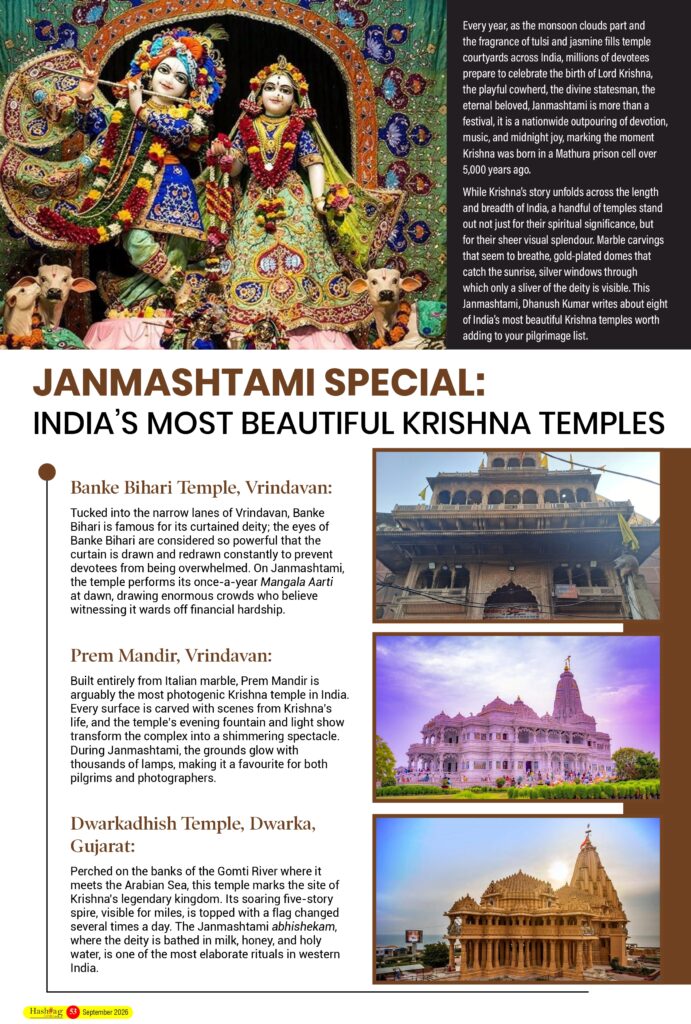
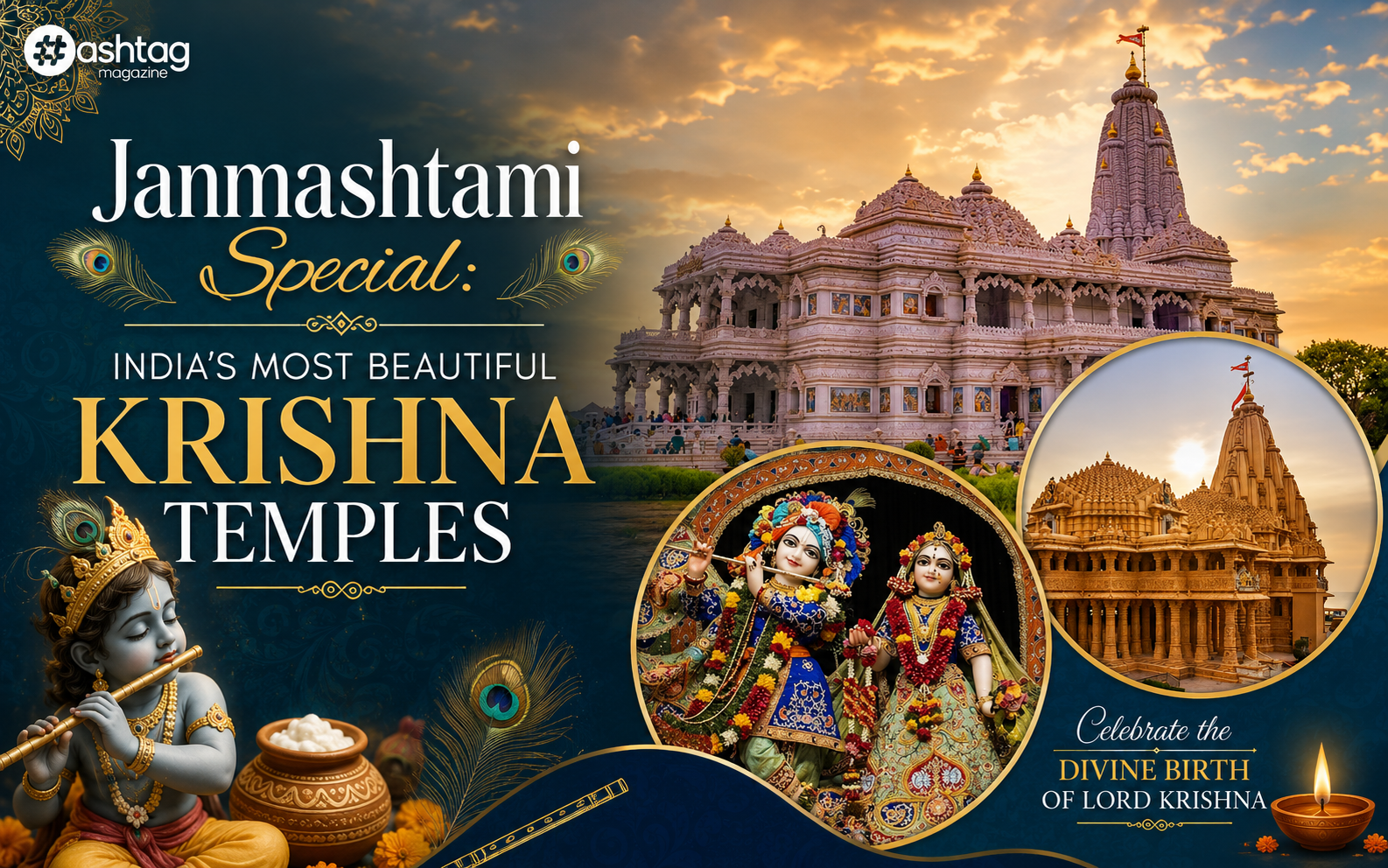
Every year, as the monsoon clouds part and the fragrance of tulsi and jasmine fills temple courtyards across India, millions of devotees prepare to celebrate the birth of Lord Krishna, the playful cowherd, the divine statesman, the eternal beloved, Janmashtami is more than a festival, it is a nationwide outpouring of devotion, music, and midnight joy, marking the moment Krishna was born in a Mathura prison cell over 5,000 years ago.
While Krishna’s story unfolds across the length and breadth of India, a handful of temples stand out not just for their spiritual significance, but for their sheer visual splendour. Marble carvings that seem to breathe, gold-plated domes that catch the sunrise, silver windows through which only a sliver of the deity is visible. This Janmashtami, Dhanush Kumar writes about eight of India’s most beautiful Krishna temples worth adding to your pilgrimage list.
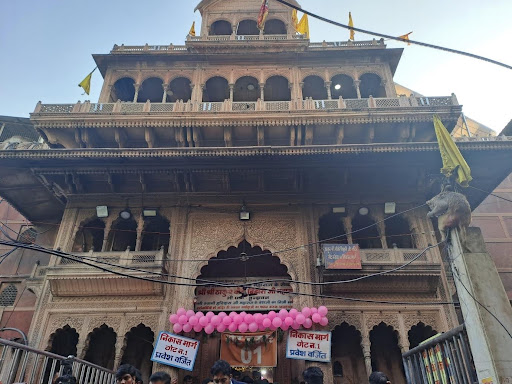
Banke Bihari Temple, Vrindavan: Tucked into the narrow lanes of Vrindavan, Banke Bihari is famous for its curtained deity; the eyes of Banke Bihari are considered so powerful that the curtain is drawn and redrawn constantly to prevent devotees from being overwhelmed. On Janmashtami, the temple performs its once-a-year Mangala Aarti at dawn, drawing enormous crowds who believe witnessing it wards off financial hardship.
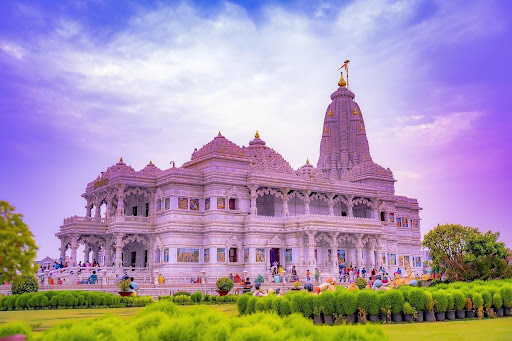
Prem Mandir, Vrindavan: Built entirely from Italian marble, Prem Mandir is arguably the most photogenic Krishna temple in India. Every surface is carved with scenes from Krishna’s life, and the temple’s evening fountain and light show transform the complex into a shimmering spectacle. During Janmashtami, the grounds glow with thousands of lamps, making it a favourite for both pilgrims and photographers.
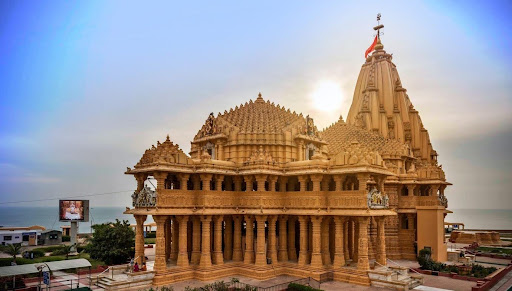
Dwarkadhish Temple, Dwarka, Gujarat: Perched on the banks of the Gomti River where it meets the Arabian Sea, this temple marks the site of Krishna’s legendary kingdom. Its soaring five-story spire, visible for miles, is topped with a flag changed several times a day. The Janmashtami abhishekam, where the deity is bathed in milk, honey, and holy water, is one of the most elaborate rituals in western India.
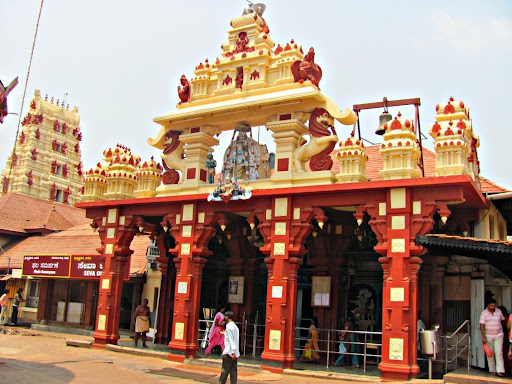
Udupi Sri Krishna Matha, Karnataka: Known as the Mathura of the South, this 13th-century temple founded by the saint-philosopher Madhvacharya has a quirk found nowhere else. Devotees view the deity not through a doorway but through a small silver window with nine holes, called the Navagraha Kitiki. Janmashtami here is a riot of chariot processions and folk performances that spill into the temple town’s streets.
Guruvayur Temple, Kerala: Called the “Dwarka of the South,” Guruvayur worships Krishna in his childlike form, Balakrishna. The temple’s gajapooja, where its resident elephants are ceremonially honoured, adds a uniquely Keralite dimension to its Janmashtami celebrations, alongside all-night devotional music and elaborate lamp displays.
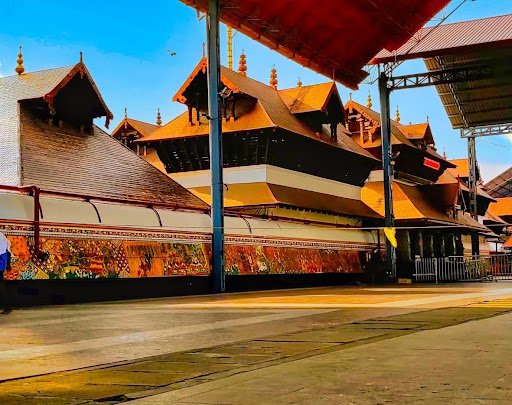
Shrinathji Temple, Nathdwara, Rajasthan- Set against the Aravalli hills, this temple enshrines Krishna in his seven-year-old form, Shrinathji, lifting Govardhan Hill. The deity’s daily darshans change eight times, each with its own elaborate attire and offerings, a living theatre of devotion. Janmashtami here blends Rajasthani folk music with centuries-old Pushtimarg rituals.
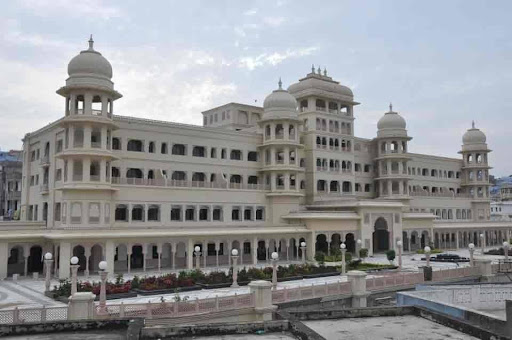
ISKCON Krishna-Balaram Mandir, Vrindavan: Built from white marble with intricately painted domes, this ISKCON flagship temple draws pilgrims from across the globe. It also houses the samadhi of Srila Prabhupada, founder of the Hare Krishna movement. Its Janmashtami festivities are famous for continuous kirtan, dramatic reenactments of Krishna’s birth, and a midnight abhishekam that international devotees travel thousands of miles to witness.
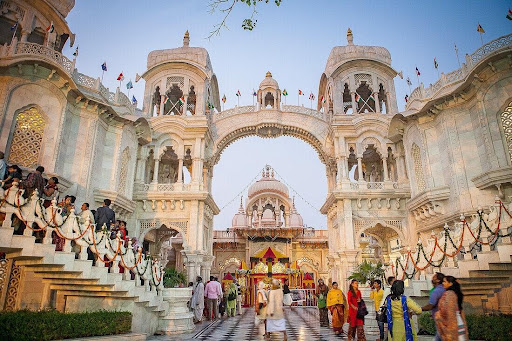
ISKCON Sri Sri Radha Madhamohan Mandir, Hyderabad: Tucked behind the bustle of Nampally Station Road and right opposite the iconic G.Pulla Reddy sweets, stands one of South India’s earliest ISKCON centres, established in the late 1970s. Its architecture blends a lotus-inspired modern design with traditional South Indian temple elements. The temple’s daily aartis and soulful kirtans have made it a spiritual anchor for the city, and Janmashtami transforms its courtyards into a glowing hub of devotional music, decorated swings for the infant Krishna, and long queues for prasadam that stretch late into the night.
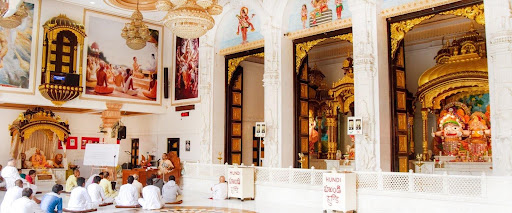
From the marble grandeur of Vrindavan to the silver-windowed sanctity of Udupi, and from the sea-facing spires of Dwarka to the quiet lotus-shaped courtyard in Hyderabad’s Abids, Krishna’s temples across India tell the same story in wonderfully different architectural languages. Each is a reminder that devotion, at its most beautiful, is never just heard or felt; it is also seen. This Janmashtami, whether you make the pilgrimage to Mathura or simply walk into your neighbourhood ISKCON temple, you’re stepping into a tradition of beauty and belief that has drawn devotees for centuries, and will likely draw many more for centuries to come.