This festive season, add a touch of gourmet to your celebrations with recipes straight from India’s chefs. Hashtag magazine offers chef-curated dishes that are perfect for family feasts or intimate gatherings. Easy to make and full of flavour here’s what should be on your festive menu.
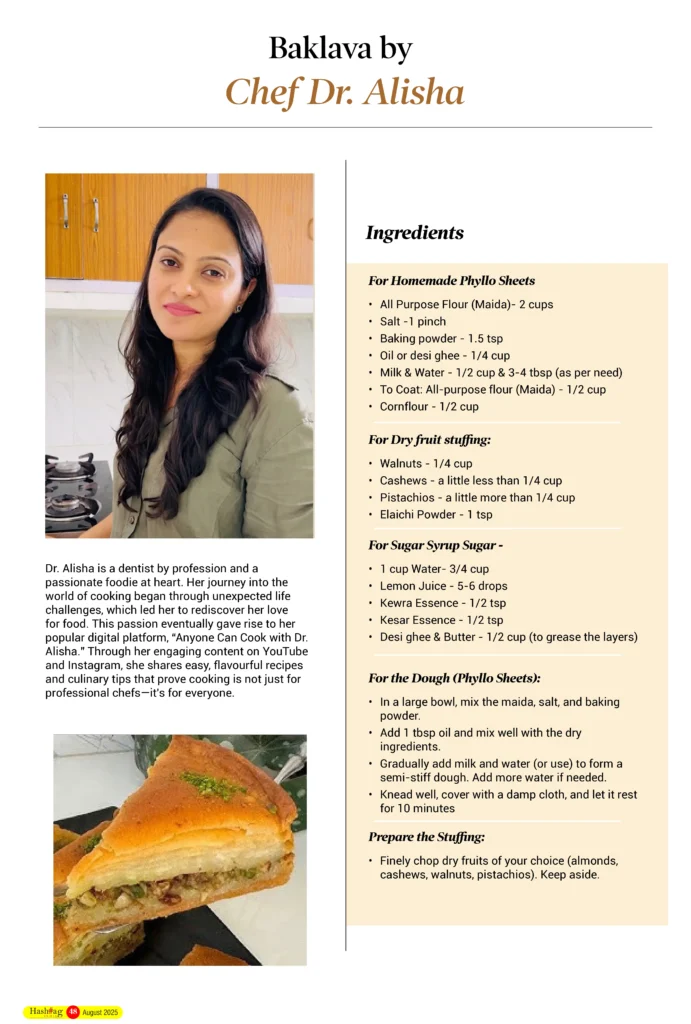
Baklava by Chef Dr. Alisha
Dr. Alisha is a dentist by profession and a passionate foodie at heart. Her journey into the world of cooking began through unexpected life challenges, which led her to rediscover her love for food. This passion eventually gave rise to her popular digital platform, “Anyone Can Cook with Dr. Alisha.” Through her engaging content on YouTube and Instagram, she shares easy, flavourful recipes and culinary tips that prove cooking is not just for professional chefs it’s for everyone.
Recipe:
Ingredients: For Homemade Phyllo Sheets
All Purpose Flour (Maida)– 2 cups
Salt -1 pinch
Baking powder – 1.5 tsp
Oil or desi ghee – 1/4 cup
Milk & Water – 1/2 cup & 3-4 tbsp (as per need)
To Coat: All-purpose flour (Maida) – 1/2 cup
Cornflour – 1/2 cup
For Dry fruit stuffing:
Almonds – 1/2 cup
Walnuts – 1/4 cup
Cashews – a little less than 1/4 cup
Pistachios – a little more than 1/4 cup
Elaichi Powder – 1 tsp
For Sugar Syrup Sugar –
1 cup Water- 3/4 cup
Lemon Juice – 5-6 drops
Kewra Essence – 1/2 tsp
Kesar Essence – 1/2 tsp
Desi ghee & Butter – 1/2 cup (to grease the layers)
For the Dough (Phyllo Sheets):
- In a large bowl, mix the maida, salt, and baking powder.
- Add 1 tbsp oil and mix well with the dry ingredients.
- Gradually add milk and water (or use) to form a semi-stiff dough. Add more water if needed.
- Knead well, cover with a damp cloth, and let it rest for 10 minutes.
Prepare the Stuffing:
- Finely chop dry fruits of your choice (almonds, cashews, walnuts, pistachios). Keep aside.
Make Phyllo Sheets:
- Mix all-purpose flour and cornflour to prepare a dry flour mix for dusting.
- Divide the rested dough into 22 equal balls, cover with a damp cloth.
- Roll out each ball into a roti-sized sheet, dusting with dry flour to prevent sticking.
- Stack the rolled sheets, dusting flour between each. Make 2 bundles of 11 sheets.
- Take one bundle and roll the stack out as thinly as possible.
- Gently separate the sheets—thanks to the flour dusting, they should come apart easily.
- Repeat the same for the second bundle. Your homemade phyllo sheets are ready.
Assemble the Baklava:
- Grease an 8-inch square or round baking dish with butter or desi ghee (or both).
- Layer 11 phyllo sheets in the dish, greasing each one before placing the next.
- Spread the dry fruit filling evenly over the layered sheets.
- Cover with the remaining 11 phyllo sheets, greasing each one as you stack.
- Grease the top layer and bake in a preheated oven at 180°C for 45–50 minutes.
Prepare the Sugar Syrup:
- In a saucepan, combine sugar and water.
- Add a few drops of lemon juice and essence of your choice (e.g., kewra, saffron).
- Boil until the sugar completely dissolves. Remove from heat and set aside.
Final Steps:
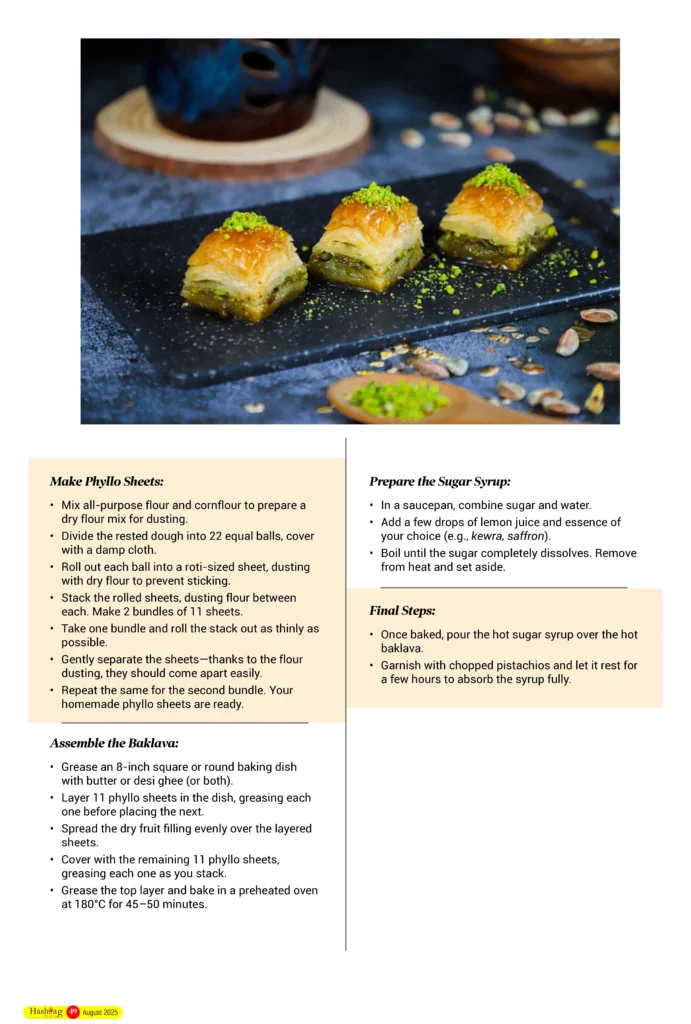
- Once baked, pour the hot sugar syrup over the hot baklava.
- Garnish with chopped pistachios and let it rest for a few hours to absorb the syrup fully.
Saffron & Rose Fusion Modak by Chef Pawan Kumar
Chef Pawan Kumar, Executive Chef at Radisson Blu Pune Hinjawadi, brings over 20 years of culinary expertise to the table. Known for his inventive take on traditional Indian fare, he blends global techniques with regional roots to craft recipes that are both nostalgic and refreshingly modern. He shares his signature recipe of the classic modak with a delicate and aromatic spin.
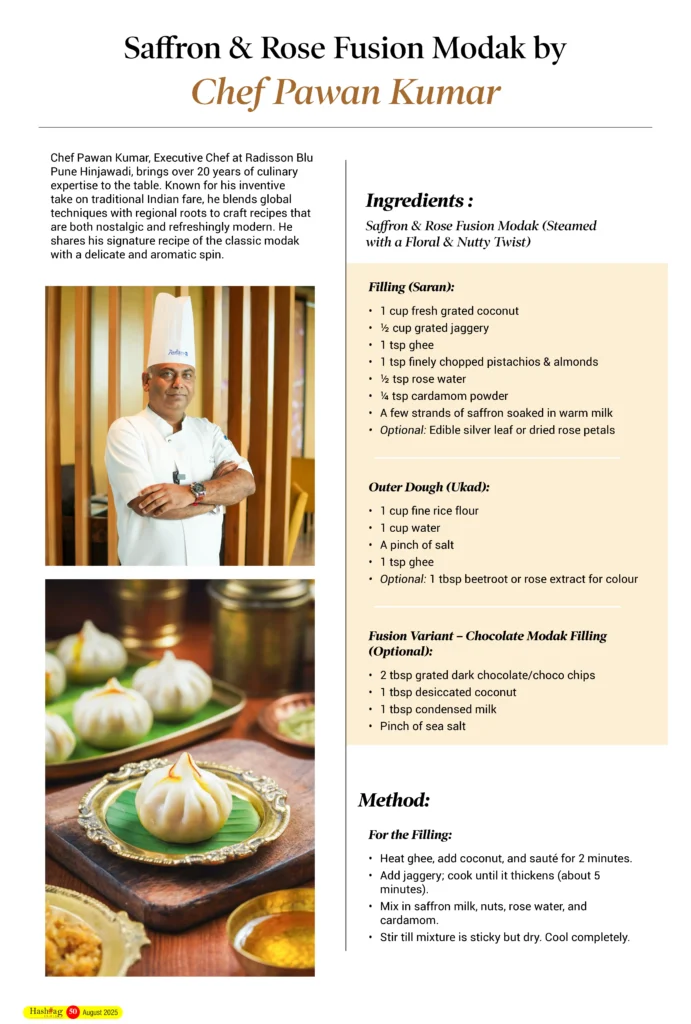
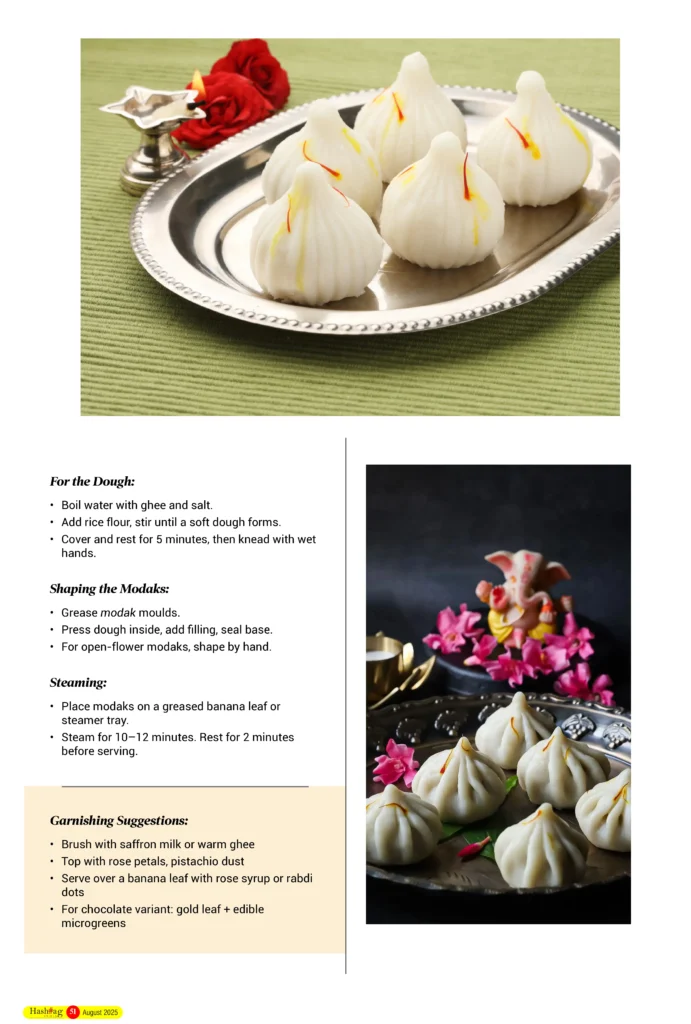
Saffron & Rose Fusion Modak (Steamed with a Floral & Nutty Twist)
Filling (Saran):
- 1 cup fresh grated coconut
- ½ cup grated jaggery
- 1 tsp ghee
- 1 tsp finely chopped pistachios & almonds
- ½ tsp rose water
- ¼ tsp cardamom powder
- A few strands of saffron soaked in warm milk
- Optional: Edible silver leaf or dried rose petals
Outer Dough (Ukad):
- 1 cup fine rice flour
- 1 cup water
- A pinch of salt
- 1 tsp ghee
- Optional: 1 tbsp beetroot or rose extract for colour
Fusion Variant – Chocolate Modak Filling (Optional):
- 2 tbsp grated dark chocolate/choco chips
- 1 tbsp desiccated coconut
- 1 tbsp condensed milk
- Pinch of sea salt
Method:
For the Filling:
- Heat ghee, add coconut, and sauté for 2 minutes.
- Add jaggery; cook until it thickens (about 5 minutes).
- Mix in saffron milk, nuts, rose water, and cardamom.
- Stir till mixture is sticky but dry. Cool completely.
For the Dough:
- Boil water with ghee and salt.
- Add rice flour, stir until a soft dough forms.
- Cover and rest for 5 minutes, then knead with wet hands.
Shaping the Modaks:
- Grease modak moulds.
- Press dough inside, add filling, seal base.
- For open-flower modaks, shape by hand.
Steaming:
- Place modaks on a greased banana leaf or steamer tray.
- Steam for 10–12 minutes. Rest for 2 minutes before serving.
Garnishing Suggestions:
- Brush with saffron milk or warm ghee
- Top with rose petals, pistachio dust
- Serve over a banana leaf with rose syrup or rabdi dots
- For chocolate variant: gold leaf + edible microgreens
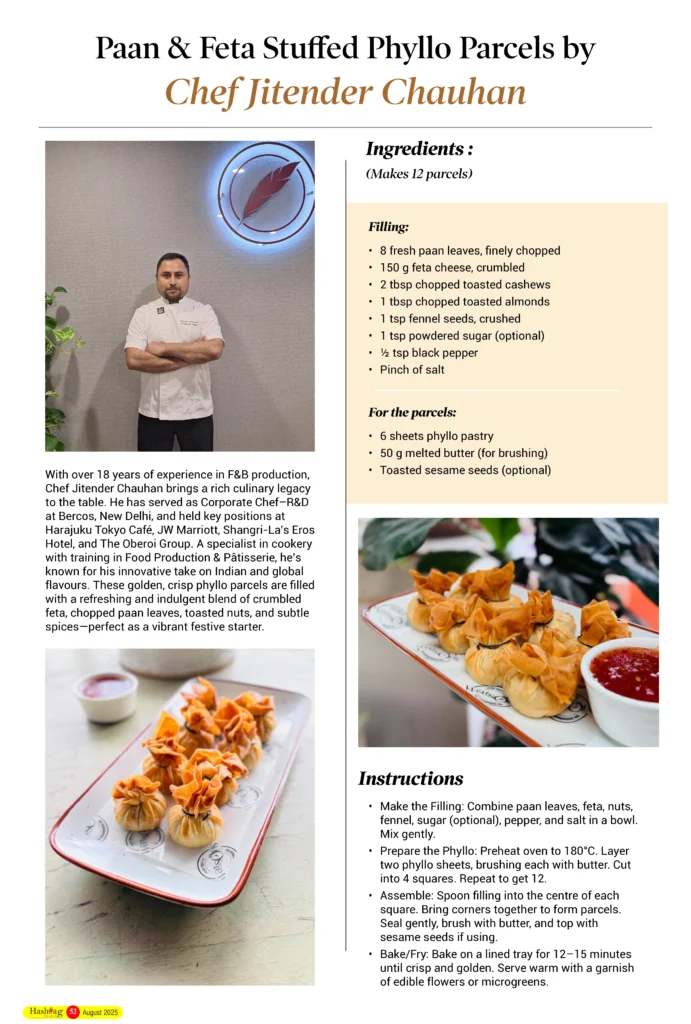
Paan & Feta Stuffed Phyllo Parcels by Chef Jitender Chauhan:
With over 18 years of experience in F&B production, Chef Jitender Chauhan brings a rich culinary legacy to the table. He has served as Corporate Chef–R&D at Bercos, New Delhi, and held key positions at Harajuku Tokyo Café, JW Marriott, Shangri-La’s Eros Hotel, and The Oberoi Group. A specialist in cookery with training in Food Production & Pâtisserie, he’s known for his innovative take on Indian and global flavours. These golden, crisp phyllo parcels are filled with a refreshing and indulgent blend of crumbled feta, chopped paan leaves, toasted nuts, and subtle spices—perfect as a vibrant festive starter.
Ingredients (Makes 12 parcels)
Filling:
- 8 fresh paan leaves, finely chopped
- 150 g feta cheese, crumbled
- 2 tbsp chopped toasted cashews
- 1 tbsp chopped toasted almonds
- 1 tsp fennel seeds, crushed
- 1 tsp powdered sugar (optional)
- ½ tsp black pepper
- Pinch of salt
For the parcels:
- 6 sheets phyllo pastry
- 50 g melted butter (for brushing)
- Toasted sesame seeds (optional)
Instructions
- Make the Filling: Combine paan leaves, feta, nuts, fennel, sugar (optional), pepper, and salt in a bowl. Mix gently.
- Prepare the Phyllo: Preheat oven to 180°C. Layer two phyllo sheets, brushing each with butter. Cut into 4 squares. Repeat to get 12.
- Assemble: Spoon filling into the centre of each square. Bring corners together to form parcels. Seal gently, brush with butter, and top with sesame seeds if using.
- Bake/Fry: Bake on a lined tray for 12–15 minutes until crisp and golden. Serve warm with a garnish of edible flowers or microgreens.
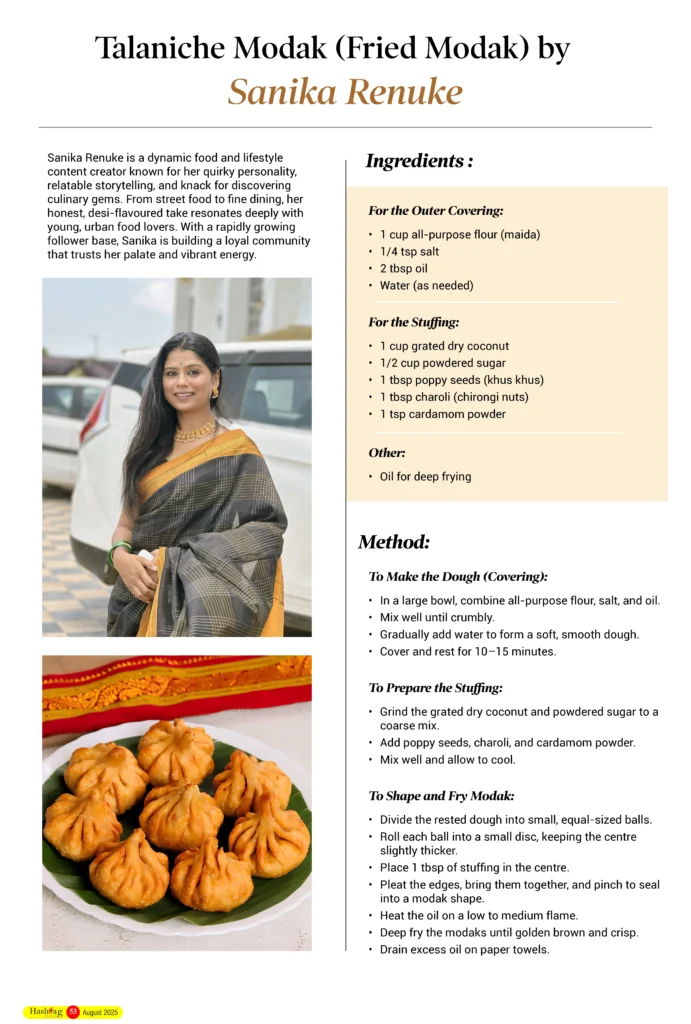
Talaniche Modak (Fried Modak) by Sanika Renuke
Sanika Renuke is a dynamic food and lifestyle content creator known for her quirky personality, relatable storytelling, and knack for discovering culinary gems. From street food to fine dining, her honest, desi-flavoured take resonates deeply with young, urban food lovers. With a rapidly growing follower base, Sanika is building a loyal community that trusts her palate and vibrant energy.
Ingredients
For the Outer Covering:
- 1 cup all-purpose flour (maida)
- 1/4 tsp salt
- 2 tbsp oil
- Water (as needed)
For the Stuffing:
- 1 cup grated dry coconut
- 1/2 cup powdered sugar
- 1 tbsp poppy seeds (khus khus)
- 1 tbsp charoli (chirongi nuts)
- 1 tsp cardamom powder
Other:
- Oil for deep frying
Method of Preparation
To Make the Dough (Covering):
- In a large bowl, combine all-purpose flour, salt, and oil.
- Mix well until crumbly.
- Gradually add water to form a soft, smooth dough.
- Cover and rest for 10–15 minutes.
To Prepare the Stuffing:
- Grind the grated dry coconut and powdered sugar to a coarse mix.
- Add poppy seeds, charoli, and cardamom powder.
- Mix well and allow to cool.
To Shape and Fry Modak:
- Divide the rested dough into small, equal-sized balls.
- Roll each ball into a small disc, keeping the centre slightly thicker.
- Place 1 tbsp of stuffing in the centre.
- Pleat the edges, bring them together, and pinch to seal into a modak shape.
- Heat the oil on a low to medium flame.
- Deep fry the modaks until golden brown and crisp.
- Drain excess oil on paper towels.
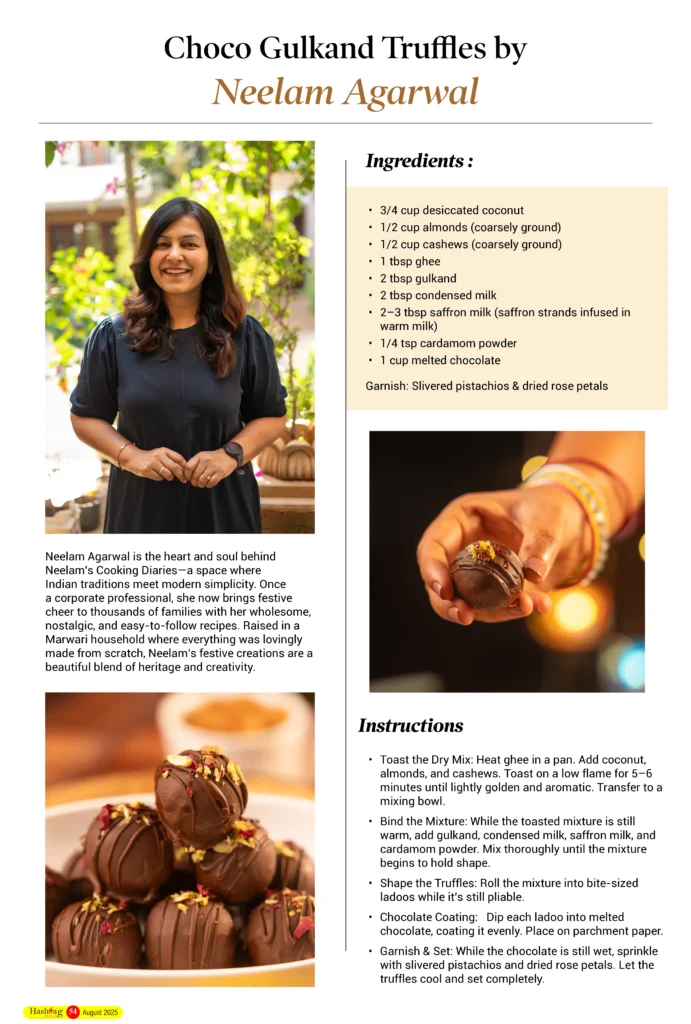
Choco Gulkand Truffles by Neelam Agarwal
Neelam Agarwal is the heart and soul behind Neelam’s Cooking Diaries a space where Indian traditions meet modern simplicity. Once a corporate professional, she now brings festive cheer to thousands of families with her wholesome, nostalgic, and easy-to-follow recipes. Raised in a Marwari household where everything was lovingly made from scratch, Neelam’s festive creations are a beautiful blend of heritage and creativity.
Ingredients
- 3/4 cup desiccated coconut
- 1/2 cup almonds (coarsely ground)
- 1/2 cup cashews (coarsely ground)
- 1 tbsp ghee
- 2 tbsp gulkand
- 2 tbsp condensed milk
- 2–3 tbsp saffron milk (saffron strands infused in warm milk)
- 1/4 tsp cardamom powder
- 1 cup melted chocolate
Garnish: Slivered pistachios & dried rose petals
Instructions
- Toast the Dry Mix: Heat ghee in a pan. Add coconut, almonds, and cashews. Toast on a low flame for 5–6 minutes until lightly golden and aromatic. Transfer to a mixing bowl.
- Bind the Mixture: While the toasted mixture is still warm, add gulkand, condensed milk, saffron milk, and cardamom powder. Mix thoroughly until the mixture begins to hold shape.
- Shape the Truffles: Roll the mixture into bite-sized ladoos while it’s still pliable.
- Chocolate Coating: Dip each ladoo into melted chocolate, coating it evenly. Place on parchment paper.
- Garnish & Set: While the chocolate is still wet, sprinkle with slivered pistachios and dried rose petals. Let the truffles cool and set completely.