Good food, when coupled with great ambience,makes for a story to tell. Modern restaurants may have insta-worthy decor as their selling point, but the real experience lies in exploring history, such as that found in restaurants with private cabins in Kolkata. While taking a stroll along the old dingy lanes of North Kolkata, MADHURIMA CHAKRABORTY discovers several dilapidated eating joints, which, despite the primordial look, remit an inexplicable aroma of fried breadcrumbs, fish and meat. We invite you to take a trip down these choice lanes and discover timeless restaurants with private cabins in Kolkata.
The cabin restaurants of Kolkata were the ubiquitous meeting point of lovers in the early twentieth century. Anjan Dutt’s iconic lyrics of the song Bela Bose evokes unfathomable nostalgia in every Kolkatan’s mind. He reminds his lover of the promises made during the adventurous cabin visits, and that life is transient. This phase of separation would eventually give way to a small home in the suburb made with love, as soon as the man secures employment!


The giant real estate sharks have been lurking to gulp down the prized location of these long-standing restaurants with private cabins in Kolkata. However, the owners have resisted, and how! Traditionally the old-school cabins featured small cubicles parted with wooden barricades and were guarded with velvet curtains in matte ruby hue. Inside, it is warm and cosy and dainty, but more than anything, it creates an illusion of the much-coveted privacy! A dash of Kasundi, a mustard relish is served on the side of fish or meat, with a handful of sliced onions and cucumbers, adding to the zing. On a good day, you can even stumble upon a basket full of duck eggs. The chef will prepare an egg devil by wrapping those duck eggs with a spicy mix of mutton keema.
Multiple literary references have credited the cabin restaurants to be the unequivocal meeting point of lovers in the era bygone
With surges in carnal emotion, along came revolutionary ideas. All of these cabin restaurants date back to the era of British Raj, albeit the last lag of it. In the dwindling political environment, defiance and resistance brewed. The Kolkata cabins paved the way for political debates storming over countless cups of tea and progressive ideas. Much of the ideas would continue to shape the politics of Indian subcontinent in the tumultuous days leading to independence and partition.
Their loyal clientele has not been deterred by the menacing pandemic. Whether it is the phenomenal quality of food, or the deeply ingrained cultural identity of Kolkata’s Bhadralok community, the cabins remain relevant even in 2021, amid the otherwise nonchalant crowd of the world wide web, Instagram-worthy cafes, relentless branding, buffets and more flukes. Our homecoming remains incomplete without an egg devil from Niranjan Agar or a pure Calcutta bhetki fry from Chittoda’s at Decker’s Lane!
Mitra Cafe, Shovabazar
47, Jatindra Avenue, Shobha Bazar, Kolkata
Hours: 3 PM to 10 PM
Meal for two: Rs 400
Running at a glorious 101 years, Mitra Cafe of Shovabazar has no contender when it comes to the famed brain chops. The unique item is prepared with goat brain, spiced up with ginger-garlic paste and kebabchini. Ample amount of black pepper goes into the heirloom recipe, adding to the spice. Further, it is breadcrumbed and deep fried.
The tiny eatery serves freshly baked bread toast smeared with butter and milky tea with a thick layer of cream during early hours. As the day progresses, Mitra Cafe’s kitchen serves some of the tastiest cutlets in town. With changing times, Chinese items have been incorporated into the menu. The likes of Soumita Chatterjee and Anjun Dutt from Tollywood had been regulars at Mitra Cafe.
Country chicken cooked in fiery hot red curry, chicken pakoras infused with the aroma of Gandhoraj lime, fish munia (an abbreviation of the legendary fish meuniere), fish Afghani are some of the best things to eat at Mitra Cafe.
Allen Kitchen, Shovabazar
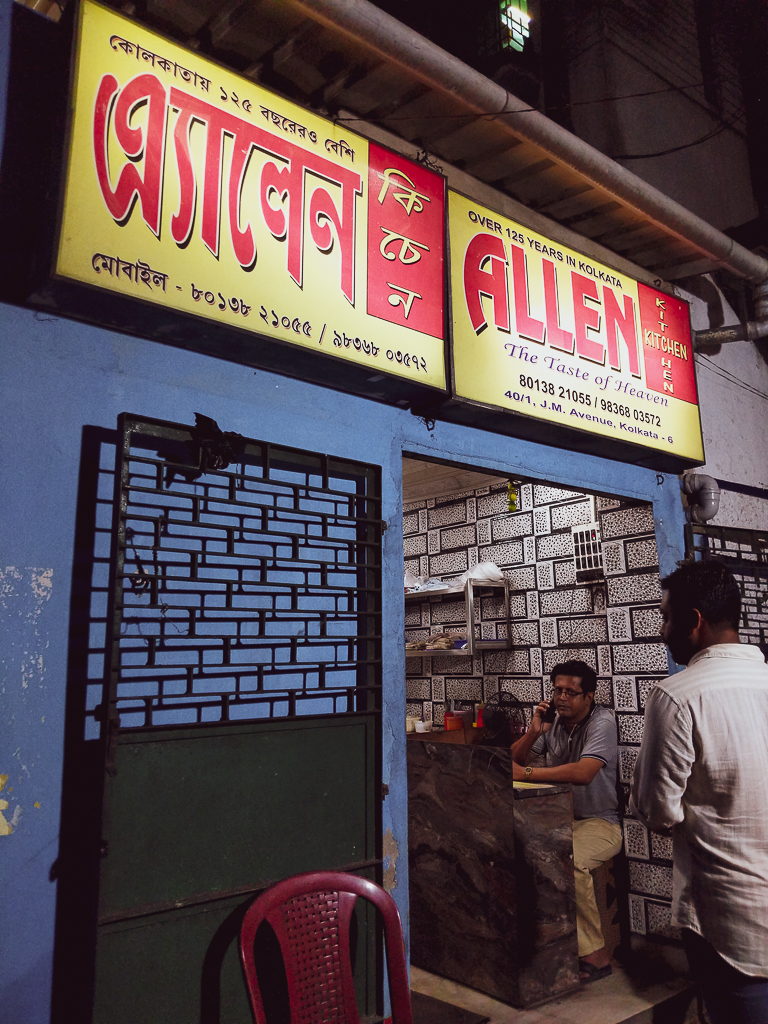
40/1, Jatindra Mohan Avenue, Shobha Bazar, Kolkata
Hours: 4:30 PM to 9:30 PM
Meal for two: Rs 300
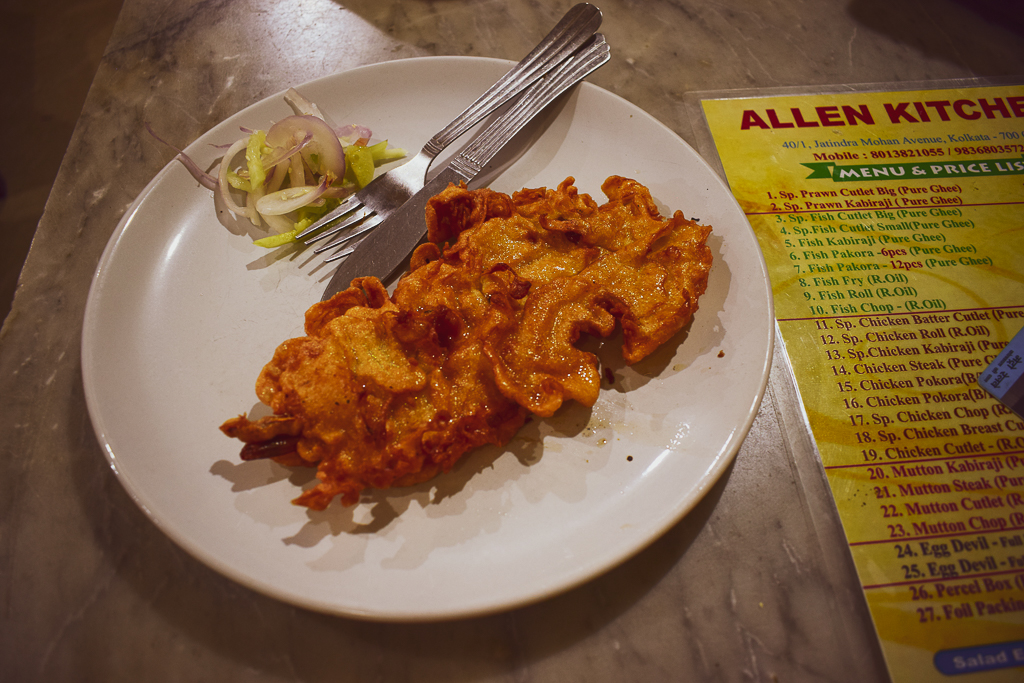
Allen Kitchen dates back 125 years. A Britisher named Allen used to run this eating house. He packed his bags and left for England, as did many Englishmen after 1947. However, he willed his shop to a loyal employee, whose successors have inherited Allen Kitchen. They have been running the show with elan and have not changed the name of the shop in memory of the generous sahib.
Visiting the cabin eateries was groundbreaking in many ways, especially for women. Women of the family could eat and spend some quality time, away from daily mundane in the comfort and privacy of a cabin. The cabins stood as a barrier from the prying eyes of the outsiders and judgemental call of a deeply patriarchal society.
Allen Kitchen sells a plethora of items, mostly cutlets and fries. However, it is blasphemous for a gourmand to visit Allen Kitchen and not taste the incredible prawn cutlets! Tiger prawns are shaped into butterflies and breadcrumbed and then deep fried in desi ghee. Each of the items sold at Allen Kitchen is prepared using desi ghee. Hence the distinct aroma has become a part of the restaurant’s USP.
Bholanath Cabin, Bagbazar
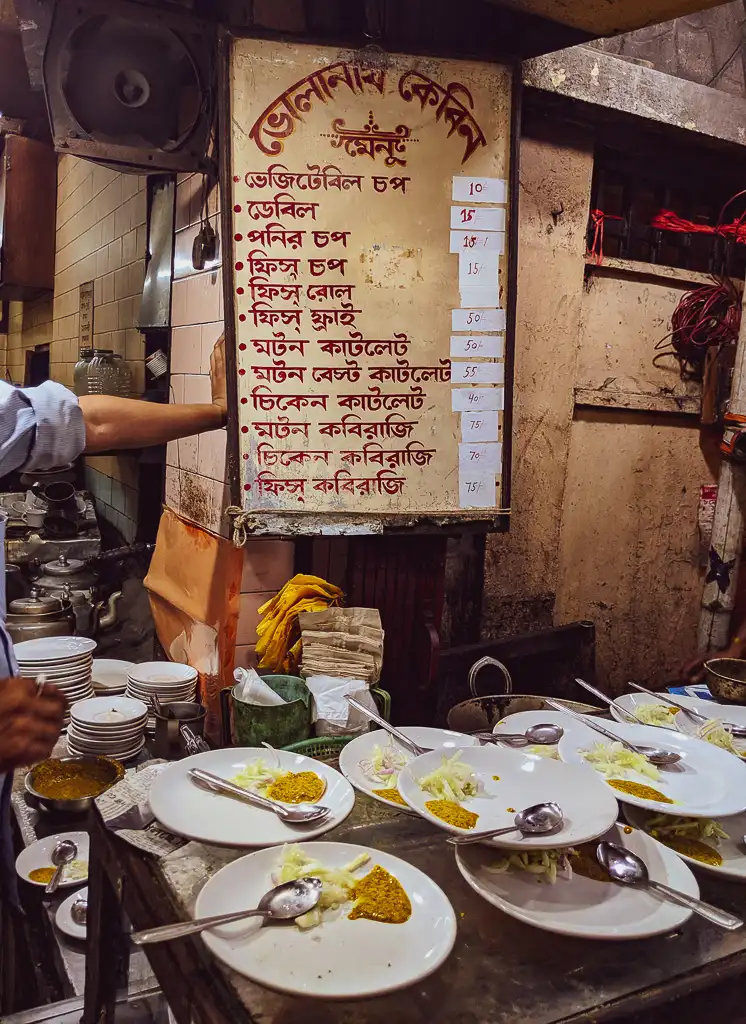
11/1A, Girish Avenue, Near Girish Mancha Xing, Bagbazar, Shyam Bazar, Kolkata
Hours: 7 am to 10 am & 4 pm to 9 pm
Mean for two: Rs 200
While walking towards the Bagbazar Sarbojonin Puja Pandal by the banks of Hoogly river from Shyambazar, you will come across this tiny cafe on your left hand side, on the same lane as KC Dass, the birthplace of the rosogolla. Bholanath Cabin is otherwise unremarkable by appearance. However, before sundown, an endless queue forms in front of the shop. The food lovers of the immediate para, as well as distant neighbourhoods, come flocking in front of Bholanath cabin to taste the legendary fish kabiraji.
To make things easier, Bholanath Cabin has kept prices on the menu well within the reach of common man even in the face of steep inflation. However the portion sizes are small. Once you are done savouring the fish kabiraji, order a chicken cutlet, followed by a paneer chop.
If you are an early riser, Bholanath Cabin would be happy to serve you a sumptuous breakfast as well. Bread butter toast, omelette, ghugni and piping hot tea at the oldest food joint of Bagbazar can kick start your day as early as 7 am.
Niranjan Agar, Girish Park
239/A, Chittaranjan Ave, near Girish Park, Station, Kolkata, West Bengal 700006
Hours: 7 am to 10 am & 4 pm to 9 pm
Mean for two: Rs 300
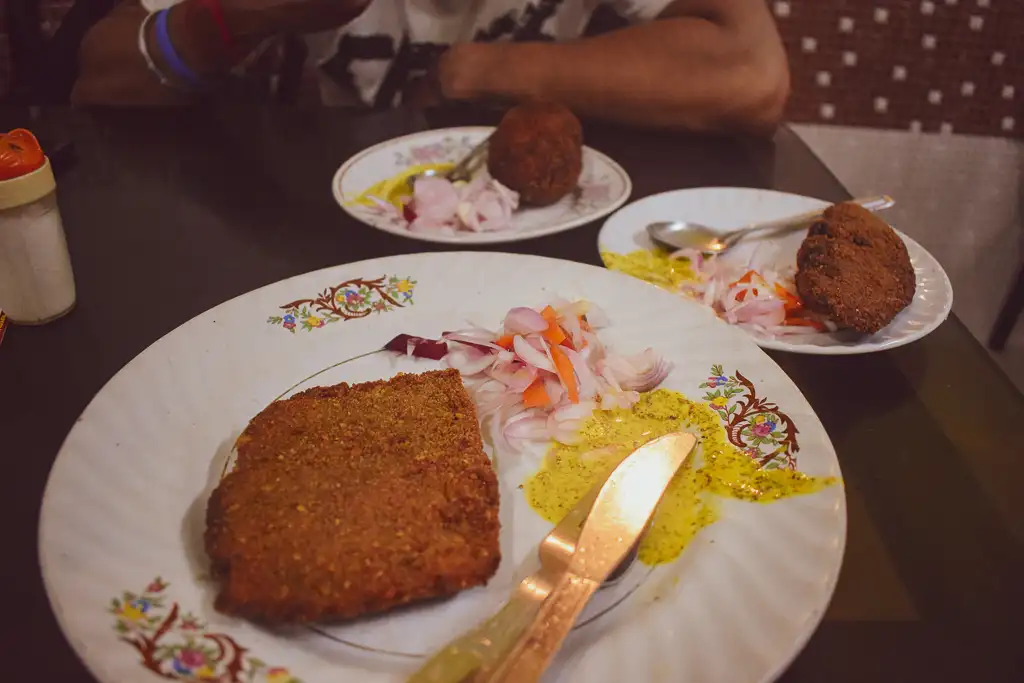
Eating at Niranjan Agar is a timeless experience. Chicken cutlet is still spelt here as fowl cutlet, as they did in the olden days. Eminent singer Manna Dey had been a regular visitor at Niranjan Agar during his stint at his hometown.
Niranjan Agar has been lauded for the exquisite egg devil for decades. So much so that you may have to return empty handed if you do not make it by 7 pm. By 8, they close the shop. You can also trust the liver curry, breast cutlet and mutton kofta to steal your heart! On Thursdays, a special and limited menu is served, devoid of goat meat items.
Basanta Cabin, College Street

53, College St, near Medical College, Lalbajar, College Square, Kolkata, West Bengal 700073
Hours: 9 am to 9 pm
Mean for two: Rs 300
Like most of the old cabin restaurants in North Kolkata, Basanta Cabin had the honour of hosting Netaji Subhash Chandra Bose and Swami Vivekananda in its heyday, having been in business since 1931. Later, it made a permanent mark in Bengali households with Uttam Kumar’s patronage. It is famous for fish kabiraji and Mughlai parota, which comes with a small portion of aloo dom and some salad and makes for a delightfully heavy meal.
Dilkhusha Cabin, College Street
College St, College Square West, College Square, Kolkata, West Bengal 700007
Hours: 9 am to 9 pm
Mean for two: Rs 300
College Street of Kolkata is a beautiful cacophony that words fail to describe. Home to the first flame of Indian renaissance, College Street is dotted with many institutes of repute and the largest book market of Asia. Finding your way through this wealth of knowledge, pausing to appreciate the quintessential heritage buildings, you deserve a tea break. This is when Dilkhusha cabin will welcome you with open arms.
Coping with changing times, Dilkhusha now serves mixed fried rice and chilli chicken with their proverbial fish kabiraji and chicken cutlets. For a robust luncheon, you can trust the handmade roti and mutton kosha served at this dated eatery. Dilkhusha Cabin mostly caters to students, and hence the price point is surprisingly affordable.
Favourite Cabin, College Street
69B, Surya Sen St, College Square, Kolkata, West Bengal 700009
Hours: 9 am to 10 pm
Mean for two: Rs 200
A tea house serving homemade heart-shaped paan cake as a side to steaming hot lemon tea or milk tea for more than 100 years, Favourite Cabin tells the tale of an era gone by. Its marble-top tables and rickety wooden chairs were once used by the Illuminati of Bengali literature, like Nazrul Islam, Shibram Chakraborty, Sunil Gangopadhyay and many others from the Kallol period.
The founder, Nutan Chandra Barua moved to Calcutta from Chattagram in 1918 and started the cabin. Inspired by the Swadeshi movement, he ensured that Favourite Cabin remained a safe haven for the freedom fighters of India under British Raj. Numerous legends related to Master da Surja Sen and Netaji Subhash Chandra Bose are associated with this eatery from the early days. The legacy of political debate and an intellectual air hovers around the place to date.
Campari, Gariahat
155B, Rash Behari Ave, Dover Terrace, Ballygunge, Kolkata, West Bengal 700029
Hours: 4 pm to 10 pm
Meal for two: Rs 200
While the north Kolkata cabins have long withstood the gnaw of time and witnessed the course of history, the south has come up with a handful of cabin restaurants boasting of impeccable quality and a loyal clientele. Campari is a leading cabin style eatery in the south, delighting the shoppers at Gariahat. Apart from the famed Chicken cutlet the menu also has a place for fish fries, kabiraji, and the famous kathi rolls of Kolkata.
Cafe, Jatin Das Park
P.S, 41/A, Shyama Prasad Mukherjee Rd, Hazra Rd, Bakul Bagan, Bhowanipore, Kolkata, West Bengal 700026
Hours: 3 pm to 9 pm
Meal for two: Rs 400
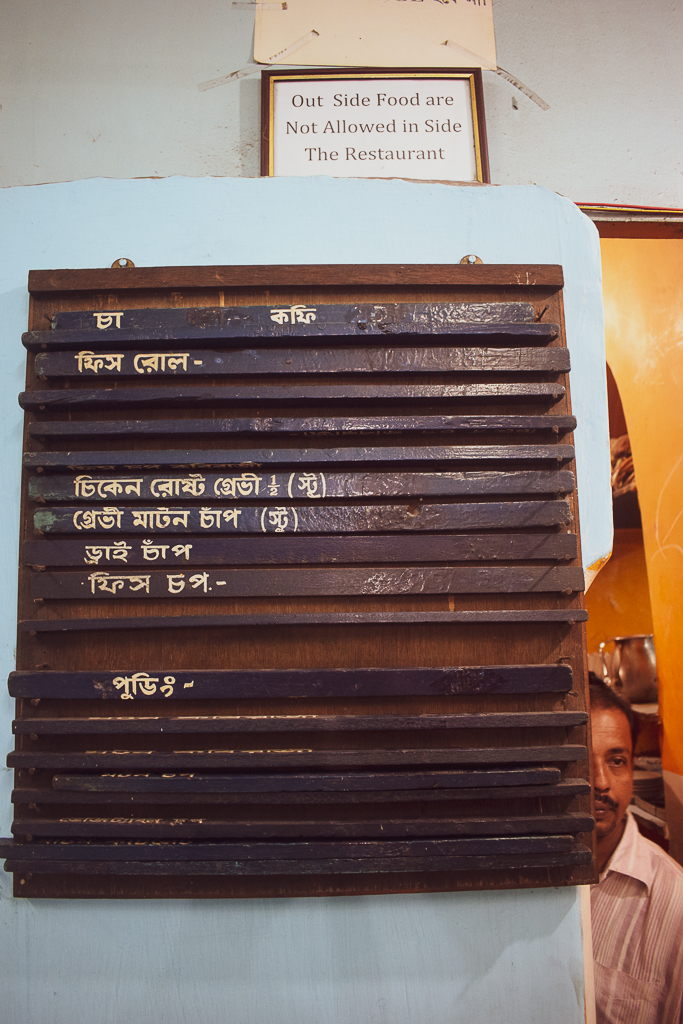
Located opposite Asutosh College and close to Hazra Mor, The Cafe is one of the best old school cabin restaurants around Bhawanipur area. The small wooden chairs, a black board where the day’s menu is scribbled down with a piece of chalk, a TV with a protruding box, fans struggling to provide relief to the weary diners from sweaty humid Kolkata summers, the 83 years oldCafe is genteel like an old friend.
Chops and cutlets served at the cabin restaurants of Kolkata are very unique to the cuisine of West Bengal. There had been profound Anglo influence on the way certain dishes are prepared. Take for example, fish kabiraji, derived from the English word, coverage. The fish fillet is covered with bread crumbs and egg wash, a very English way of cooking. However, gentle sprinklings of spice mixes elevate this humble fish dish to a heavenly stature.
It is one of the last frontiers in Kolkata’s gastronomy where authentic pudding is served. I always order the pudding first lest it gets over. I also recommend the mutton stew at Cafe. It is a light stew made of goat meat and served with a generous portion of potato. The fish roll, kabiraji, and cutlet of Cafe are equally great accompaniments to the famous milk tea.
Apanjan, Kalighat
58, Sadananda Rd, Anami Sangha, Kalighat, Kolkata, West Bengal 700026
Hours: 1 pm to 9 pm
Meal for two: Rs 400
I believe it is Apanjan’s fish fry that has made Kolkata Bhetki a thing of envy for the rest of the world. The fish fry, the prawn fry, the mutton shingara, the duck egg devil cooked with minced mutton, the fish kochuri; Apanjan serves an impeccable range of dishes from the tiny shop tucked at the corner of Kalighat’s labyrinth of bylanes.
To avoid the crowd, you should aim to reach the shop by 6 pm. Apanjan has recently opened an outlet at Sector 5, Salt Lake where the young IT crowd of the city works. The new outlet looks swank compared to the original hole in the wall eating joint at Kalighat. Nonetheless, it lives up to its name and offers great quality food.