
SEVEN SIMPLE WAYS TO BANISH NEGATIVE THOUGHTS

Negative thoughts are natural, and you have gotten tangled in them some time or another in your life. Our thoughts and emotions are interlinked, and we need to understand this before getting rid of the intensity or frequency of negative thoughts we face. 

Once we understand this, we also need to comprehend that thoughts create patterns and, in turn, create a behaviour that leads to more negative thoughts. It is like an endless loop if not consciously broken. 

Negative thinking can contribute to social anxiety, depression, stress, and low self-esteem. The key to changing your pessimistic thinking pattern is to understand how you think now (and the problems that result), then use strategies to change these thoughts or make them have less effect.

It is fundamental to know that thoughts will always keep coming, negative and positive, as they cannot be completely stopped. But negative thoughts can be expelled or banished when they go or replaced with happier and more optimistic thinking.

Let us look at seven simple ways to banish negative thoughts:

  1. Breathe-one minute calming & release 

When you feel you are getting too many harmful or disturbing thoughts, take a moment and concentrate on your heart centre. As you do this, bring your attention to your breathing, and for a minute or two notice how you breathe and as you breathe out, release all the stress and negative thoughts you are having in your mind. Consciously feel and see the thoughts exit your body. You can practise this as many times as you like or require during the day. 

  1. Watch your tone of self-talk.

Sometimes, when low or negative thoughts crawl your mind, you switch your tone with yourself, and your style becomes aggressive, depressing, or even discouraging. For this, you must be aware of your emotional triggers and keep a tab on how you treat yourself in your mind. Understand and address the cause, the situation with empathy and try not to judge yourself with a judgemental two-edged sword. Be kind to yourself. Use words that are more positive in the sentences you make consciously

  1. Create a gratitude list

Do not forget all the good things you have going for you? 

Occasionally in the daily grind, we lose focus on all the things going right in our lives. When things are feeling glum, and you feel nothing seems to be going right, or you believe you are drowning the ocean of melancholic emotion, look at your life and create a checklist of things you are grateful for. Write them down on a piece of paper. Then, a repetition of a simple prayer saying thank you will help you create a happy vibrational frequency. 

Don’t take anything for granted anymore. So many times, good things in our lives are literally in front of our faces, and we still fail to see them.

  1. Express it:

Expressing how you feel or your thoughts will help you feel happy and channel your emotions to release negative thoughts. You can use a pen and paper, write down all the thoughts you are feeling, all the feelings you are experiencing in your mind and body. Once you do – you can burn the paper to feel the release of these emotions from your system. 

You can also try to release negative emotions through meditations. 

Another great way to express is the mirror technique; sitting in front of a mirror voicing all the negative emotions you feel and thoughts you have, and then blends the second point of watching the tone and showing gratitude. You will feel a sudden shift of thoughts and when you stick with the happy ones for a minute or two, consciously.

  1. Affirmation

When you find yourself in the web of thoughts that are pulling you down, start affirming positive thoughts like, “I am happy now”, “I am a magnet to happiness and pleasant thoughts”. This will help you construct a neuro pathway that will send only positive messages to your mind shifting your thinking process instantaneously. If done regularly, it can also crack old thinking patterns and behaviours. 

  1. Anchor yourself in spirituality 

It is essential to know we are spiritual beings having a human experience. Therefore, we need to be rooted in spiritual understanding and learning about ourselves and discovering the lessons our experiences teach us through the medium of thoughts and emotions. So get into the habit of reading or reciting or even chanting something that uplifts your spirit and helps you connect with the universe or divine; it will help you see life holistically with a bigger picture. 

Everything passes, and so shall the negative thought; when you know this, the low and sad thoughts will lose authority and release your mental agony. Kindly note that this is not an overnight process; it takes time. 

  1. Seek professional help

Sometimes when emotions and thoughts become deep-rooted and old, it is hard to release them off so quickly. It is essential to get to the root cause of the issue, which is done best with the help of a healer or therapist. It will help you move forward in life, let go of the past, and break the negative thinking pattern. 

Along with all the above ways, I advise you to regularly take salt water (rock salt) baths once a week. This will help release negative emotions that might lead to thoughts and actions later. In addition, it will keep you feeling happier and lighter. 

Rome wasn’t built in one day. Similarly, your negative thinking patterns might not break overnight; you will need to work on them and with them. But try these to release and banish negative thoughts to begin your journey towards positive and emotionally free living. 

Leave a comment

Your email address will not be published. Required fields are marked *

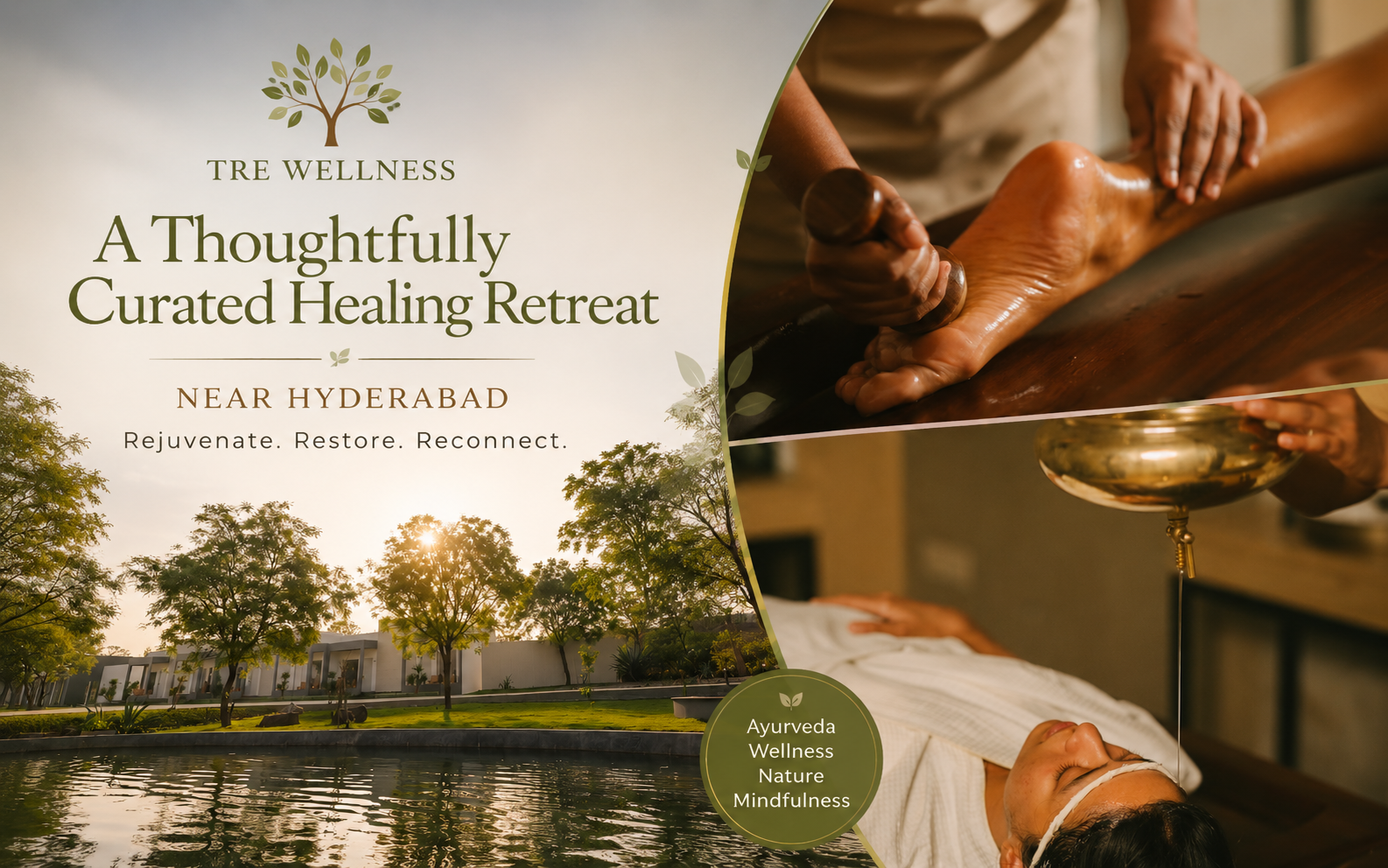
Tre Wellness: A Thoughtfully Curated Healing Retreat Near Hyderabad

Just two hours from Hyderabad, surrounded by open skies, birdsong, and the calming calls of peacocks, Tre Wellness feels more like a serene healing sanctuary than a typical wellness escape. Located in Kolkunda, the 20-room retreat blends Ayurveda, naturopathy, and mindful hospitality into a deeply restorative experience. Sinduri Vuppala shares her stay at Tre Wellness, where every detail is thoughtfully designed around holistic wellbeing. I honestly didn’t know what to expect before arriving. Wellness retreats often promise transformation, but very few manage to balance authentic healing with genuine comfort. Tre Wellness surprised me because it did both, thoughtfully, quietly, and without feeling performative. The experience began on a warm and welcoming note the moment we checked in. Before anything else, there was a detailed wellness questionnaire followed by a one-on-one consultation with the in-house doctor that lasted close to 30 minutes. It didn’t feel rushed or standardised. The doctors genuinely tried to understand lifestyle patterns, health concerns, stress levels, sleep habits, digestion, and overall well-being before suggesting therapies. What stood out immediately was how personalised everything felt. Rather than placing guests into fixed wellness packages, the team carefully blended Ayurveda and naturopathy based on individual needs. By lunchtime on the very first day, each of us already had a customised healing plan prepared. My therapies began with an Abhyanga massage, and from there, every treatment felt intentionally curated. Day two was Udwartana, an Ayurvedic dry powder massage therapy known for stimulating the lymphatic system and activating pressure points and improving circulation, while another involved a deeply relaxing potli massage. Reflexology is also given daily for around 15 minutes as part of the healing routine. There were also mud packs, liver treatments, water yoga, face yoga, detox therapies, and herbal treatments woven seamlessly into the schedule. Every guest follows a structured

A Slower Side of Goa: Elements by Rosetta and Evenings at Ouzo Delmar

There’s a version of Goa that doesn’t try too hard to be seen. It’s quieter, a little more contained, and far more rewarding if you let yourself slow down. That’s the space Elements by Rosetta fits into. Set in Varca, slightly removed from the busier stretches, the property feels designed to hold you in, not isolate you, but gently detach you from everything outside. You’re close enough to the beach, but not constantly aware of it. Instead, the focus stays within, on space, light, and how you move through it. The layout is simple but effective. Low-rise blocks frame a central pool that becomes the heart of the property. Most rooms face into it, so no matter where you are, there’s always a visual connection to water. Check-in is smooth, without the usual over-explaining. You’re handed fresh coconut water, branded, yes, but still refreshing enough to land in your room, within minutes. Room tariffs typically range from ₹10,000 to ₹15,000, with higher rates for premium categories. The jacuzzi room with direct pool access is easily the one to pick. It changes the way you use the space entirely. You’re not scheduling pool time, you’re stepping in and out of it between everything else. The pool itself carries most of the day’s energy. Some people are stretched out with books, some in the water, others parked by the poolside bar, which adds just enough movement to keep things from feeling too still. It never tips into being loud, which is what makes it work. Mornings are slow. Afternoons are slower. Evenings naturally find their way back to the jacuzzi or a quiet corner of the property. It’s indulgent, but in a way that doesn’t feel forced. Beyond the obvious, the property is fairly well-rounded. There’s a small game room, a gym,

Eat Clean with Eshanka: Dubai to Delhi Wellness Journey

With her professional base in Dubai and strong roots in Delhi, Eshanka Wahi brings together global business acumen and deeply personal purpose. An alumna of the European Business School, London, where she earned her Master’s in International Business, and a BCom (Honours) graduate from Delhi University, her academic foundation is firmly strategic. But her real education, she says, came from lived experience. At 21, she returned to India to build her first company from the ground up. “Those early years taught me resilience, decision-making, and the courage to build something from scratch,” she reflects. By 23, she had expanded independently into Dubai, navigating a new culture and market. Each transition strengthened her belief in “intentional growth, self-leadership, and manifestation backed by consistent action.” Wellness as Philosophy Eshanka describes her professional identity as rooted in holistic wellness, conscious living, and culinary nutrition. “My work is not confined to a single title; it is an extension of my beliefs and the way I choose to live,” she shares. Her journey into wellness unfolded organically. What began as personal exploration evolved into a calling. “Wellness was never just an interest; it was a philosophy and a responsibility.” Through recipes, products, and immersive experiences, she aims to simplify well-being. “Wellbeing is not a luxury; it is foundational to how we show up in every role we play.” Soul-Driven Creation What distinguishes her brand is alignment. “Everything I create is deeply soul-driven,” she says. Nothing is trend-led or mechanical. Her recipes use ingredients she personally trusts; her products reflect practices she follows; her retreats are designed to foster genuine reconnection. “This alignment between my beliefs, my lifestyle, and my work naturally differentiates me,” she explains. “Everything is built from authenticity, intention, and soul.” A Pandemic Pivot During COVID-19, her primary company in corporate events and

CINTA & Pantai Pura Founder Rupika Harshwardhan P

For Rupika Harshwardhan P, design has never been merely aesthetics; it is emotional architecture. A graduate of Srishti School of Art and Design, with further studies in art history at Chitrakala Parishad, her education trained her to see spaces as layered narratives shaped by material, form, and feeling. An early internship at Elle Decor India proved pivotal. It offered her an insider’s view of the design industry and crystallised a quiet but firm decision: she would not simply participate in design, she would build something of her own. Drawn instinctively to craft traditions and handmade objects, Rupika’s understanding of “home” is rooted in belonging. For her, furniture is not functional; it is memory made tangible. Brands Built on Meaning Rupika is the Founder and Creative Director of CINTA and Pantai Pura. CINTA, meaning “love,” is a children’s home décor brand centred on imagination and family bonds. Pantai Pura, “Sacred Beach,” explores natural harmony and mindful living. “I didn’t create these brands just to sell furniture,” she explains. “I wanted to change how we see materials and craftsmanship.” Her work bridges tradition and modernity, connecting artisan communities with contemporary homes. Particularly through CINTA, she reflects on how a child’s first furniture piece can become part of their emotional blueprint. Reimagining Rattan At the core of her practice is rattan, a material she champions for its agility, durability, and quiet elegance. Challenging misconceptions that it is dated or interchangeable with bamboo, Rupika reinterprets rattan through a contemporary lens while honouring traditional craft. Her approach rests on three pillars: craftsmanship, co-creation, and community. Designs are developed collaboratively with artisans, resulting in bespoke pieces that respond to real homes rather than fleeting trends. “Design is a conversation, not a monologue,” she says. From Online Beginnings to Experiential Spaces Both brands began online, where one

You May Also Like

Connect with us