
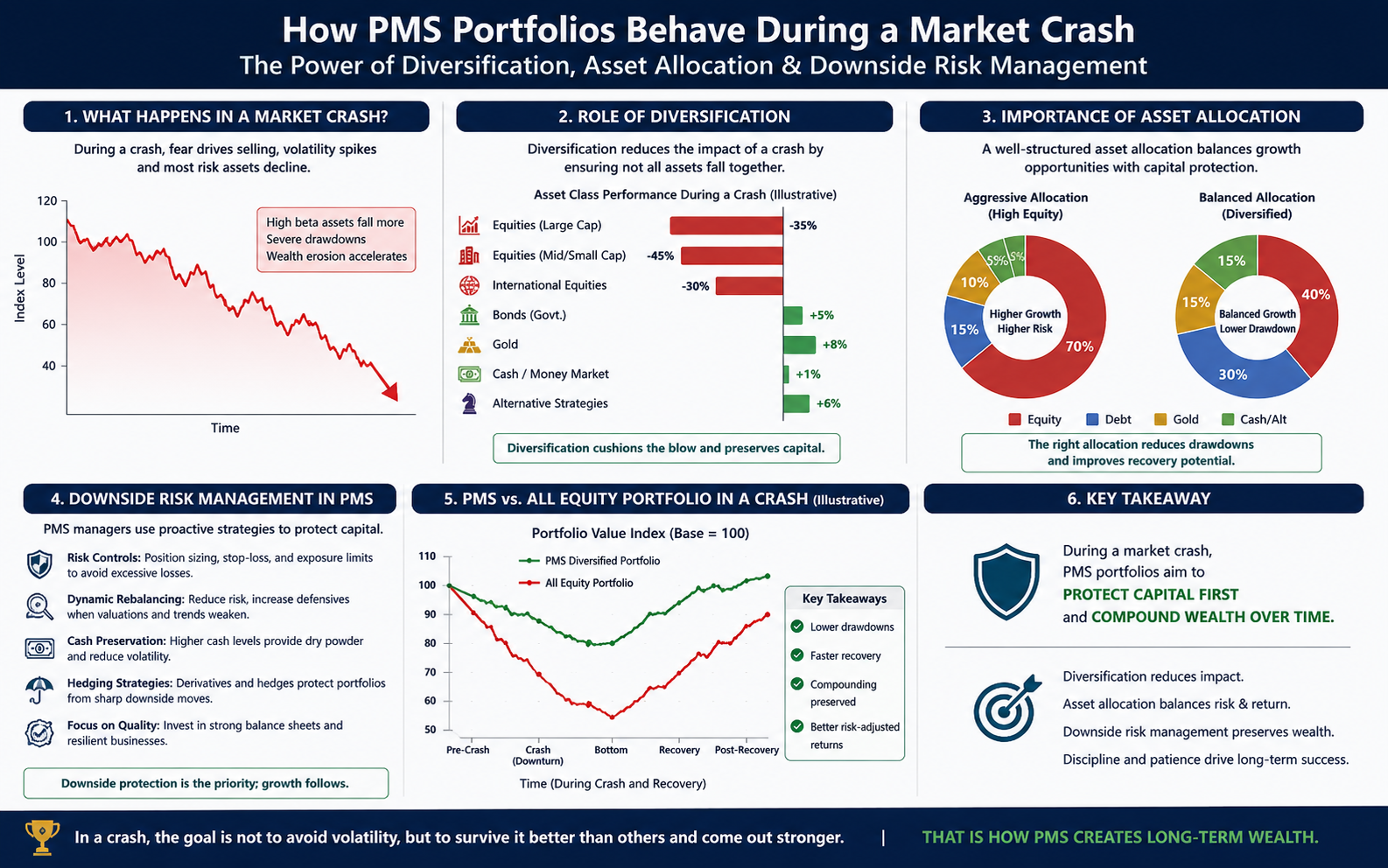
Market crashes are the ultimate stress test for any investment strategy. While returns dominate conversations during bull markets, it is during downturns that the true structure and resilience of a PMS portfolio become visible.
Many investors assume that all portfolio management services portfolios behave similarly in a crash. In reality, outcomes can vary significantly depending on how the portfolio is constructed.
1. What a Traditional PMS Looks Like
A traditional equity PMS is typically built as a concentrated portfolio of 15–30 individual stocks.
This structure is intentional:
- Managers aim to generate alpha through high-conviction bets
- Capital is allocated meaningfully to each idea
- Diversification is limited compared to mutual funds
However, during a market crash, this concentration becomes a double-edged sword.
What happens in a crash?
- If a few key holdings fall sharply, the overall portfolio can decline disproportionately
- Single-stock risk gets amplified
- Liquidity issues in mid and small caps can worsen drawdowns
For example, if a PMS holds 20 stocks and 3–4 of them fall 40–50%, the portfolio impact can be severe.
This is the structure most investors picture when they think “PMS in a crash” — and it is also what has given PMS an unfair reputation for being high-risk by default. But concentration in direct stocks is a choice, not a requirement of the PMS structure. What sits inside the portfolio is what determines crash behaviour.
2. Not All PMS Portfolios Are Built the Same
It is a common misconception that all PMS providers only buy direct stocks. In reality, a PMS is simply a personalized account managed by a professional. The strategy inside can vary wildly.
While many providers stick to equities, others take a multi-asset approach. These providers build portfolios using a mix of mutual funds, direct bonds, gold, REITs (Real Estate Investment Trusts), and InvITs (Infrastructure Investment Trusts).
For instance, Dezerv allocates a client’s corpus across multiple PMS strategies (equity-oriented, debt-oriented, gold, REITs, and InvITs) rather than placing everything into a single stock-picking mandate. Each underlying strategy is professionally managed within its own asset class. The diversification is achieved at the allocation level, across strategies.
3. What Happens to Each Component of an MF-Based PMS in a Market Downturn
If your corpus is allocated across multiple PMS strategies, a market crash does not hit everything at once. It hits each strategy differently, depending on what that strategy holds and how its underlying asset class behaves.
Equity Mutual Funds
Equity funds do fall during market crashes, but they offer built-in diversification:
- Depending on the fund category, an equity mutual fund holds anywhere from 30 to 100 underlying stocks — large-cap funds tend to run tighter portfolios of 30-50, while flexi-cap and multi-cap funds can hold significantly more
- Exposure is spread across sectors and companies
However:
- Large-cap funds tend to fall less than mid/small-cap funds
- Sectoral funds can fall sharply depending on the theme
In severe crashes, correlations increase, and most equity funds fall together initially—but the magnitude still varies.
Debt Mutual Funds and Bonds
Debt is often seen as a stabiliser, but not all debt behaves the same.
- Government bond funds and short-duration funds tend to be more stable
- Corporate bond funds can face credit spread widening, leading to NAV declines
So while debt can reduce volatility, it is not accurate to assume that all debt is risk-free during a crash.
Gold Funds
Gold has historically acted as a partial hedge, especially in:
- Inflationary environments
- Currency instability
However, in sharp liquidity events (like March 2020):
- Gold can also fall temporarily as investors sell assets to raise cash
Over time, it has shown the ability to diversify risk, but it is not a guaranteed protector in every scenario.
REITs and INVITs
REITs (Real Estate Investment Trusts) and INVITs (Infrastructure Investment Trusts) are income-generating real asset instruments.
- They provide exposure to commercial real estate or infrastructure assets
- Returns are linked to cash flows and interest rates
Important considerations:
- They are interest-rate sensitive
- India has a limited crash history for these instruments (REITs launched in 2019)
They should not be viewed as direct downside protection but as diversifiers with different return drivers.
4. The Double Diversification Argument
A multi-asset PMS offers two distinct layers of protection that a traditional stock-picking PMS lacks:
- Layer One – No Single Stock Can Sink the Portfolio: Because the equity allocation sits within a mutual fund-based PMS strategy, where the fund itself holds dozens of underlying companies, a single company’s bad earnings or regulatory shock cannot disproportionately damage your corpus. And because that equity strategy is just one part of a broader multi-strategy allocation, its drawdown is further cushioned by the debt and gold strategies running alongside it.
- Layer Two – Different Assets Recover at Different Rates: During a crash, debt and gold allocations that have held their value create a structural opportunity. A well-managed MF-based PMS can use these relatively stable allocations to systematically rebalance into equity at lower prices. This means the recovery is not passive — the portfolio is designed to participate in the upturn more fully than it absorbed the downturn.
The Honest Truth: Multi-asset doesn’t mean your portfolio won’t move into the red. It means the force of the crash is distributed across instruments that do not all fall at the same time or by the same magnitude.
To illustrate: during the COVID crash of March 2020, the the Nifty 50 fell approximately 40% from its January 2020 peak of 12,431 to its March 2020 trough of 7,511. A multi-asset portfolio with meaningful allocations to debt and gold would have absorbed a significantly smaller drawdown during the same period — the exact magnitude depends on the specific allocation mix, but the distribution of risk across uncorrelated assets is what creates that buffer.
There is also a mechanical advantage that rarely gets discussed. When a crash hits and equity falls while debt and gold hold relatively steady, the portfolio’s allocation to equity drops below its target weight. A systematic rebalancing trigger buying more equity with the proceeds from stable assets means the portfolio is, by design, adding to equity positions at lower prices. This is the counter-cyclical benefit that most investors talk about in theory but few portfolios are actually built to execute.
5. The Metric Investors Should Ask About: Downside Capture Ratio
If you want to know how “crash-proof” your PMS is, ask for the Downside Capture Ratio.
The Math Made Simple: If the Nifty 50 falls by 10% and your PMS portfolio falls by only 6%, your downside capture ratio is 60%. A ratio below 100% means the manager is successfully protecting your capital during market drops.
A superior PMS isn’t just one that makes the most money in a boom; it pairs a low downside capture ratio with strong upside participation.
6. What to Ask Your PMS Provider Before the Next Crash
Don’t wait for the red candles on your screen to start asking questions. Verify these five points today:
- “Which fund categories and fund houses does my PMS allocate across, and what is the rationale for each?”
- “What is the percentage currently allocated to non-equity assets like gold and debt?”
- “What was the maximum drawdown (the biggest drop from peak to trough) this strategy saw in 2020 and 2022?”
- “What is the portfolio’s downside capture ratio relative to the Nifty?”
- “What is your rebalancing trigger? Do you buy more equity when prices crash, or do you stay defensive?”
7. Conclusion
How much a crash affects your portfolio is not a matter of luck or market conditions alone. It is a direct outcome of how the portfolio was built before the crash arrived.
A PMS constructed around direct stocks concentrates both the upside and the downside into a small number of bets. A PMS built across mutual funds, bonds, gold, and real assets distributes that exposure so when one part of the market falls sharply, the full force of that fall does not land on your entire corpus at once.
The right question to carry into any PMS conversation is not “what returns have you generated?” It is “show me your downside capture ratio, your maximum drawdown in 2020 and 2022, and how you rebalanced during those periods.” Those three data points will tell you more about a portfolio manager’s competence than any bull-market track record.
Long-term wealth is built as much by what a portfolio does not lose as by what it gains. Structure is what determines that.
Frequently Asked Questions
What happens to a PMS portfolio during a market crash?
During a market crash, a PMS portfolio typically declines in value, especially if it is heavily exposed to equities. However, the extent of the fall depends on how the portfolio is constructed.
Concentrated stock-based PMS portfolios may see sharper drawdowns, while diversified, multi-asset PMS portfolios tend to experience relatively lower volatility due to exposure across equity, debt, gold, and other instruments.
Are PMS portfolios riskier than mutual funds during downturns?
Not necessarily. PMS portfolios can be riskier if they are concentrated in a small number of stocks.
However, PMS structures that use mutual funds and diversified assets reduce single-stock risk significantly. In such cases, the risk profile can be comparable to, or in some cases more balanced than, a standalone equity mutual fund portfolio — because the multi-asset construction adds debt and gold as stabilisers that most equity-only mutual funds do not carry.
How does diversification impact PMS performance in a crash?
Diversification limits losses by ensuring that not all strategies fall by the same magnitude during a crash. When a corpus is spread across equity, debt, and gold strategies, each component responds differently to market stress. A falling equity strategy is partially offset by debt or gold holdings that hold relatively steady.
The key caveat is that in severe systemic crashes, correlations can increase temporarily and most asset classes fall together in the short term. Diversification reduces the depth of the drawdown, but it does not eliminate it.
What is the downside capture ratio in PMS?
Downside capture ratio measures how much a portfolio falls compared to the market during a downturn.
For example, if the market falls by 10% and your PMS falls by 6%, the downside capture ratio is 60%. A lower ratio indicates better downside protection and stronger risk management.
Should investors exit PMS investments during a market crash?
Whether to exit depends on individual circumstances, investment horizon, and portfolio structure. However, historically, exiting equity and multi-asset portfolios during sharp drawdowns has meant locking in losses and missing the recovery. Investors are better served by reviewing whether their portfolio strategy remains sound rather than making decisions based on short-term market movements. Consult your PMS relationship manager or a SEBI-registered adviser before making any changes to your investments.
What should you check in your PMS before a market downturn?
The four most important things to verify are: your current allocation across equity, debt, and gold; the portfolio’s historical maximum drawdown in periods like 2020 and 2022; the downside capture ratio relative to the Nifty 50; and your manager’s rebalancing approach during a crash. For a full list of questions, go through Section 6 of this article