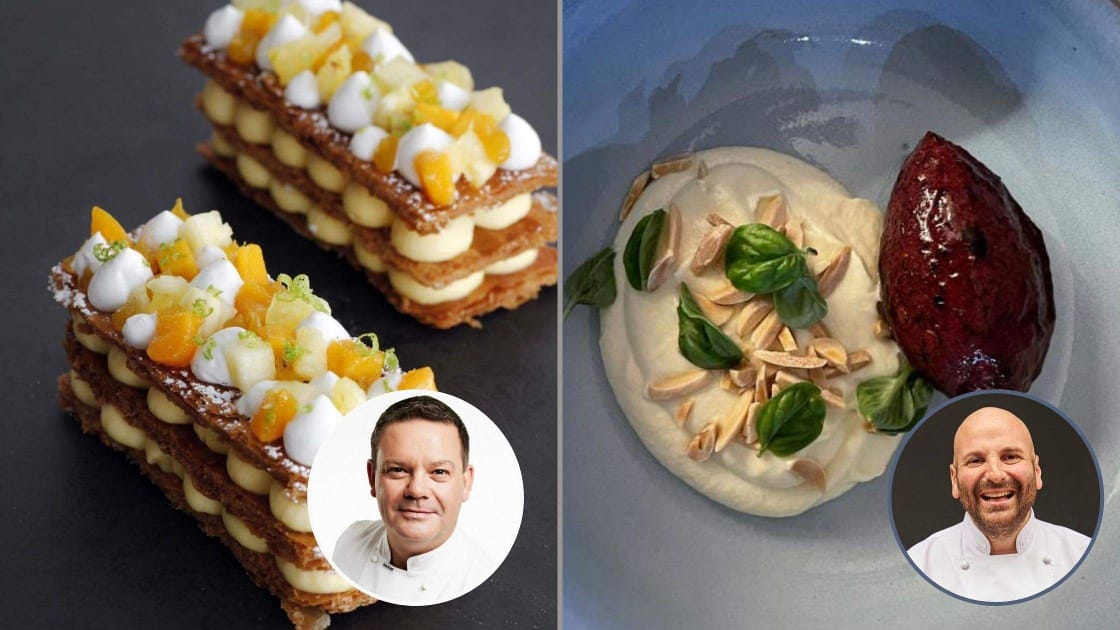
Indian bakers chefs were in for a treat, as masters chefs and restaurateurs George Colambaris and Gary Mehigan organised a master class of gluten free eggless desserts with Indian cooking community Conosh. Hashtag shares some delicious recipes and also catches up with Gary for an exclusive interview….
One of the most loved judges on Masterchef Australia Gray Mehigan is a common household name in every food loving Indian home. A chef of 30 years, he marks the two Michelin starred restaurants that were the most formative in his early career-The Connought Hotel under Michel Bourdan and Le Souffle under Peter Kromberg, two hugely influential chefs in Britain with opposing styles and ideas. MasterChef by all accounts was a game changer…11 years and 12 episodes later, he is today an inspiration for generations of young cooks. We catch up with him at his favourite spot, the kitchen….
You association with MasterChef has ended. How does it feel after 11 long years?
Just so everybody knows, it was time to change, time for something different, for something new. Life is certainly being different, though 2020 was unexpected and life-changing to some degree. I am sure many people would feel the same. I’ve been writing a book that has kept me busy, getting stuck into podcasting which I love and pitching numerous ideas to various production companies. I’ve also spent much more time doing some of the things that I always have seemed to have missed out on, having been so busy in the past.
I’m sure I speak on behalf of Matt (Preston) and George (Calombaris), but all three of us were extremely lucky and blessed to be part of MasterChef Australia for such a long time. We also know that we are inextricably linked to the show forever, and people will probably always know us as The Three Musketeers or the three boys from MasterChef.
Over the years Masterchef has managed to become an international culture of its own. What do you think made this show so successful?
First of all, MasterChef was a unique television proposition at a time when reality- based television was cruel and sensationalist – MasterChef wasn’t. Matt, George and I set that tone deliberately, and we are very proud of the legacy. Secondly, the audience loves to see the ‘journey’. Think of Julie Goodwin, an everyday Australian mum with a dream to be in food. Nervous, often clumsy and prone to tears as things got on top of her. But she showed grit, determination and the kind of passion that saw her win through. She was inspirational to all that watched season one.
The show’s success was, ultimately, because it was genuine. The three of us always trusted the food gods! Simply put, whatever tasted the best always won, and it was rare that we disagreed. We never nudged, fabricated or contrived to be more than a great cooking competition, and we would fall in love with the contestants as we followed their progress, regardless of whether they were good in front of the camera or not.
How has your association with Masterchef over the years changed your approach to food …
MasterChef has been a wonderful conduit for conversation, family and community, something that unites us, not divides us, in an increasingly impersonal and stressful world. Bringing food to life, encouraging amateur cooks to make their food dreams come true and offering positive feedback and genuine advice that has pushed many of the contestants on to bigger and better things. To be honest, for me, the thrill of being involved was always about the relationships we formed with the contestants.
Being part of their growth as cooks during filming was extremely rewarding but more importantly, becoming friends and colleagues once they had left to follow food careers of their own made the whole experience very special. Working on the show made it even more evident that food has the singular power to bring us all together no matter our differences.
You have made several trips to India and even whipped up some Indian dishes, do you have a favourite?
The more I have travelled to India, the more excited I am by its regionality, the origin of flavours and dishes, and of course, its people and their stories. Indian cuisine is a riot of flavour, texture, and colour that I find addictive and the mastery of spices that ultimately makes everything taste so delicious. I love all the sweet regulars gulab jamun, jalebi, malpua, rabri ghevar and halwa! Enough to put me into sugar overload! However, I must say I do like the trend of reducing the amount of sugar in all of these desserts, lightening them with a twist and modern touch.
Do you believe it is important to switch to gluten-free diets? Why?
Obviously, if you are allergic to gluten, it’s a bad idea to consume it in any form. There are thousands of recipes and ideas now for gluten-free diets, which are easily tapped into through social media, social groups, YouTube or countless cookbooks. Gluten-free flours and breads, in particular, have come along leaps and bounds over the last few years and offer some great alternatives for those that need to change their diets.
However, as a rule, if you’re not allergic to gluten then why would you eliminate it from your diet? I do have a few golden rules, which include that all my breads tend to be sourdough because they are certainly tastier and better ßfor you. However, things like pasta, cakes and pastries are never quite the same when you substitute a strong flour that contains gluten with something else, which means you will miss out on some incredible dishes, textures and experiences
What are some typical Indian ingredients that you enjoy incorporating into your recipes?
Learning about Indian spices has been a bit of a revelation for me. I understand now that the spices used in Indian cooking are not just to add flavour but add historical, cultural and medicinal properties to the food. I bring back little quantities of spices on my visits to India, but more than anything, it’s ideas that I bring home with me.
What other flavour do you enjoy?
To be honest, anywhere in Southeast Asia tickles my taste buds. I am a big fan of Thai and Vietnamese food for the sweet, sour, salty and hot flavours, and of course, the texture and crunch. The use of fresh, aromatic and vibrant ingredients makes it light and healthy.
What’s your go-to quick recipe for a lazy summer afternoon?
Summer in Australia is all about the barbeque, simple marinades, delicate seasoning and lots of fresh ingredients. I often barbeque a marinated chicken or some lamb cutlets and serve with a crispy salad, grilled asparagus, or just tomatoes pulled from the vine, cut into chunks and drizzled with a really good extra virgin olive oil, cracked pepper and flaked salt.
What next, any big projects lined up?
I hate to say it, but I’ve enjoyed slowing down far more than I expected — more time to do the things I want at my own pace. I’m looking forward to my book coming out later this year, to continue to podcast and focus on my coffee brand. I have my fingers crossed that the world will begin to open up next year, and we can resume our travels. We have a few pitches in the works for food television of various kinds, but it’s far too early to talk about it yet. TV is a fickle beast, but I am sure we will be returning to your screens in one form or another soon.
Quotes:
“The three of us always trusted the food gods! Simply put, whatever tasted the best always won, and it was rare that we disagreed.”
“Bringing food to life, encouraging amateur cooks to make their food dreams come true and offering positive feedback and genuine advice that has pushed many of the contestants on to bigger and better things.”
Recipes:
MILLE-FEUILLE OF CARAMELISED WHITE CHOCOLATE, MANGO & COCONUT BY Gary Mehigan
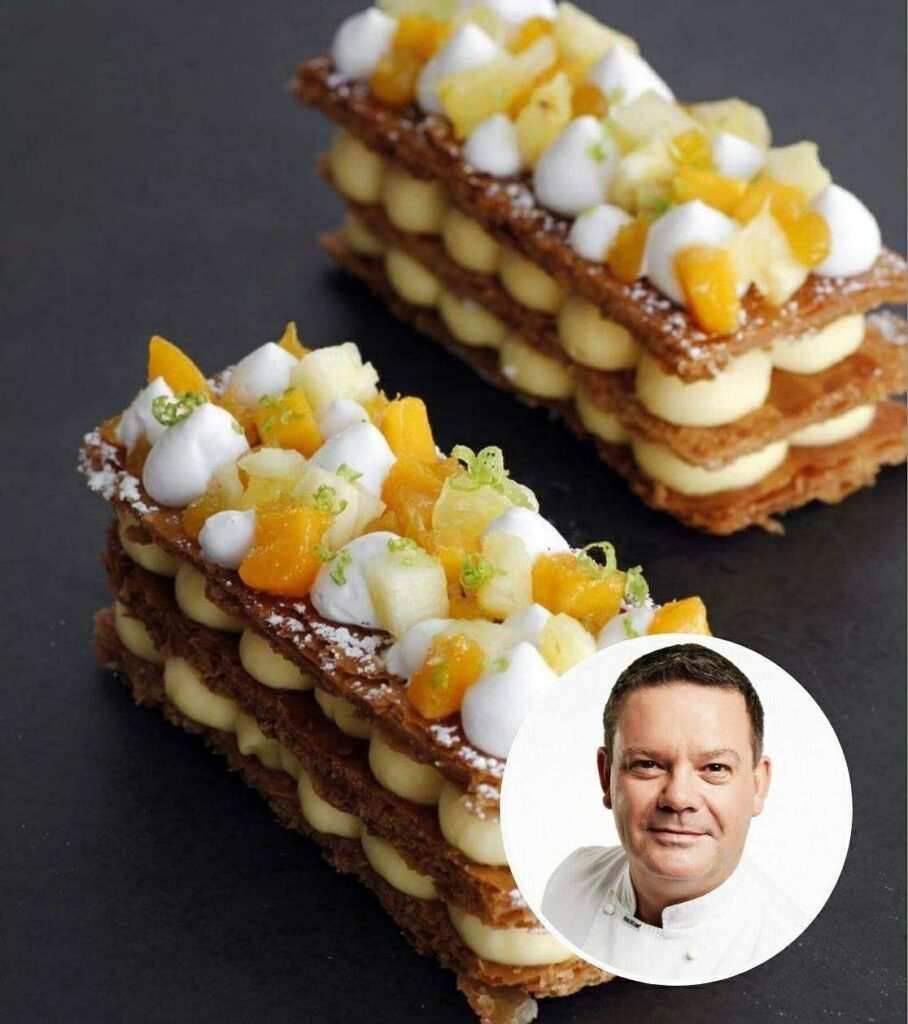
Ingredients – Rough Puff (makes 500g)
- 250g plain flour, plus more for dusting
- 1 tsp salt
- 250g unsalted butter, room temperature
- 120ml water
Directions – Rough Puff
1. Combine the flour and salt in a large bowl and add the diced butter. Gently break the butter into the flour but leaving most of the butter intact. Add the chilled water and using your hand collect the flour from around the sides of the bowl and turn into the centre, repeat a few times until the dough comes together in a rough mass but not fully mixed together.
2. Turn out onto the bench and bring together into a clump, press down and repeat until it has formed into crumbly if not a little messy dough. Press down and shape into a rectangle. Cover and place into the fridge for 20 minutes. Remove the dough, flour the bench lightly and roll the dough out into a long rectangle approx. 40 cm by 15 cm. It will appear crumbly and marbled with chunks of butter, but don’t worry it will come together as you roll and fold the pastry.
3. Fold one end into the middle and then fold the other end into the middle, now fold in half like you are closing a book, so you have 4 layers. This is called a double turn. Rotate the pastry so the layers are facing you and the ‘book’ is facing you. Now repeat the roll and fold. Cover and refrigerate for 20 minutes. Remove the pastry form the fridge and repeat which gives the pastry two more double turns. (or two more roll and folds)
4. Pre heat fan forced oven to 190 C. You will need two large baking trays for this recipe. Line one with baking with baking paper and set aside.
5. Cover and rest in the fridge for 30 minutes. Once rested, remove the puff pastry from the fridge. Uncover and cut in half. Roll out the pastry on a lightly floured work surface into 4mm thick rectangle. Carefully place the pastry sheet onto the baking tray. If it’s too large use two baking trays. Pop in the fridge for 20 minutes to rest.
6. Remove the pastry from the fridge and prick the surface of the pastry all over with a fork. Place another sheet of paper on top of the pastry and then pace the second baking tray on top and press down firmly.
7. Bake the pastry for 12 minutes then reduce the heat to 175C and bake for another 20 minutes, or until it’s a dark golden brown. (Check periodically to make sure its not colouring too much)
8. Remove from the oven and allow to cool. Using a sharp knife cut the pastry carefully into 4cm by 8cm rectangles..
Ingredients – Mille Feuille – fillings & topping
- Caramelised white chocolate mousse
- 4g agar agar
- 200g white chocolate buttons
- (couverture min 26% cocoa butter)
- 600g heavy cream – 36%
- 100g castor sugar
- 3g salt
- 1 vanilla bean – split or 1/2 tsp
- Other Ingredients
- Vanilla essence 200g cream cheese
- 1 fresh mango, peeled and cut into
- 1/2 cm dice
- 1 fresh coconut, flesh removed or dried coconut flakes
- 1 lime zest only
Directions – Rough Puff
1. Pre heat fan forced oven 180 C
2. Line a baking tray with baking paper. Scatter the white chocolate buttons and pop into the oven. Cook for 10-15 minutes stirring regularly after the chocolate begins to caramelize so it colours evenly. Remove from the oven when the chocolate is golden brown and allow to cool slightly. Place 25g of the chocolate into a small bowl and reserve for later. Place the remaining caramelized chocolate into a jug or canister and set aside.
3. Pour 450 ml of the cream into a medium sized pot and add the salt, sugar, agar agar, lime zest and vanilla bean. Place onto a moderate heat and bring gently to the boil. Whisk regularly to combine all the ingredients, cook for 30 seconds and remove from the heat. Remove the vanilla bean and pour the hot mixture over melted caramelized white chocolate and emulsify with a stick blender until smooth. Pour into a medium sized bowl and allow to cool. Cover and place in the fridge until thoroughly cold approx. 1 hour.
4. Meanwhile place the cream cheese into another bowl and bring to room temperature. Mix with a spatula until creamy and smooth and gradually add the remaining cream. Set aside.
Whip the caramelized chocolate custard until smooth and add the cream cheese and cream mixture. Mix until smooth and place into a piping bag with a 1.5cm nozzle.
Assembly
Lay three pieces of pastry down on the workbench. Pipe dollops of white chocolate cream over the surface of each piece of puff pastry add a few cubes dice mango on each sheet and grate a little zest over the top. Gently lift one on top of the other to form two layers and then lift the final piece and gently pop on top. Decorate with a few shavings of coconut and the repeat the process for the remaining mille-feuille.
Note:
Wash the vanilla pod briefly with water to remove any custard and dry with a paper towel. The vanilla pod can be used again for another custard and will still impart flavour or simply pop into castor sugar to infuse to produce vanilla sugar.
TAHINI, YOGURT, EVOO AND WHITE CHOCOLATE MOUSSE, BLUEBERRY SORBET, ROASTED ALMONDS
BY GEORGE CALOMBARIS
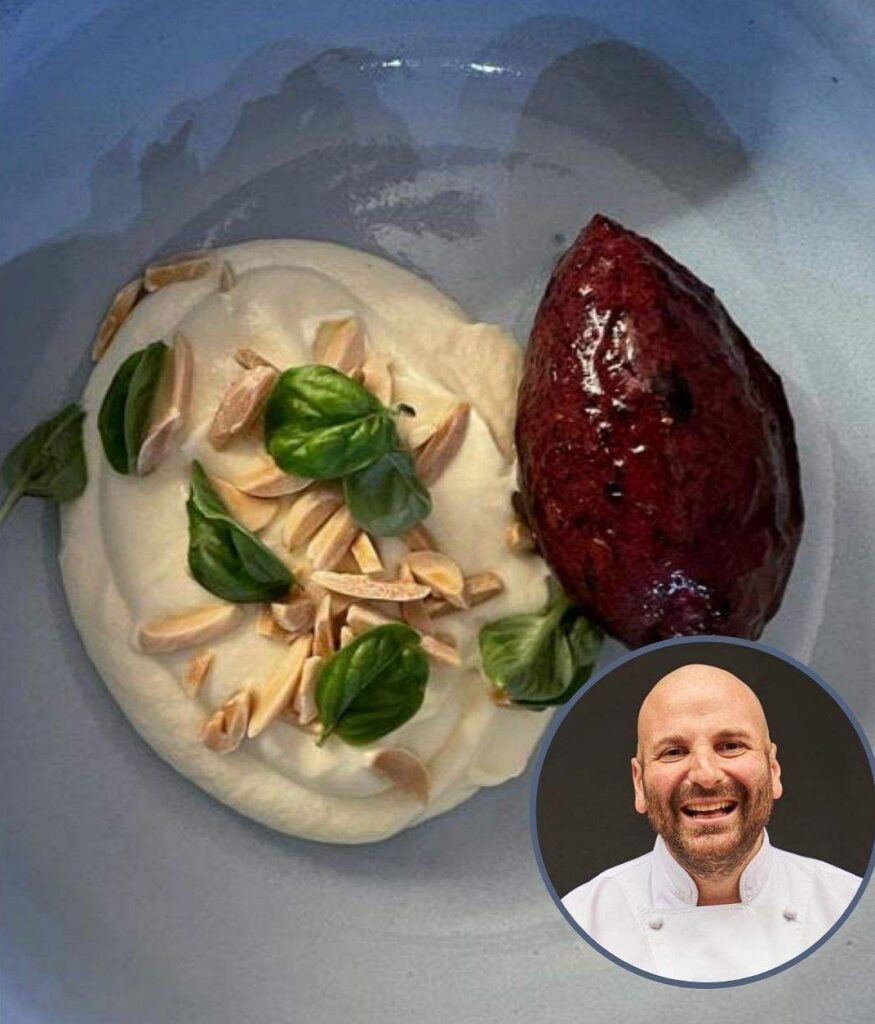
Ingredients
- white chocolate tahini mousse
- 100g chocolate callebaut white callets 28%
- 50g extra virgin olive oil (light in flavour)
- 25g tahini paste
- Pinch sea salt
- 50g Greek yogurt
- 250g whipping cream
Directions – overnight
1. Freeze blueberries overnight
2. Place blender bowl in freezer overnight
Directions – Tahini mousse
1. Place a pot of water on the stove and bring to the boil. Place white chocolate, olive oil, tahini and salt into a stainless steel bowl and set aside
2. Semi whip cream with a whisk and set aside in fridge
3. Take the bowl with white chocolate, olive oil, tahini and salt and place over the boiling water then turn heat off. Using the residual heat, stir to allow the mixture to melt and come together. Once the mixture is combined, remove the bowl from the pot and set aside. Allow the mixture to cool to body temperature using a finger as a guide.
4. Once the mixture has cooled to body temperature, take the semi whipped cream and combine the two mixtures gently.
5. Combine the yogurt to the mixture and set aside in the fridge
(NOTE: do not leave mousse in the fridge too long as the extra virgin olive oil will solidify).
Ingredients – sorbet
- 250g blueberries (frozen overnight)
- 1/4 cup golden syrup
- Pinch sea salt
Ingredients – garnish
- 4tsp almonds silvered and roasted
- Fresh basil leaves and flowers
Presentation
Once sorbet is made, remove the mousse from the fridge.
Place two spoons of mousse on the bottom of each bowl.
Garnish with roasted silvered almonds and basil leaves/flowers.
Add a quenelle of sorbet.
Directions – sorbet
1. Place the blueberries into the chilled blender bowl, add the golden syrup and blend at high speed. Every 30 seconds, remove the lid and scrape the sides of the bowl until achieving sorbet texture.
2. Once the blueberries have turned into sorbet, either place the same bowl with the mixture back into the freezer or scrape the sorbet out and place into a clean container that has been pre chilled in the freezer.
Note: It is very important when making sorbet to work quickly and have all ingredients and equipment ready ahead of blending.