Statue of Equality Celebrates Third Anniversary with Grand Samatha Kumbh Festivities

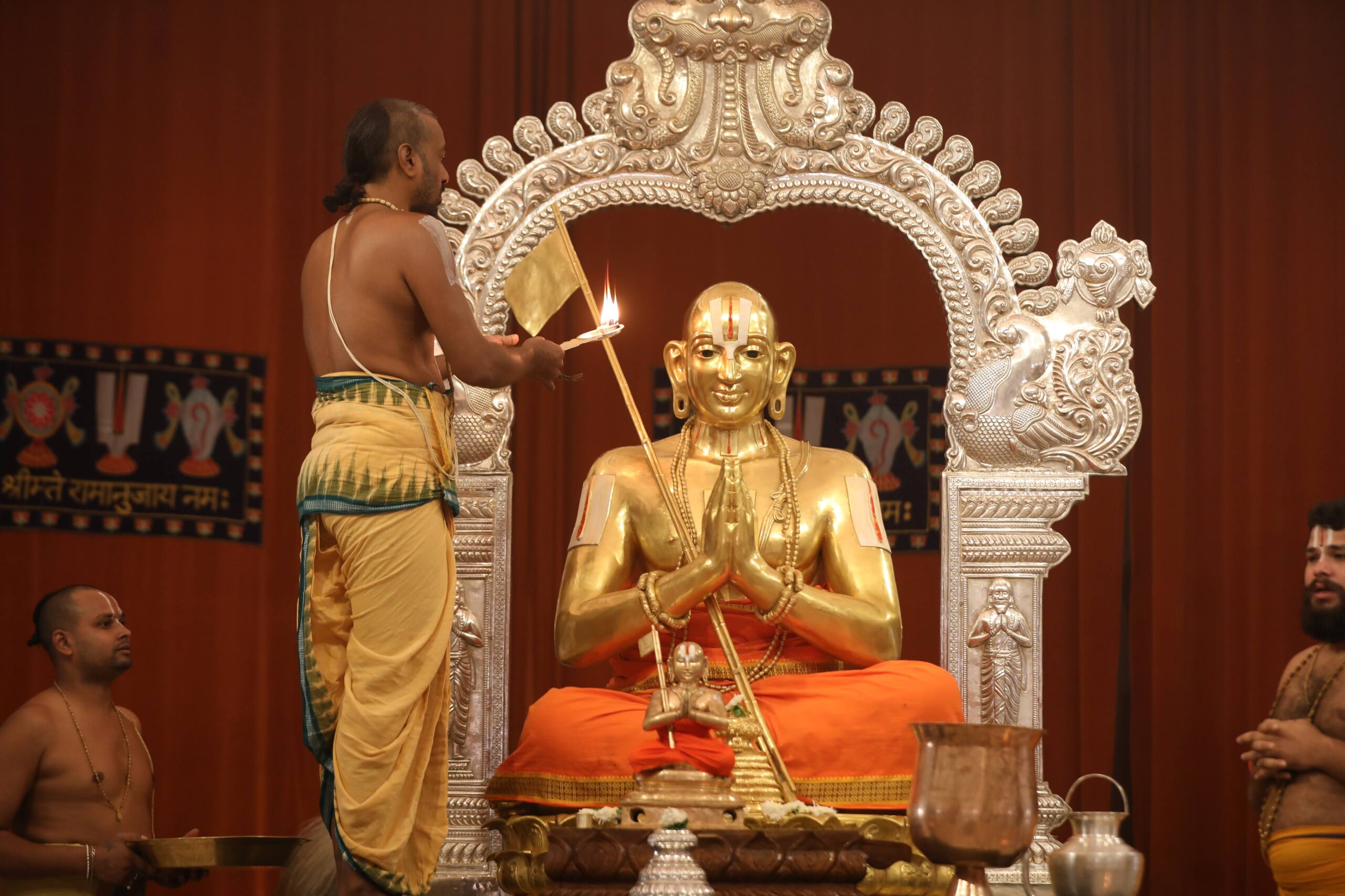
The Statue of Equality and the 108 Divyadesams celebrated their third anniversary with grandeur. The 11-day Samatha Kumbh festivities commenced on February 9, 2025, with a ceremonial abhishekam to the Golden Ramanuja. The celebrations honored Sri Ramanujacharya Swamy’s legacy, promoting unity, equality, and social justice through processions, educational sessions, and cultural events.
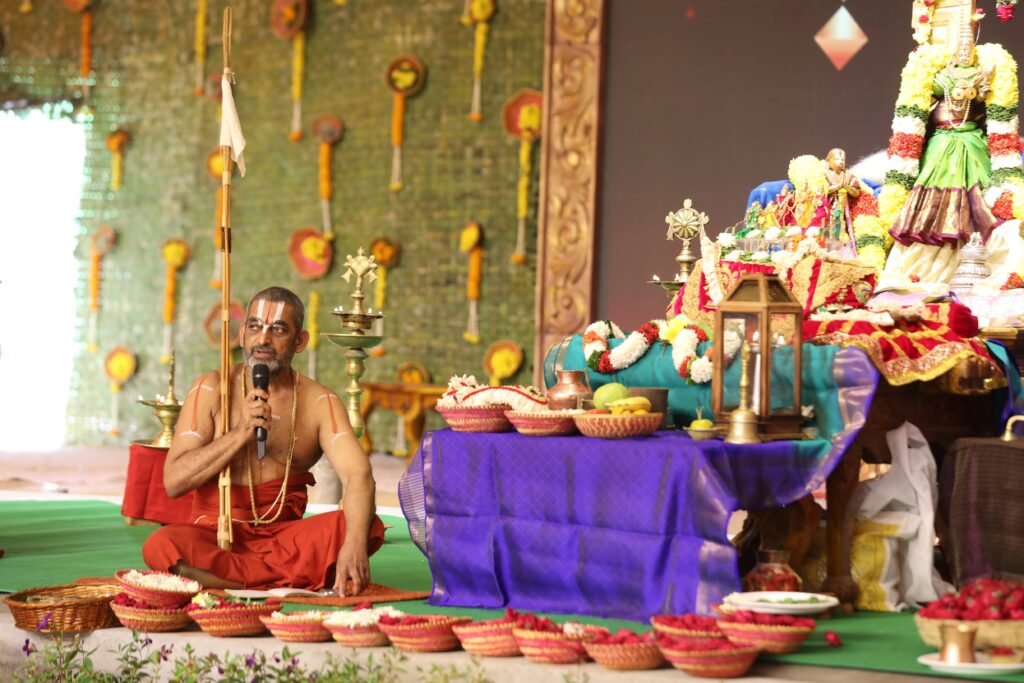
The third anniversary celebrations of the Statue of Equality and the 108 Divyadesams commenced on February 9, 2025, with a ceremonial abhishekam, or divine shower, to the Golden Ramanuja. This sacred ritual was performed under the guidance of His Holiness Chinna Jeeyar Swamiji, marking the beginning of the 11-day Samatha Kumbh festivities.
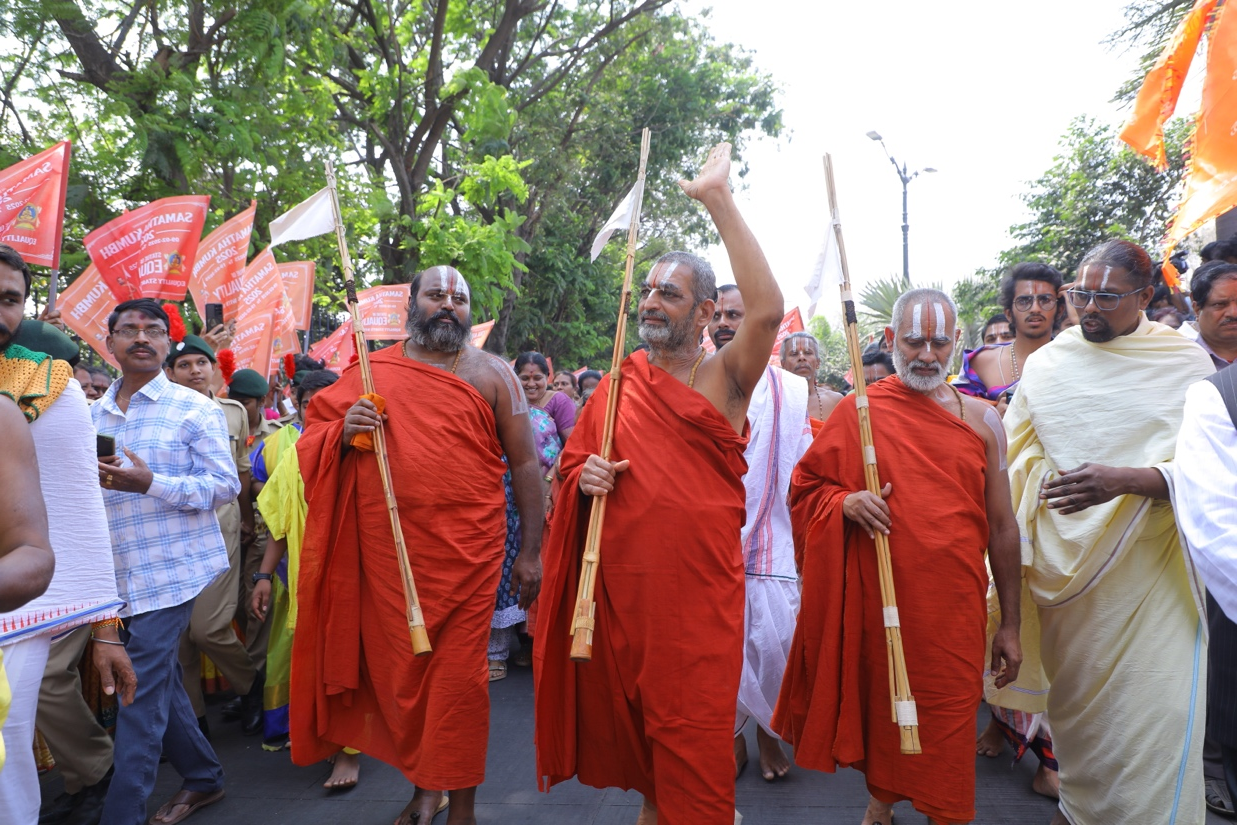
A group of men in red robes walking down the streetDescription automatically generated

The Samatha Kumbh festivities, held annually, begin on the Ardra star, the birth star of Sri Ramanujacharya Swamy, during the month of Magha. This year’s celebrations were marked by a grand procession, the Samatha Yathra, which stretched from Necklace Road, Tankbund to the Statue of Equality in Muchintal. Over 100 buses participated in this sacred procession, symbolizing unity and a shared purpose.

Before the procession, a powerful walk was organized, with 5,000 participants from all walks of life. The march began at the Statue of Dr. Ambedkar and concluded at People’s Plaza. HH Chinna Jeeyar Swamiji offered a garland to Dr. Ambedkar’s statue, emphasizing the message of equality championed by Sri Ramanujacharya Swamy.
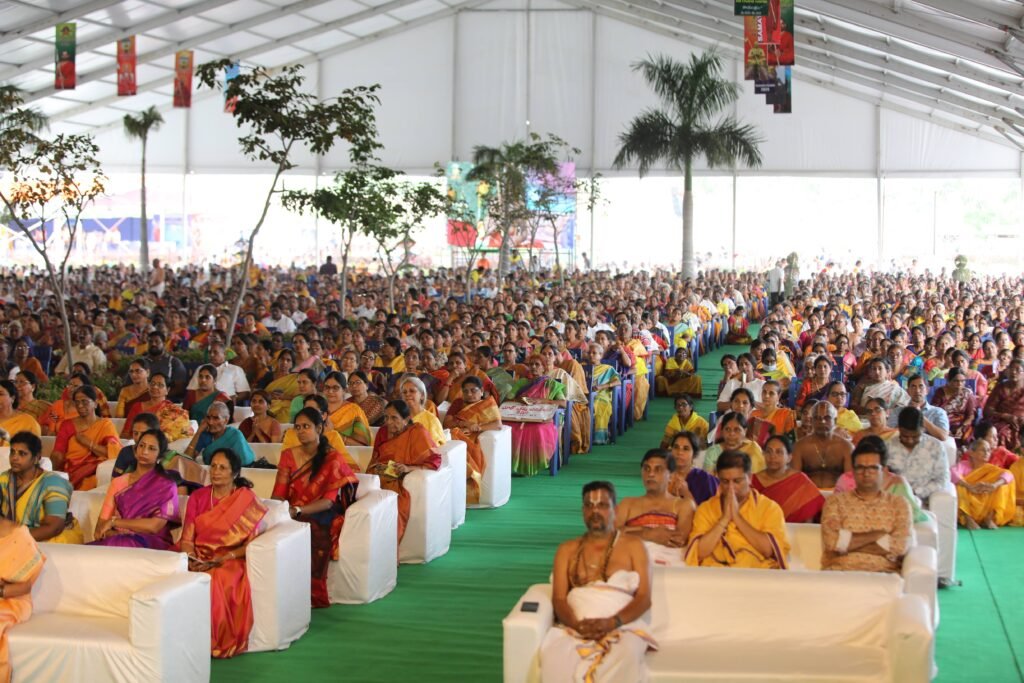
Sri Ramanujacharya, who lived from 1017 to 1137 CE, is renowned for his efforts to eliminate social inequalities and promote equality before God. Traveling across India, he advocated for a society where all individuals, regardless of caste, religion, or background, were treated equally. His progressive vision resonated with Dr. B.R. Ambedkar, who praised Ramanujacharya’s reforms in his 1927 publication “Bahishkrit Bharat.”

In his speech, HH Chinna Jeeyar Swamiji highlighted the relevance of Ramanujacharya’s teachings, which are still vital in today’s world. “When society faces a need, it is our duty to offer our services, share knowledge, and contribute physically. This truth, imparted to us a thousand years ago, remains as relevant today. The festival we celebrate honors Sri Ramanujacharya, who embodied this principle of social unity,” Swamiji stated.

The Samatha Yathra marks the third annual celebration of the Statue of Equality and will conclude at the Statue of Equality in Muchintal. The procession is expected to reach the Statue of Equality by 4:30-5 PM. In the coming days, from February 10-13, educational sessions focusing on knowledge and social equality will be held every afternoon with students from nearby colleges. These sessions aim to inspire and empower the next generation to promote social equality and justice.

The Samatha Kumbh 2025 Mahotsav, running from February 9 to February 19, invites everyone to join in these meaningful celebrations. The event is an opportunity to reflect on the values of equality and social justice that were championed by Sri Ramanujacharya and Dr. B.R. Ambedkar and to carry these ideals forward for the betterment of society.

The Statue of Equality, a 216-foot-tall monument of Sri Ramanujacharya, is a symbol of equality and inclusiveness. It is a reminder of the sacrifices made by Sri Ramanujacharya in his quest for a more equal society. The statue serves as a beacon of hope for those who are marginalized and oppressed, inspiring them to fight for their rights and dignity.

Leave a comment

Your email address will not be published. Required fields are marked *

RAMAYANA: THE EPIC REIMAGINED

Ramayana: The Epic Reimagined is shaping up to be one of Indian cinema’s most ambitious productions, bringing together a star-studded cast and an international creative team. From its two-part format and reported ₹4,000-crore budget to its cutting-edge visual effects and global release plans, here are 10 things to know about the epic cinematic spectacle. 1.Two films, one epic Ramayana is planned as a two-part cinematic project. The first instalment is scheduled for release during Diwali 2026, with the second chapter planned for Diwali 2027. The films are directed by Nitesh Tiwari and produced by Namit Malhotra. Ranbir Kapoor has revealed that the team shot around six hours of footage for the first film before editing it down. A Chinese listing reportedly indicates a runtime of about 166 minutes for Part One. 2.Ranbir Kapoor as Rama: The first choice Ranbir Kapoor plays Lord Rama, amid years of speculation over other names. Mahesh Babu, Hrithik Roshan and Ram Charan were among the actors linked to various versions of the project. However, director Nitesh Tiwari and producer Namit Malhotra have clarified that Ranbir was always their first choice for their current Ramayana. Tiwari cited his physicality, screen presence and ability to convey emotion through his expressions. Interestingly, Yash, who plays Ravana, was also reportedly considered for Rama before taking on the antagonist. 3.Sai Pallavi is Sita Sai Pallavi plays Sita opposite Ranbir Kapoor’s Rama. The role marks a major Hindi-film project for the acclaimed South Indian actor and adds another prominent South Indian star to the cast alongside Yash. 4.A large ensemble cast An extensive ensemble supports the three leads. Sunny Deol plays Hanuman, Ravi Dubey plays Lakshman, Arun Govil plays Dasharath, Lara Dutta plays Kaikeyi, Indira Krishnan plays Kausalya, Kajal Aggarwal plays Mandodari, Rakul Preet Singh plays Shurpanakha, Kunal Kapoor plays Indra

Exclusive Interview: Nikhil Siddhartha on Swayambhu, Family and Politics

After the pan-India success of Karthikeya 2, Nikhil Siddhartha finds himself at a pivotal phase in his career. The actor is currently gearing up for the release of Swayambhu, one of the most ambitious projects he has undertaken to date, a historical action drama that demanded nearly two-and-a-half years of dedication, extensive physical transformation, and months of post-production work. In a candid conversation with Priyanka Goud, Nikhil opens up about the challenges of mounting a large-scale period film, why he prioritises quality over quantity, how fatherhood has changed his outlook on life, and his belief in using cinema as a tool for social awareness. A Two-and-a-Half-Year Commitment Describing Swayambhu as a project unlike any other in his career, Nikhil revealed that he dedicated nearly two and a half years exclusively to the film.“Some films are easy to make, and some are difficult. Swayambhu falls into the category of films that demand complete commitment. I underwent a significant transformation for the role, growing my hair long, maintaining a specific physique, and immersing myself in the character and story throughout the production period,” he said. A Historical Story with Universal Appeal One of the aspects that attracted Nikhil to Swayambhu was its historical backdrop. Nikhil plays Krishnan Raman, a historical figure whose name appears on ancient copper plate inscriptions that have recently gained attention. “This story is rooted in history, but its themes are universal,” he said. “It’s not confined to one region; audiences across India will be able to connect with it.” The actor also highlighted the growing importance of visual effects in modern filmmaking. Swayambhu reportedly contains nearly 2,700 VFX shots, making post-production one of the most demanding phases of the project. “We completed principal photography in December 2025, but for the last five to six months it has been

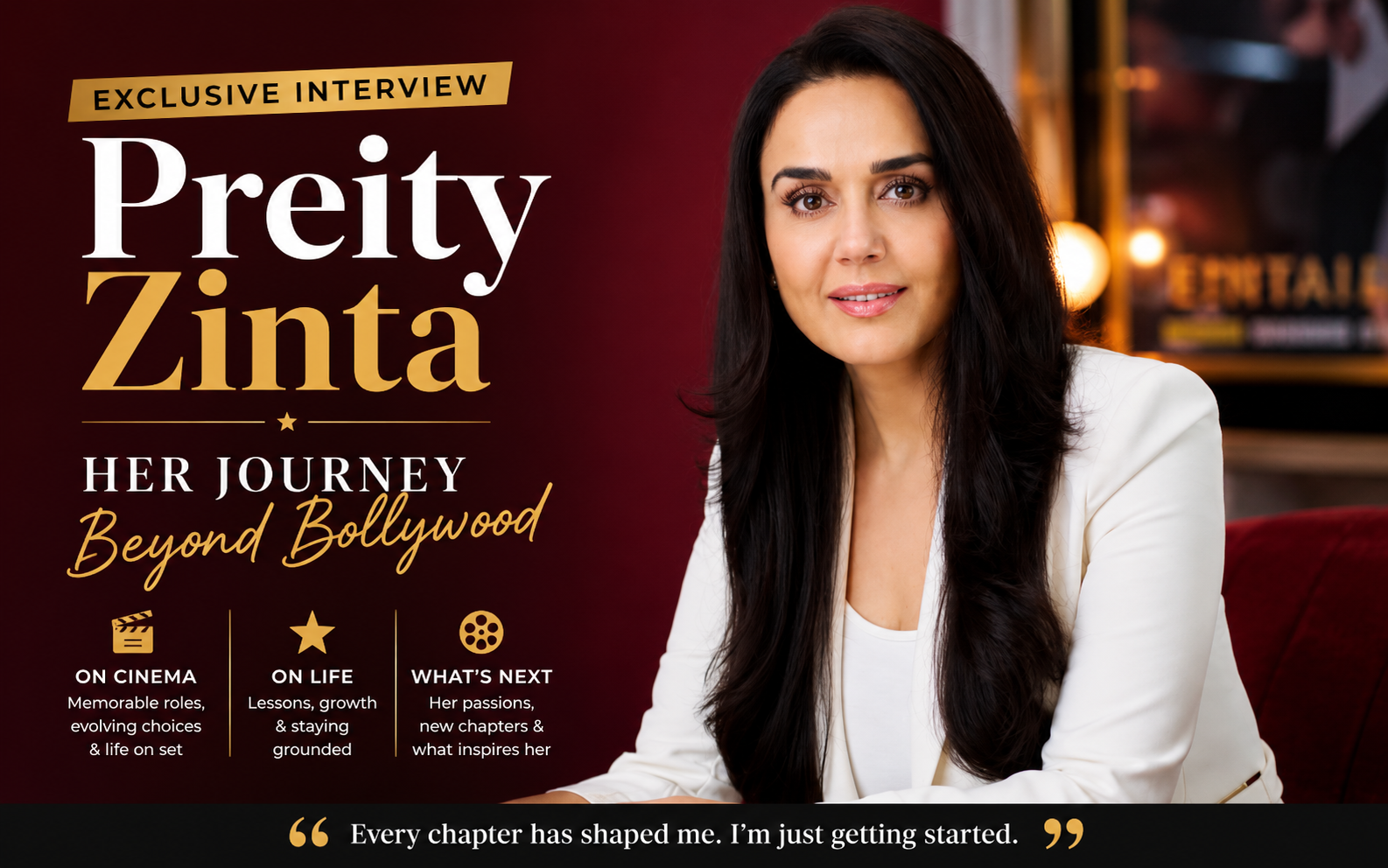
Preity Zinta on Batwara 1947, Motherhood and Finding Her Way Back to Cinema

For Preity Zinta, returning to the screen with Batwara 1947 is about more than making a comeback. The period drama allowed her to explore a chapter of India’s history, work with director Rajkumar Santoshi for the first time, and step into a world far removed from her own. But the film also made her reflect on how much life has changed since she began her career, from the freedoms available to women today to the perspective that comes with becoming a mother. For Zinta, Batwara 1947 is ultimately a story about family, resilience and hope, as she tells Lipika Varma in an exclusive conversation. Why did you say yes to doing this film? What touched you the most? There were a couple of things. First, I really wanted to work with Raj ji. I had never worked with him before, so working with him was always on my bucket list. I had also always wanted to do a period film. Beyond that, I genuinely loved the story. What touched me most was that even in the darkest of times, there is always a ray of hope. People may see this as a story about two countries, but for me, it is essentially about a family. I was also deeply affected by stories of families who believed they were leaving their homes temporarily, even burying their jewellery and valuables, thinking they would return. They never imagined they would lose everything forever. Since this is my first period film, I spent time researching and understanding that era. After such a long break from films, why did you choose this project? I was enjoying my personal life, focusing on my family and raising my children. Professionally, I had always wanted to work with Raj ji and also wanted to do a period film.

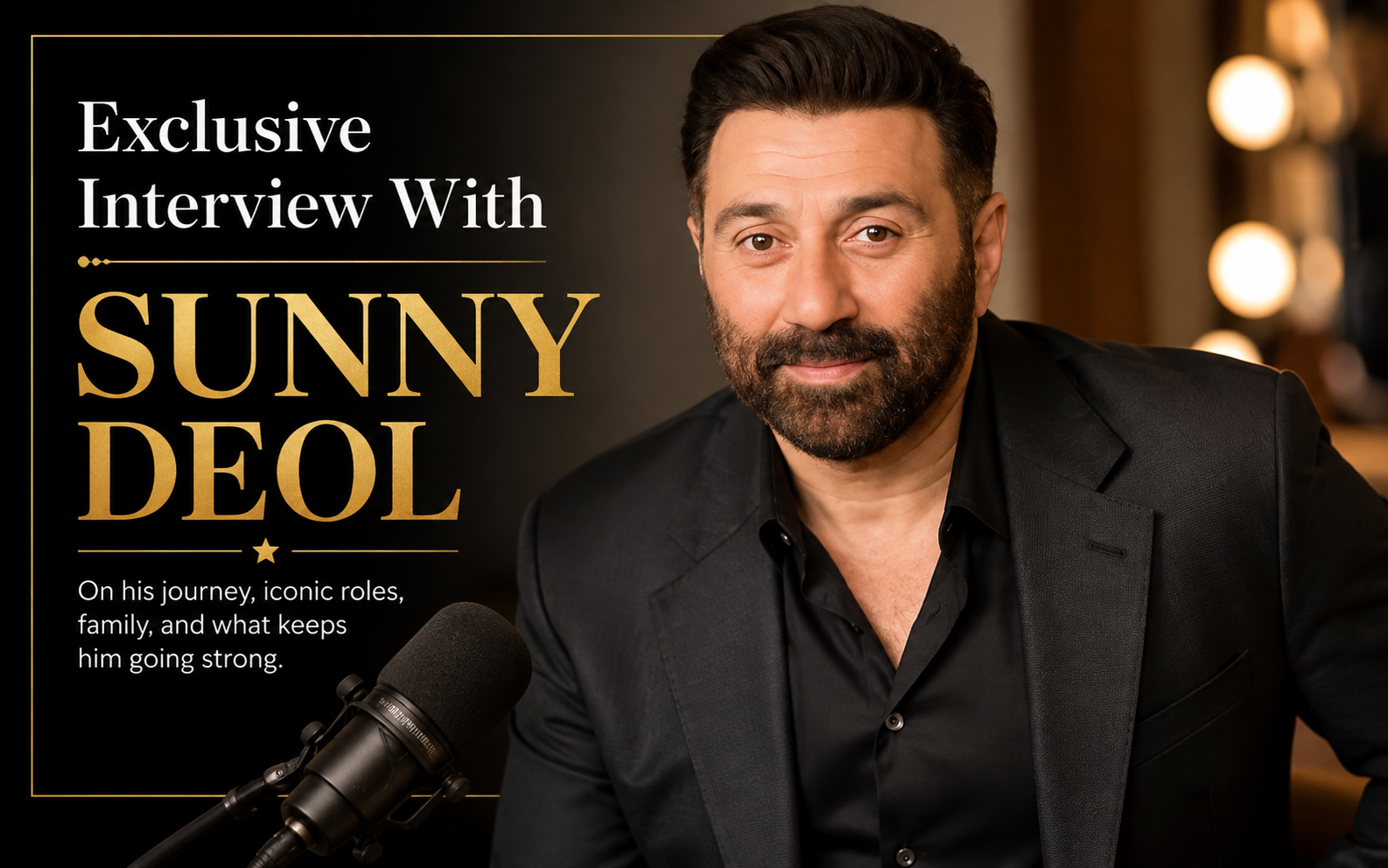
Exclusive Interview with Sunny Deol: Life Beyond Bollywood

Sunny Deol: “Every Film Leaves Some Kind of Impact” With Batwara 1947, Sunny Deol returns to a story rooted in Partition, family and the human cost of one of the most defining moments in Indian history. The actor reflects on why he sees the film as fundamentally different from Gadar, his long-standing association with director Rajkumar Santoshi, his father Dharmendra’s connection to their shared cinematic history, and the responsibility actors carry when their work leaves a lasting impact on audiences. In conversation with Lipika Varma, Sunny Deol also opens up about playing a character outside the action-driven image audiences often associate with him and working alongside his son Karan. How did you approach the character in this film? For me, it was the subject, the story and the character that I had heard about, and I approached it accordingly. I don’t know exactly what was tweaked. I didn’t read the original play or see it. Vivek Raj had read it, and we had been working on this story since 2010. Unfortunately, we couldn’t make it back then, so we had been waiting all these years. As soon as we got the opportunity, we jumped into it. Sunny, are you happy that your fans, including those in Pakistan, will get to see you in a completely different kind of role this time, without the iconic hand-pump moment or typical action scenes? Actually, I don’t think it’s about that. Fans are always there, and they love you no matter what. Sometimes journalism and politics come into the picture and change the colours of things. But the actual viewer, the person sitting in the theatre and watching the film, doesn’t necessarily look at things that way. They simply watch the film. I’ve met a lot of fans across the country and around the