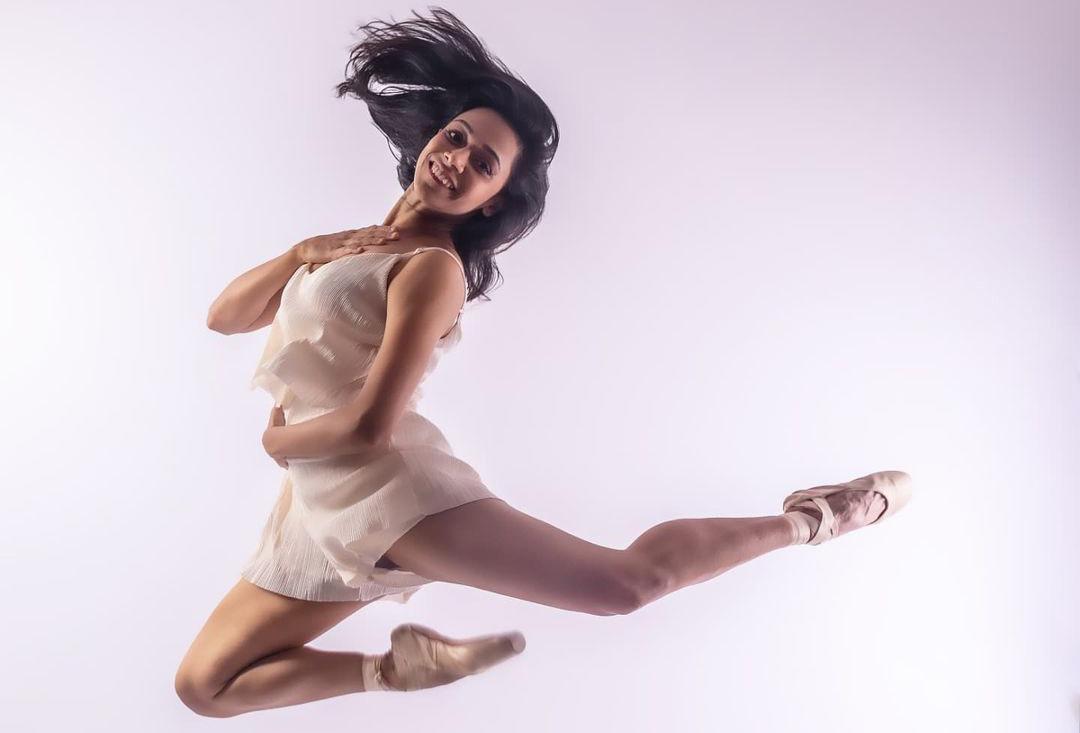
Ballet Beckons – Shivani Mistry

Canta Dadlaney talks to Miss Twinkle-Toes, as Shivani Mistry likes to call herself, to understand her interest in this graceful dance form which many admire but few pursue. 
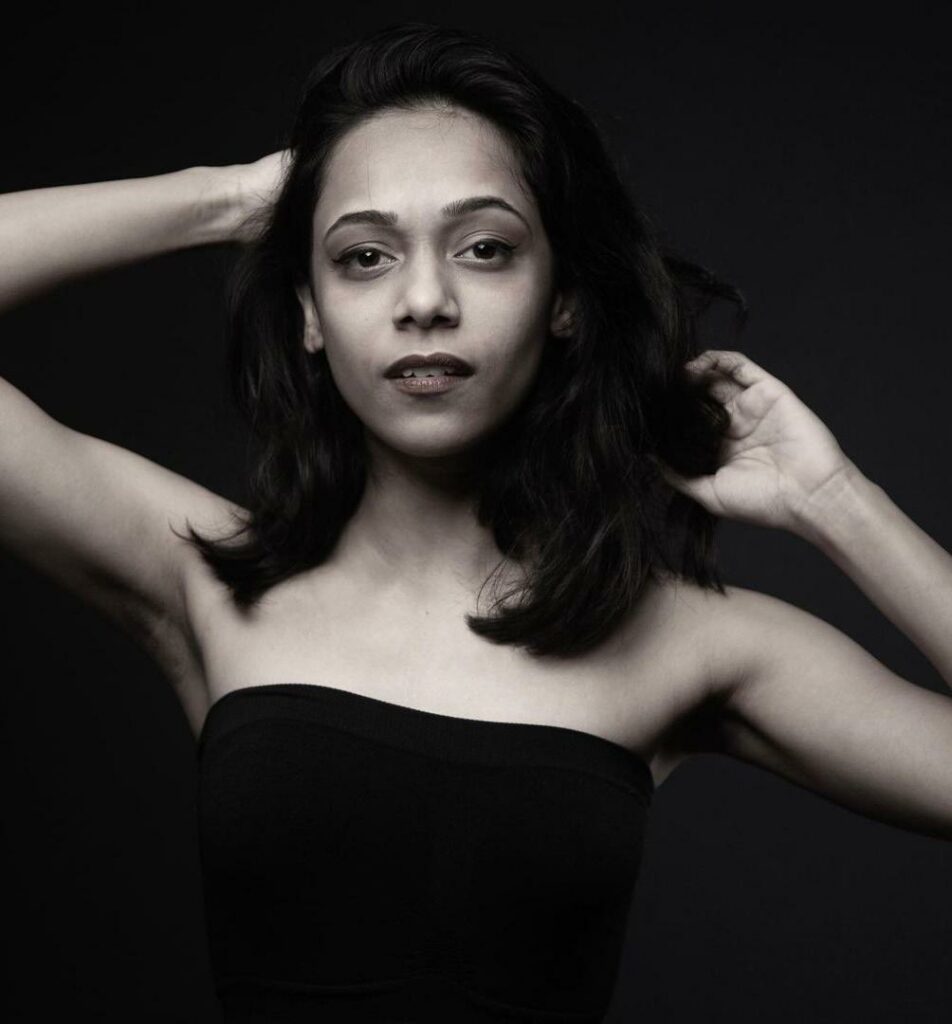
Shivani Mistry

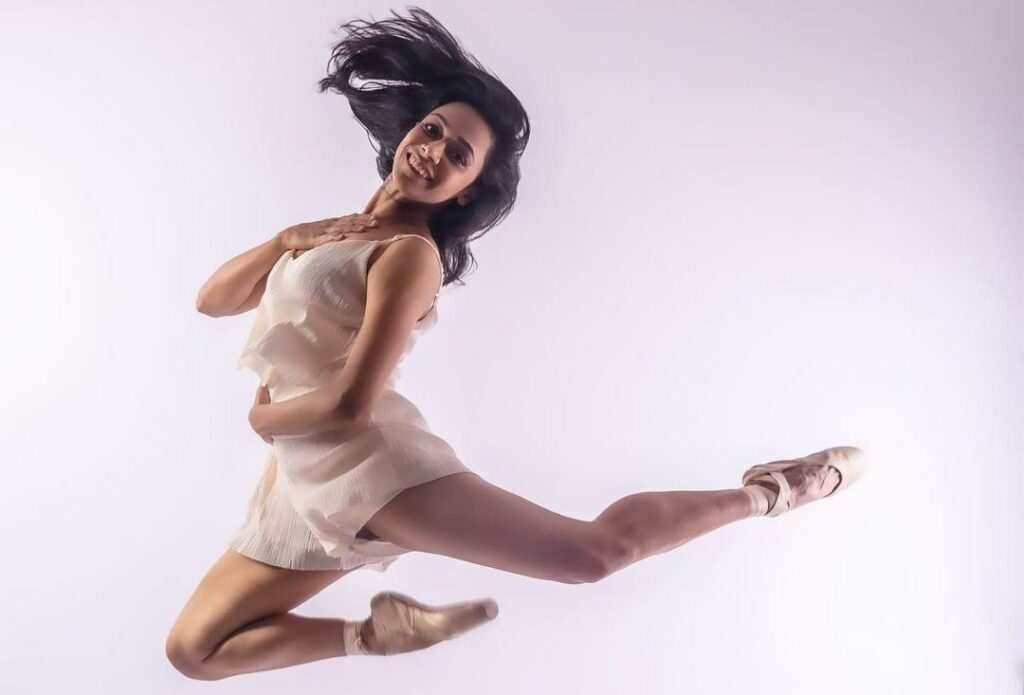
Shivani translates to follower of Lord Shiva; it is perhaps this that impacted Shivani Mistry to pursue the dance form of ballet at the tender age of 5 years. A degree in biotechnology and a career in ballet could baffle anyone. She’s been featured in the ISTD International Dance magazines for being one of the youngest to accomplish a lot in the field of Modern Theatre, Ballet and Latin American. She has also been featured in the anniversary edition of Vogue’s Blurred Lines as a physical and mental health activist and influencer. We learn more about her fascination with ballet, and what inspires her to dream.
How It All Began

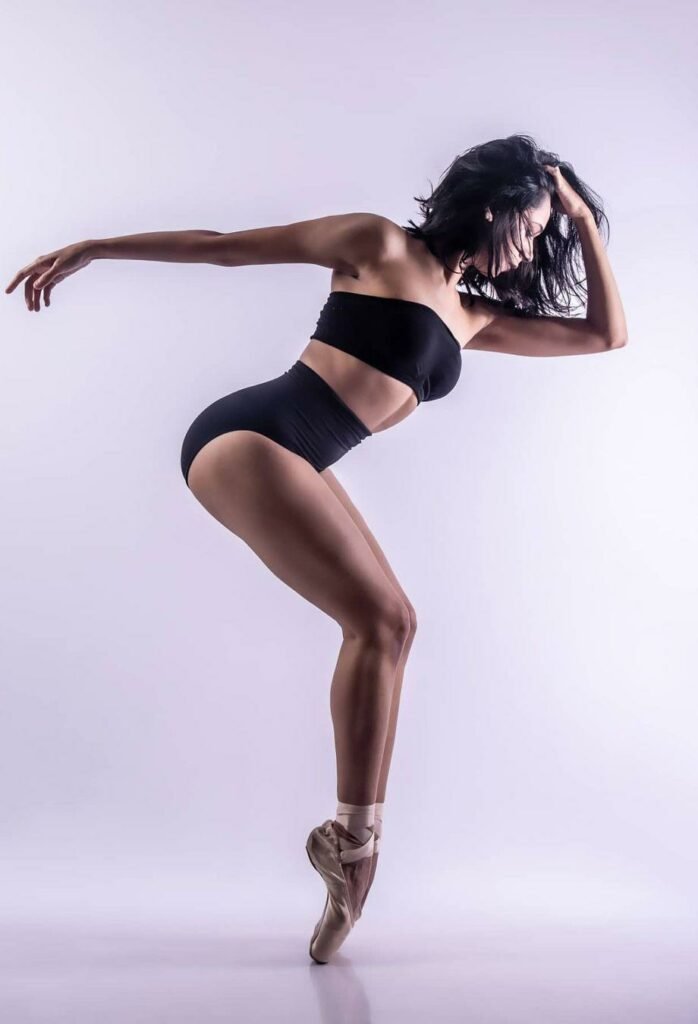
How does the dream for ballet begin? Says Shivani, “I was only 5 years old when my parents noticed me walking constantly on my demi pointes. My Dad learnt of Tushna Dallas and The School of Classical Ballet and Western Dance for young kids through one of his clients. My parents contacted Tushna and secured a place for auditions. Since the fees were too steep, my parents decided against it. Tushna however, was determined to train me. She believed I was a prodigy and offered a scholarship. That’s how I started my incredible, long, dedicated journey in this dance form. At first, I pursued ballet as my only extra-curricular activity. I enjoyed it immensely. With time I found myself becoming adept at it. The challenges were many, but I never stopped.”

My parents have been pillars of support.
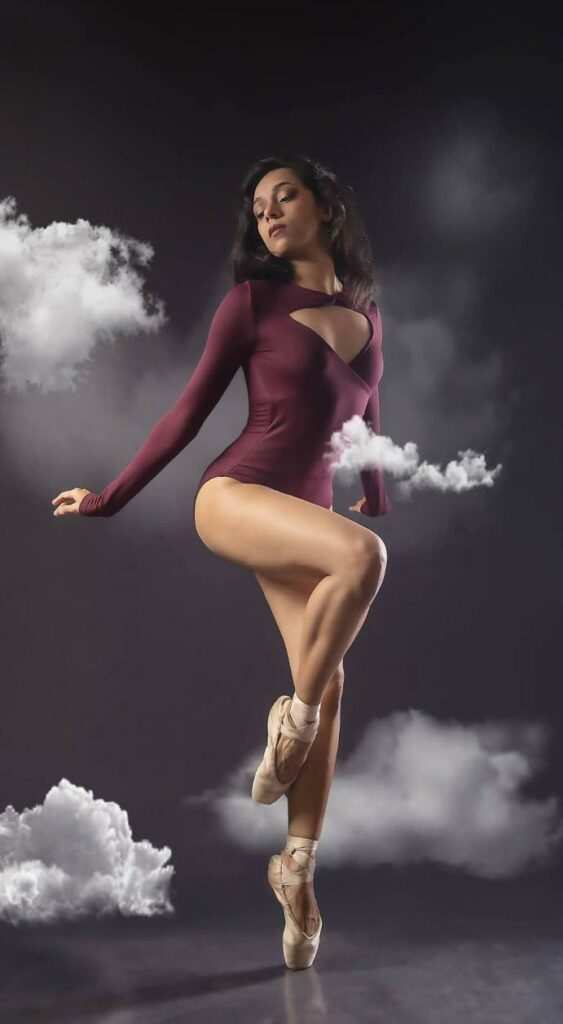
To be endowed with a scholarship at the age of 5 is no mean task. No wonder then, that Shivani started teaching at the age of 16 when most teens are at crossroads about career paths. An innate passion made this precocious teenager start saving as much as she could from her nominal earnings from the age of 18. Every time the savings accumulated, she would enhance her skills with a 3–6-month training schedule, overseas. Gifted yet humble, this amazing danseuse makes no bones about her family’s inadequacy to fund this expensive dance form. 

Dance science is an aspect where you research, understand and discover things required or related to movement.

“My parents have been pillars of support; why else would they have taken a 5-year-old for auditions. Ballet training entails many expenses and beyond a point there was not much they could do,” says Shivani, who never fails to express her gratitude to her parent’s initial support which she says shaped her future. 

Core Learnings

Dance Science, as she calls it is an inherent part of her teaching. “Science is around us. Our bodies and minds function on the fundamentals of science. Dance science is an aspect where you research, understand and discover things required or related to movement. You must understand the anatomy, the mechanics as well as the physics behind a movement. There are so many other factors like the usage of breath, movement across the floor, injury prevention, and even safe teaching. I love to incorporate everything that science has taught me in dance and dance has taught me in science,” notes Shivani.
A Vibrant Career

Not one to be content only with teaching, this poised young lady has performed at numerous stage-shows, corporate events, and has enjoyed performing on stage in Israel and Australia. It has been a decade of teaching for Shivani. Teaching at the same school which gave her a break at 5 is something she plans to do always. In addition to that, she has taught at Shiamak Davar’s institution (Joy program and OYPs) and the Goa Dance Residency. From choreography to modelling and teaching, Shivani has achieved a lot at 27 years. Her visit to Israel in 2019 saw her train with the Kibbutz Contemporary Dance Company for 6 months. 

Ask her what ballet has taught her in her journey of life so far and this is what she has to say: “Ballet for me has been a learning about everything that life holds for us. My incredible teacher, Tushna Dallas, taught me patience, humility, kindness, optimism, gratitude, and the art of respecting all. I have truly applied these in my life and continue to better myself every single day. I did not allow my challenges to dissuade me even once. I never looked back.”

NATOYA is Shivani’s entrepreneurial online venture which she founded during the pandemic phase. “I had never come across any stores which sell ballet-wear and accessories. I decided on this online store to encourage as many dancers as possible across the country to access this merchandise at reasonable prices.” 

Ballet for me has been a learning about everything that life holds for us.

Going Forward

Change is the only constant goes the adage. Shivani’s choreographies are always inspired by change. Her efforts at creating an awareness of the many things that require change inspired her to produce works like Plastic Pollution, Survivors, Social Man Kind, Apocalypse, and Riyaaz, among others. Shivani believes that in a country with a rich, diverse culture, the concept of dance as a career has many prospects in India. “I truly wish to uplift the entire artist community because I believe that India and Indian artists have a lot to offer; the world has only witnessed the tip of the iceberg.” An inspiring ballet dancer, Shivani is ready to take on new challenges and embrace as many as possible, in her passion-filled community. 

Leave a comment

Your email address will not be published. Required fields are marked *

It’s Not Just a Painting, It’s an Emotion on Canvas: Live Wedding Art in 2026

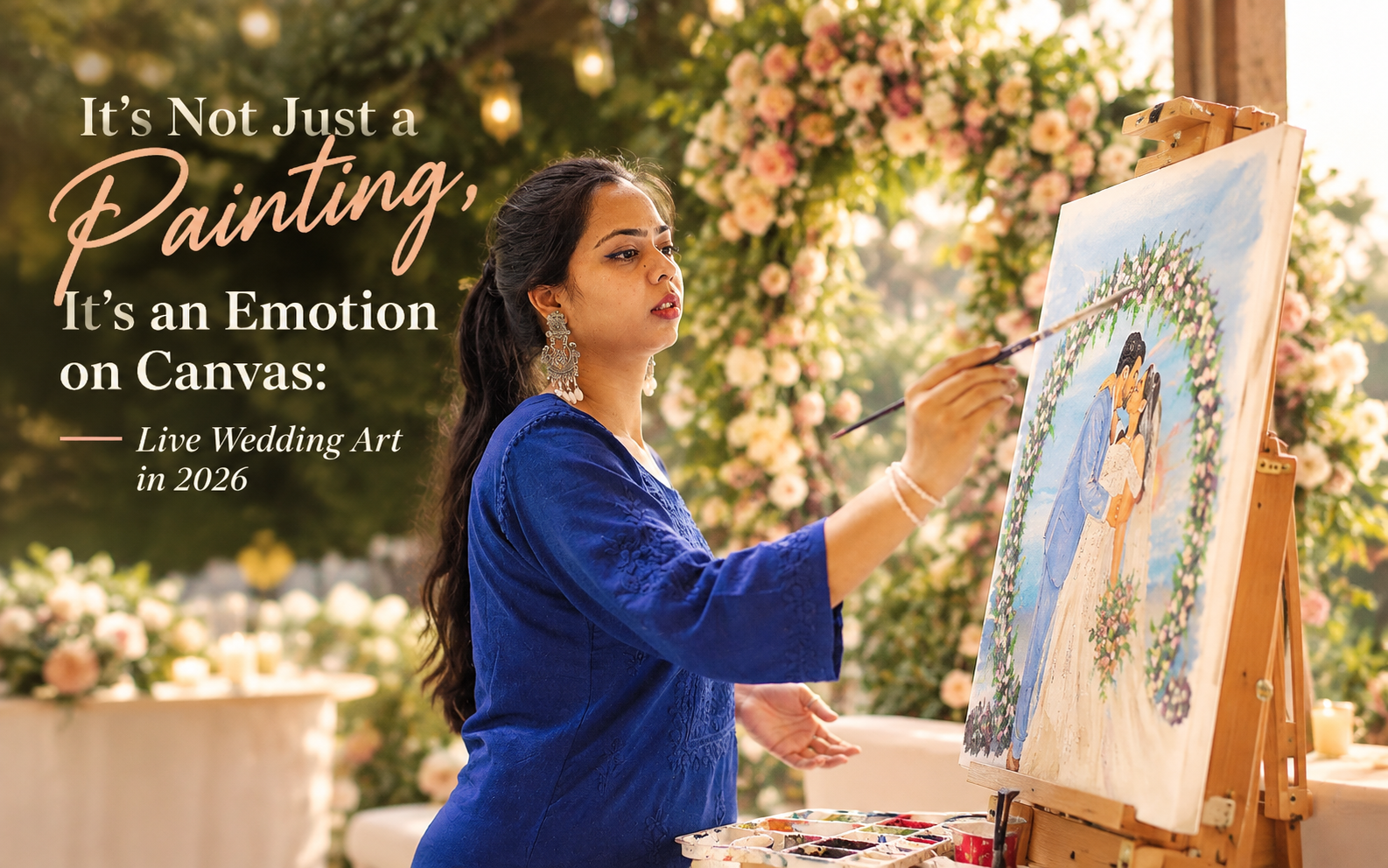
Bangalore-based artist Shivani Jaiswal paints live at weddings and events across India, including destination weddings, translating fleeting moments onto canvas as the celebration unfolds. Her view for 2026: a wedding painting is no longer just a portrait of the couple, but a visual story of the whole day, made to bring back how the wedding felt, not only how it looked. Here is what she sees shaping the art form. From Portrait to Whole-Wedding StoryLive wedding painting is becoming less about a portrait of the bride and groom and more about the feeling and atmosphere of the entire celebration. Couples now want the venue, décor, flowers, family and small details included, so the painting reads as a visual story of the day. It is also becoming more personal: the aim isn’t to reproduce a photograph on canvas, but to interpret the light, expressions, colours and emotions of the wedding in her own artistic style. Painting the Moment That MattersCouples increasingly ask for one specific moment: a forehead kiss, a romantic glance, a groom down on one knee at the ring ceremony, the exchange of garlands, the first dance or the wedding entry. These moments last only seconds in real life, but they are the ones couples want to hold on to forever. A Gift Filled With EmotionThe painting has become a deeply emotional gift. A groom may surprise his bride, a bride her husband, or siblings, friends, and parents may gift it to the couple. It carries the emotion of the giver too, as if to say- I saw this moment, I know how much it means to you, and I wanted you to have it forever. Art That Becomes Part of the CelebrationPainting live means the canvas becomes part of the wedding itself. Guests wander over to ask questions

Backstage Siblings: Turning Bhajans into a Global Movement of Music, Connection & Belonging

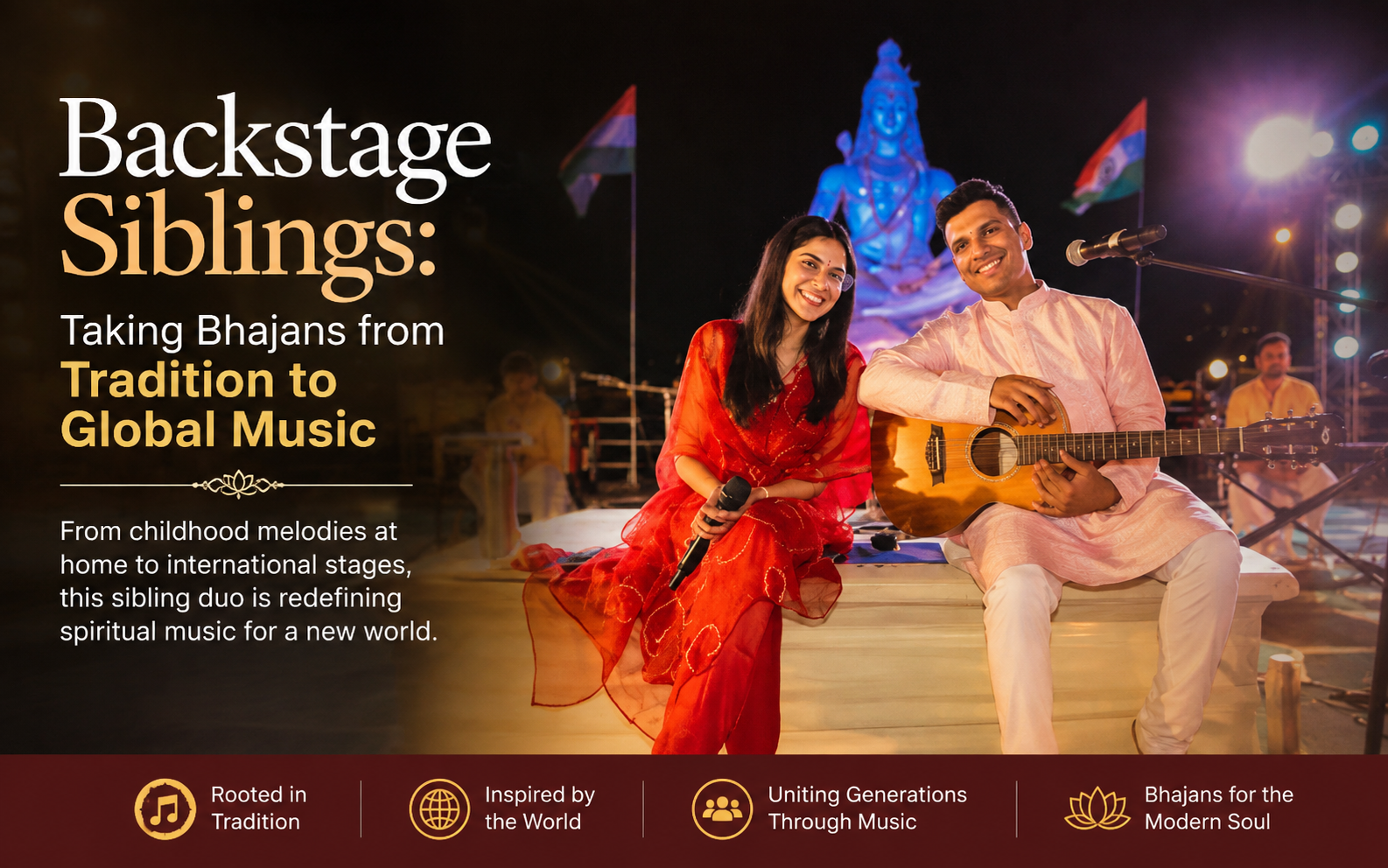
What began as childhood satsangs has evolved into one of India’s most compelling live music experiences. Siblings Raghav and Prachi, founders of Backstage Siblings, have reimagined bhajans and collective singing for a new generation seeking meaning beyond the noise. From intimate living room sessions to sold-out shows across cities and international stages, their journey is less about scale and more about creating spaces where music becomes a shared emotional release, raw, real, and deeply human. You grew up attending satsangs with your father. At what point did you realise those childhood musical memories could evolve into something this massive?Honestly, there was never one big moment where we thought that this was going to become massive. We grew up going to satsangs with our father, and bhajans were just a very natural part of our lives. They were familiar, comforting and always gave us a sense of peace. That stayed with us quietly, even as we grew older and moved into completely different lives. It was only when we were deep in our corporate careers, surrounded by the constant noise of being always on, that we started feeling the need for something slower and more honest. We kept asking ourselves whether we could create a space where people could feel what music had always made us feel. That question became the beginning of Backstage Siblings. Both of you came from demanding corporate careers. What pushed you to leave that world behind and take Backstage Siblings seriously?Corporate life was fast, demanding and relentless. There is a certain kind of exhaustion that comes from always being connected, always responding, always moving to the next thing. For us, music was the one thing that genuinely slowed everything down. At first, Backstage Siblings was something we did because it felt honest. But very quickly, the

Independent Tattoo Artists Making India’s Ink Scene Cooler Than Eve

There was a time when getting tattooed meant walking into the most popular studio in town and choosing a design off a wall. But India’s tattoo culture has evolved far beyond that. Today, people are searching for something far more personal, with art that carries identity, emotion, storytelling, and individuality. In an era where self-expression matters more than trends, independent tattoo artists are becoming the real stars of the ink scene. Mehak Walia in conversation with six independent tattoo artists, discussing their specializations and beyond. From hyper-detailed realism and hand-poked art to experimental linework and culturally rooted designs, a new generation of tattoo artists across India is building loyal communities purely through their distinct styles and creative vision. They are not just creating tattoos; they are creating experiences, safe spaces, and deeply personal collaborations that stay with people for life. So, let’s just shine a spotlight on some of the most exciting independent tattoo artists making their mark and redefining what India’s modern ink culture looks like today. Six Must-Check Independent Tattoo Artists: AZ aka Azrael: For Azrael, tattooing is far more than a profession; it is a deeply personal and meditative form of expression. Drawn to the idea of creating lasting art on somebody else’s skin, he describes the process as both peaceful and creatively fulfilling. “I love the whole process of creating art on somebody else’s skin,” he says, adding that tattooing is also where he feels most connected to music and to his own individuality as an artist. “I feel like I want to do my own thing in my own way.” While many artists view tattooing purely as body art, Azrael sees the medium extending far beyond skin. Inspired by the intersection of fashion, design, and tattoo culture, he believes the industry has the potential to

ABHAY PRABHAVANA: WHERE INDIA’S ANCIENT VALUES MEET THE FUTURE

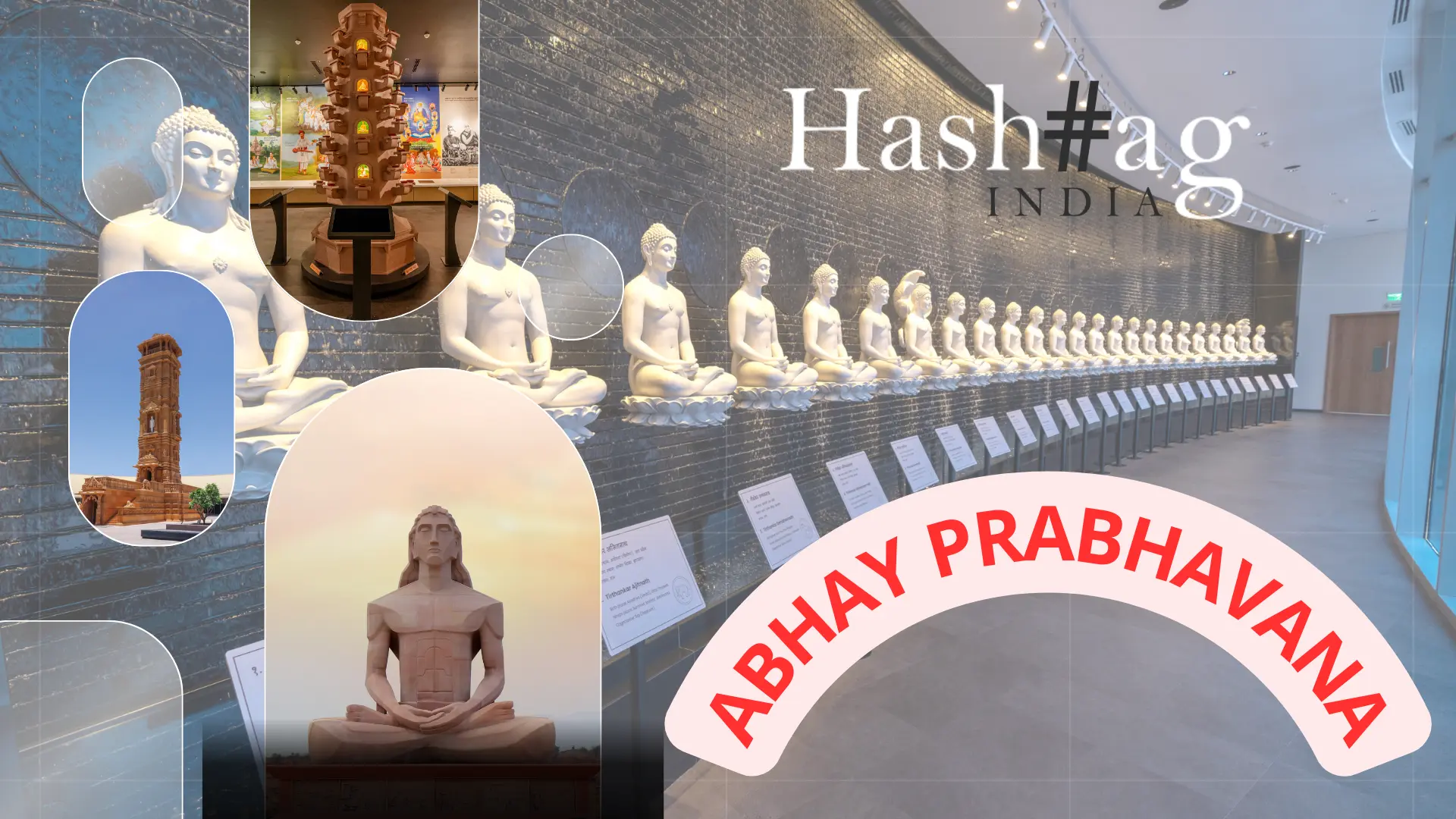
What if a museum didn’t just show you history, but revealed the very values that built India as a civilisation? Abhay Prabhavana is a remarkable museum nestled far away from the rush and noise of the city. Surrounded by peaceful rural landscapes and open skies, the place feels deliberately distanced from distractions, almost as if silence itself is part of the experience. As Vonteru Aarthi Reddy explores, this space offers far more than visual exhibits. Unlike any museum I’ve visited, Abhay Prabhavana does not rely on ancient artefacts or recycled displays. Instead, it invites you on a carefully crafted journey to understand India’s values, evolution, and inner wisdom. What makes it even more extraordinary is that the museum took nearly ten years to build researching, writing, sculpting, designing, revising, and refining all dedicated to presenting India’s civilisation with clarity and integrity. A Museum Built Like a Civilisation — Layer by Layer The first thing that struck me was how thoughtfully everything is structured. This is not a place that overwhelms you with dates and artefacts. Instead, the museum unfolds like a narrative, a story of who we are, where we came from, and why our civilisation stood firm for thousands of years. The journey begins with India’s ancient values. Concepts like Atma, Karma, restraint, truthfulness, compassion, and discipline, often misunderstood or oversimplified, are explained here with remarkable clarity. Visual storytelling blends seamlessly with philosophy. As you move forward, the museum transitions into India’s civilizational story. You witness how our earliest cultures formed along the rivers, how Jain, Buddhist, and Vedic traditions shaped thought, and how ideas circulated freely in ancient India. The narrative is honest and balanced; it explains prosperity, decline, resilience, and transformation without exaggeration or omission. Everything inside the museum is freshly created: every sculpture, every painting, every

You May Also Like

Connect with us