
Work from Anywhere: Bangalore Edition

The pandemic fueled lockdown meant a big change for office goers as work from home became the mandate. Two years into the changed world we live in, the meaning of office in terms of location has also changed. Starting with work from home, the concept today is work from anywhere. Bindu Gopal Rao explores some newer spaces that are becoming popular in Bangalore and be rest assured all of them have COVID-19 safety protocols in place. Do keep your vaccination certificate handy.

Work from a Museum

At the Indian Music Experience Museum by Brigade, there is a new concept called ‘Work From Museum.’  Manasi Prasad, Museum Director, Indian Music Experience Museum by Brigade, says, “We believe the space is ideally suited for an inspiring and creative work environment, because it is part of a beautiful and aesthetically designed museum, with greenery and calmness all around. The spaces where people can work from are the open-air cafe (it has a roof but is open on the sides) and cubicles in the Learning Centre if people need an indoor space. People can take a break to walk around the sound garden or wander through the exhibit galleries, listen to music, view the artworks and musical instruments on display, and recharge their batteries for more productive work. It is ideal for creative people like graphic designers, artists, writers, bloggers, techies and other professionals.” A day pass costs Rs. 250 for 10 am – 6 pm and includes a working space, a table (this may be shared as cafe tables are big), charging point, access to Wifi internet, museum ticket, and free parking. Food and beverage, printer, and stationery are extra.

Work from a Club

BLVD Club, India’s first private luxury club, makes for a perfect workstation space where one can host meetings, send emails, or make calls. The club has powerful WiFi, seating, and well-equipped conference rooms. A leisurely 20-minute drive from the Bangalore International Airport Road, the club is located inside the sprawling Embassy Boulevard campus, combining exclusivity and sophisticated luxury. Kamakhya Singh, General Manager, BLVD Club says, “BLVD Club has two meeting rooms/Boardrooms (with 8 pax each) equipped with super-fast WiFi and full time IT support. The boardroom opens to a beautiful Koi pond. At Level 1, members can also use the Spirit lounge area along with the boardroom on a chargeable basis. The cost for a boardroom (with 8 pax) is Rs. 4000 for half-day and Rs. 7000 including refreshments. Similarly, for the Boardroom (with 16 pax), the fee is Rs. 8000 for half-day and Rs. 14000 including refreshments wherein taxes will be additional to the overall cost.” BLVD Club brings together the world on your plate with its in-house restaurant ‘Core’ that serves an all-day dining menu with international cuisine.

Work from Restaurant

SOCIAL Works is the pan-India iconic all-day cafe and bar chain SOCIAL’s collaborative shared co-working space, designed to take the creative community offline. SOCIAL Works is an ideal place to connect and collaborate with like-minded creators and professionals across fields and is also the most chilled-out workspace where a member can choose between a cup of coffee or a pint of beer. In Bangalore, SOCIAL Works is present at 4 SOCIAL outposts – Church Street SOCIAL, Indiranagar SOCIAL, Koramangala SOCIAL and Sarjapur SOCIAL. Ranveer Sabhani, Business Head – South, Impresario Handmade Restaurants says, “SOCIAL Works offers full cover membership which means the member gets free food and drinks worth the membership package and effectively making it a zero-rental workspace. It is the most affordable workspace with a day’s pass starting at only Rs 300 (inclusive of taxes). A week’s pass costs Rs. 1200 and a month’s pass will cost Rs 4500 (inclusive of taxes). Members get access to high-speed unlimited free WiFi and free SOCIAL food and drinks worth the package price. The member also gets access to 24 SOCIAL Works across Mumbai, Delhi, Bangalore, Pune, Chandigarh, Chennai and Indore. SOCIAL Works is operational every weekday {Monday – Friday}, between 11.00 am and 6.00 pm.”

Work from a ResortOlde Bangalore Resort has a workcation package of three days, a week, and five days for a couple and single occupancy. It is inclusive of breakfast (Indian and Continental) and unlimited free Wi-Fi. Shravan Nayar, Director, Olde Bangalore Resort says, “You will be in the heart of nature, waking up to the sounds of birds and fresh coffee. The food is homely and satisfying. With plenty of greenery all around, the space lets you unwind amidst the serenity of nature while letting you stay updated with your work and other commitments.” The resort is located 15 minutes before the airport, behind the ITC factory and has luxe tent-style cottages for your stay along with top-notch facilities, including high-speed Wi-Fi to enable seamless working. The workcation package costs Rs. 4500 for single occupancy and Rs. 5250 for double occupancy per night, if you book for three nights. Rates per day can reduce based on the duration and there is unlimited free Wi-Fi included in the package. A special menu will be offered with the food package or you could get a 25% discount on all a-la-carte food orders and a 30% discount on all beverage orders including alcohol. To rejuvenate, you can also check out treatments from Itoozhi, their Ayurvedic partner, at subsidised prices. 

Leave a comment

Your email address will not be published. Required fields are marked *

Wear It Beyond the Wedding: The New Rules of Bridal Jewellery

Mohar Jewels, the Mumbai fine jewellery house founded by Nakul and Priyanka Jain and rooted in a three-generation legacy of gemstones and craftsmanship, sees 2026 bridal jewellery becoming more personal, versatile and made to be worn long after the wedding. Here, the brand shares the trends brides are turning to, from coloured gemstones to detachable polki. Bridal Jewellery Trends 2026Bridal jewellery is becoming more personal, versatile and expressive. Brides are moving beyond jewellery worn only on the wedding day and want pieces that become part of their wardrobe for years. Coloured gemstones, particularly emeralds, rubies and sapphires, are gaining importance alongside classic diamonds and polki, adding colour and individuality. There’s also growing interest in refined layering, detachable pieces and jewellery that can be styled in multiple ways across celebrations. Compared to 2025, when statement sets and traditional silhouettes were still dominant, 2026 is more considered: brides are mixing heritage-inspired elements with contemporary silhouettes rather than committing to one uniform look. Balancing Tradition and PersonalityThe balance comes from respecting the craft while letting the design evolve. Traditional elements like polki, diamonds and coloured gemstones are presented through cleaner silhouettes, unexpected combinations and contemporary proportions, such as classic polki and emerald pieces alongside baguette diamonds, unusual gemstone cuts and more minimal designs. The modern bride wants jewellery that feels like an extension of her personality, not something chosen purely because it’s traditional. The idea isn’t to choose between heritage and modernity, but to make the two coexist in one piece. Dressing Every Celebration Each celebration has its own mood, and jewellery should complement it rather than compete. For daytime functions like haldi and mehendi, think lighter, versatile pieces: delicate polki chains, gemstone earrings, refined bracelets and rings that can be layered, plus detachable polki necklaces. For grand evening receptions, jewellery turns dramatic,

The Biggest Bridal Trends of 2026: Fresh Drapes and Statement Jewellery

What are the three biggest bridal trends you predict will dominate 2026? For me, it’s the reimagining of the drape, the beauty of crafts like chikankari and lace, and a much stronger focus on jewellery. Whether it’s a traditional necklace from our High Jewellery or a contemporary ear cuff that can completely change the feel of an outfit. I think we’ll see the sari and different interpretations of the drape becoming a big part of bridalwear again. There is something so timeless about it, but there are endless ways to make it feel fresh and personal. Which colours and fabrics are going to be particularly relevant? I see a beautiful mix. Ivory and soft pastels continue to feel very relevant, but I also see deeper jewel tones, wine, garnet and unexpected blues becoming important. In fabrics, I love organza, tissue, lace and chiffon for their lightness and movement, balanced with richer silks and velvets. What interests me most is mixing textures rather than allowing one fabric to dominate the entire look. What is one bridal fashion choice you think women should avoid? Wearing something simply because it is trending. Your wedding photographs stay with you forever, and the most beautiful brides are always the ones who still look like themselves. Experiment, absolutely, but don’t allow the outfit to wear you. How should couples approach the challenge of dressing for multiple wedding events without making every look feel repetitive? I always look at a wedding wardrobe as a story. If the wedding is traditional, perhaps the sangeet becomes more glamorous and experimental, the mehendi lighter and playful, and the reception sharper and more contemporary. Change the silhouette, colour, texture and jewellery rather than simply changing the outfit. Every event should reveal another side of you, but together they should still feel

Grazing Tables: The Party’s New Centrepiece

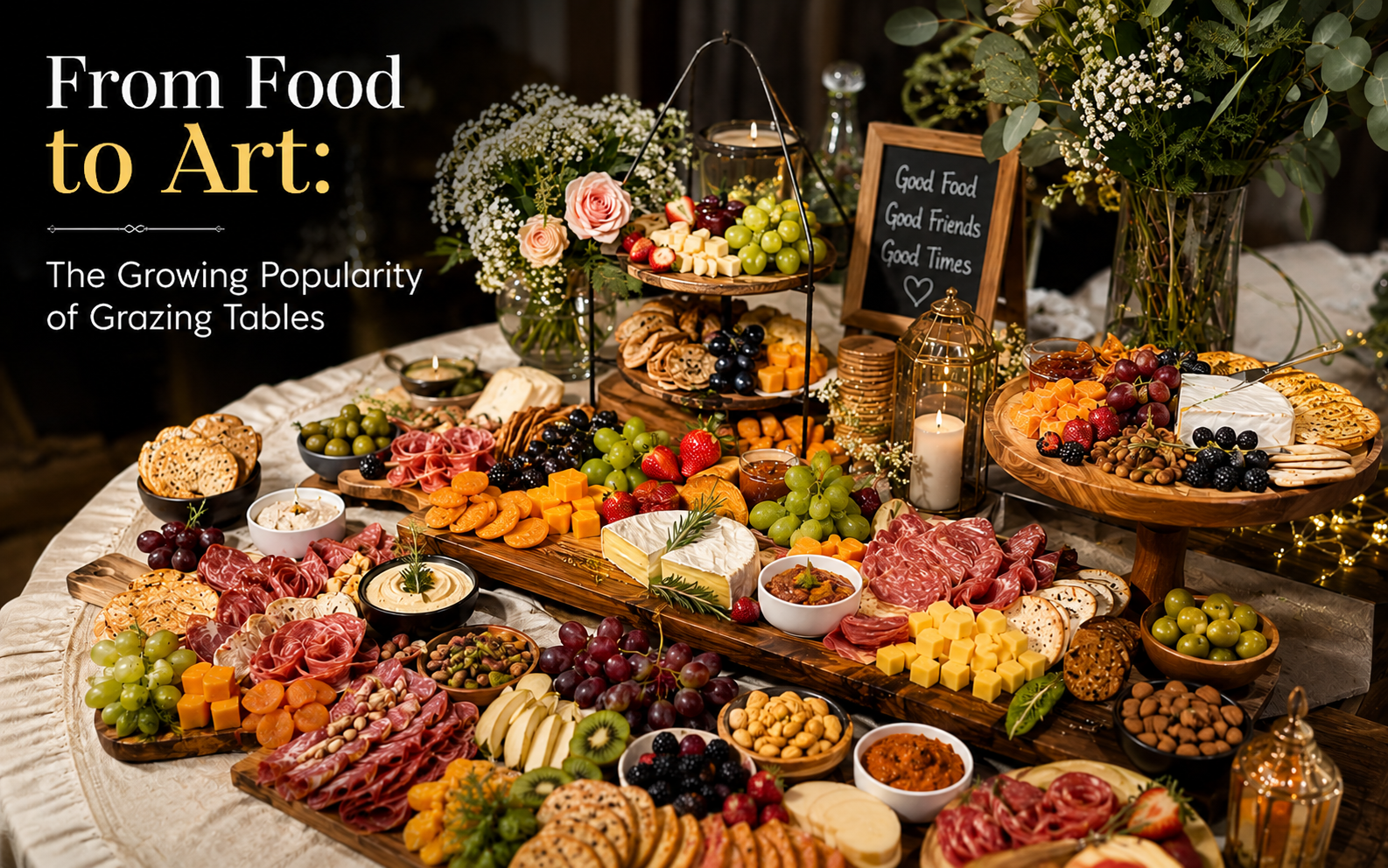
Move over traditional buffets; grazing tables are taking centre stage at celebrations. Budda Swecha explores the rise of this entertaining trend and speaks to grazing-table experts about how they create these edible works of art and why they’re becoming a must-have at parties. Casere: Tanya Tarang Agarwal | Hyderabad For Tanya Tarang Agarwal, founder of Hyderabad-based premium food and gifting brand Casero, grazing tables are about much more than food; they are about creating an experience. With a love for food, aesthetics and entertaining, Tanya brings together thoughtful curation and beautiful presentation to create celebrations that feel effortless, personal and memorable. “Casero has always been about creating an experience around food,” she says. “I love how a beautifully curated grazing table allows conversations to flow freely, accompanied by good food.” Relaxed and social, the format allows guests to eat, talk and enjoy themselves without the formality of a sit-down meal. Tanya believes this ease is what has made grazing tables a favourite at celebrations. “You can simply walk up, pick a bite or two, move around, continue your conversations and come back to the table whenever you want.” With no waiting to be served, the grazing format keeps the party moving naturally. For the perfect visual impact, Tanya swears by height and elevation. “A grazing table should never feel flat,” she says. Different levels, beautiful serving pieces and layers create dimension, abundance and an instant wow factor. FESTIVE FAVOURITES CHIP + DIP A great pairing to start the spread. WOW ELEMENT Something that gets everyone talking. DESSERT A delicious sweet finish. FESTIVE TOUCH An Indian chaat-inspired bite, a flavourful cheese ball with crisps and a refreshing drink to cleanse the palate. Crumble Royale: Saakshi Sabharwal | Delhi For Saakshi Sabharwal, Founder and Head Chef of New Delhi-based Crumble Royale, grazing

Yuvraj & Yashraj Bhardwaj | Powering India’s Circular Economy

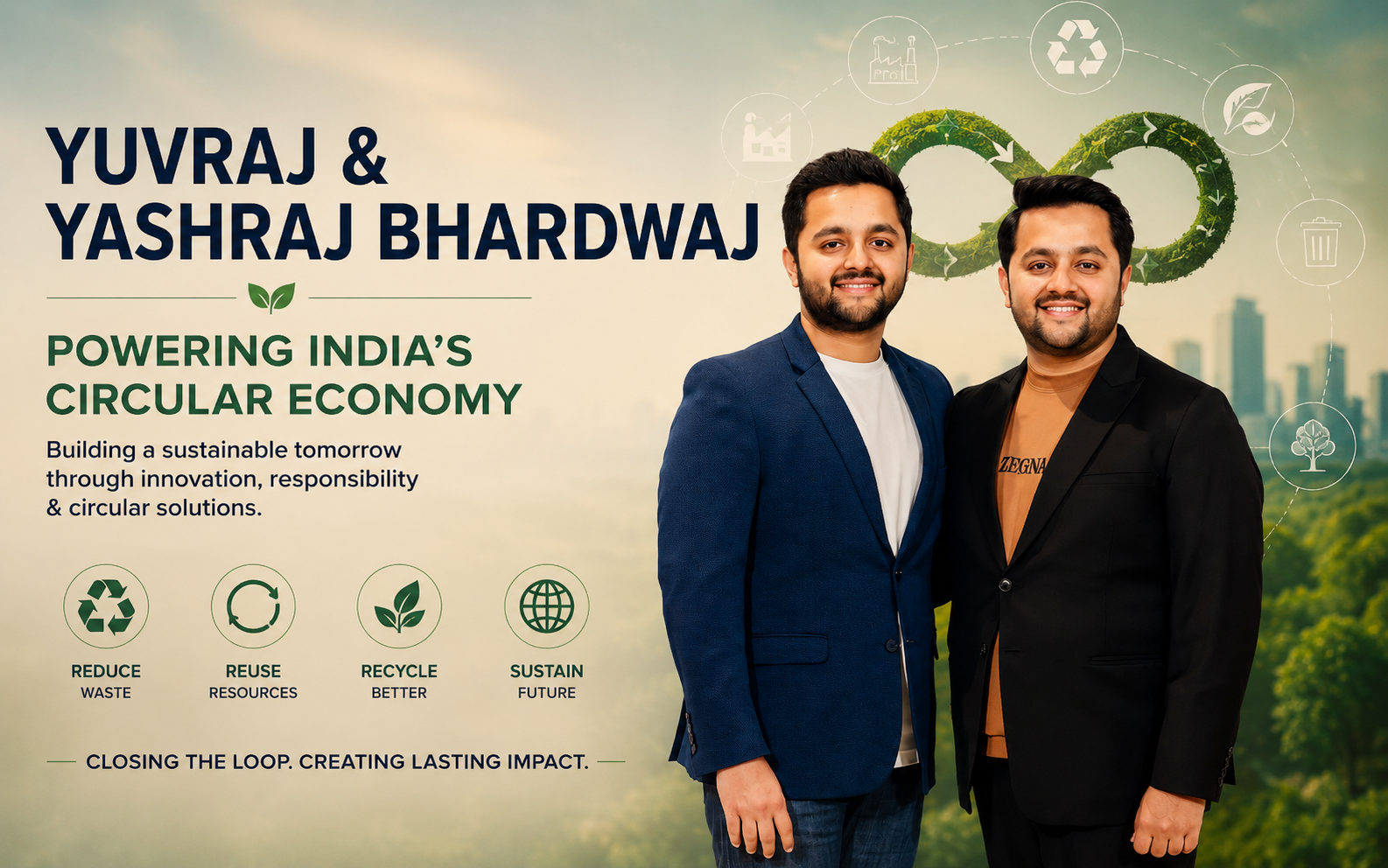
Twin brothers Yuvraj Bhardwaj and Yashraj Bhardwaj are the co-founders of Plannex Recycling, a Gurugram-based circular economy company transforming waste management through technology and innovation. Both entrepreneurs began innovating at the age of 14, filing patents and undertaking research projects long before launching their ventures. Today, while Yuvraj, Co-Founder & CEO, leads operations, technology, and execution, Yashraj drives strategy, policy, partnerships, and global expansion. Together, the Forbes 30 Under 30 Asia honourees have built one of South Asia’s leading recycling platforms, processing over 500,000 metric tonnes of waste annually across 18 facilities in seven countries, proving that sustainability and scale can go hand in hand. 1. Tell us about your venture and how the idea first came to life. What made you decide to build it together as siblings? Yashraj: We’ve been building things together since we were 14, so becoming co-founders wasn’t really a decision; it was the natural next step. We saw India’s waste sector as a fragmented industry with enormous potential but very little technological intervention. While most people saw waste, we saw an opportunity to build infrastructure for the future. Yuvraj: Today, Plannex processes over 500,000 metric tonnes of waste annually across categories such as e-waste, PET plastics, batteries, tyres, and industrial waste, while creating employment for more than 2,000 people. Being twins gave us something every founder hopes to build: complete trust. We couldn’t imagine creating this business any other way. 2. How do your personalities and strengths complement each other? Yuvraj: Although we’re twins, we think very differently, and that’s our biggest advantage. I focus on operations, technology, and execution, making sure every facility runs efficiently and every process delivers on its promise. Yashraj: I spend more time on strategy, partnerships, policy, and investor relationships, helping Plannex expand globally. One of us imagines what’s

You May Also Like

Connect with us