
Upcoming innovations in Smartphones

Smartphone technology has come up with one mind blowing innovation after another year after year. While some of it is just fancy quirks, most work towards optimising your experience of using this device that has effectively and irrevocably transformed our lives. Tech guru Aniket Pandey demystifies some of the innovations that are doing the rounds in the pipeline, and will soon hit our stores too.

Aniket Pandey
Aniket Pandey

Folding/Rollable Display in Smartphones

The display of a smartphone is something we interact with the most, and we have seen smartphone display technology improving leaps and bounds over time. From those old low resolution TFT displays to high resolution Quad HD and 4k AMOLED displays with a faster refresh rate of 120-144 Hz, the experience has become a lot smoother. And it seems that flat and curved displays are soon going to be passe too. In 2018 smartphone OEM’s started showcasing their foldable display technology in which you can actually fold your smartphone to use it in a compact form and unfold it to use it as a mini tablet. The first smartphone launched with a folding display was the Royole Flexpai in October 2018. 

Samsung Galaxy Fold
Source: The Verge

Later in February 2019, Samsung launched their first folding smartphone which was the Samsung Galaxy Fold.

Samsung Galaxy Fold
Source: Samsung.com

Since the technology was new and manufacturers were using a plastic display the phones lacked durability, and had some serious issues with the hinge mechanisms. Over time Samsung, Motorola and Huawei, have started coming up with good quality foldable phones, albeit on the expensive side, costing over a lakh. Brands like Xiaomi and OPPO will also be coming up with their folding smartphones soon and in coming years we are going to see this technology getting more affordable.
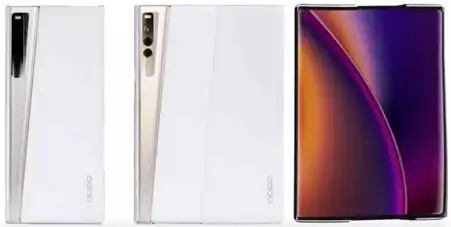
Oppo foldable phone
Source: spickandroid.com

Apart from folding smartphones recently OPPO showcased their rollable display concept smartphone OPPO X 2021. The smartphone has a motorized slider on the edge and the display can be expanded from 6.7 inches to 7.4 inches. OPPO calls it their continuous variable OLED display. It seems like a development other brands are sure to tap into in the near future.  
Source: Xiaomi

Under Display Front Camera

Over the last few years, the most popular trend in smartphones has been the bezel-less design in order to achieve that higher screen to body ratio. In trying to manufacture an edge-to-edge design, the front camera cannot be ignored. And to accommodate that, design choices such as Big Notch, Small notch, Punch holes and even motorized pop up cameras have been adopted. 
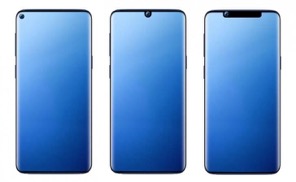
Under Display Front Camera
Source: gsmarena.com                                             
Pop Up Camera
Source: gadgets360.com
Source: The Verge

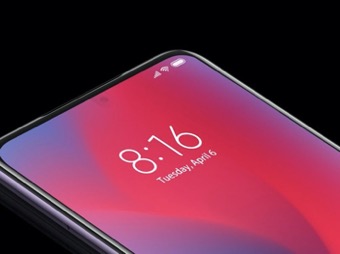
The biggest technology leap after this is going to be the Under Display Front Camera. Xiaomi, Oppo and other OEM’s have been exploring this technology since last year, and currently Xiaomi is working on its 3rd generation under display camera technology for mass production. A working camera under a lit up display might sound impossible, but in current generation technology, the small display layer above the front camera uses self developed pixel arrangement which allows the light to pass through the gap of sub pixels allowing every pixel to retain a complete RGB subpixel layout which would eventually produce equally good pictures as a normal front camera.

Source: Android Authority

Recently ZTE launched the world’s first under display front camera smartphone, the Axon 20 5G. The smartphone does feel like a first generation product as it uses the older generation technology and due to this the front facing camera performance is mediocre. But since this technology is still evolving and getting better over time we might get to see more such under display camera smartphones by the end of this year or in 2022.

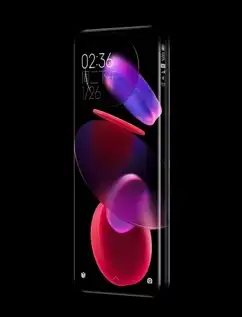
Xiaomi also recently showcased their first Quad-curved Waterfall display in their concept smartphone in which the display curves to all four sides with an 88 degree curvature and there are literally no buttons or ports on the smartphone. The design is not very practical but something really unique.

True Wireless Charging

Over the last few years the charging solutions in smartphones have also evolved a lot. Qualcomm introduced its improved Quick Charge Technology, and OPPO has always been ahead in this race thanks to its super fast VOOC charge technology, which can also be seen in OnePlus smartphones where it is called Warp Charge. Current generation smartphones support charging from 65W to a steep 120W. Wireless charging has been in the market for a while now, and has grown faster over the years, making 65W of wireless charging 0 to 100% a half an hour process. Xiaomi recently announced something really futuristic with their Mi Air Charge Technology.
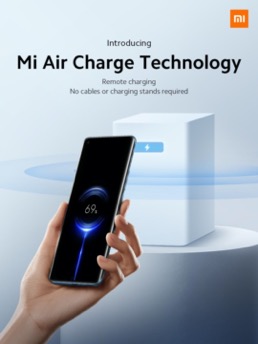
Mi Air Charge Technology
Source: Xiaomi

Xiaomi said they are currently working on this technology and with Mi Air Charge you can wirelessly charge multiple smartphones at a time through air without attaching any cable. This is something we all have been waiting for since ages. The tech supports 5W charging, and uses space positioning and energy transmission. There are multiple antennas involved in this process where the main charging station composed of 144 antennas will transmit mmWave (used in 5G technology) and the receiving 14 antennas on the smartphone will convert that mmWave signal into electric energy through the rectifier circuit. The whole process and technology seems very futuristic and fascinating but still there are few health concerns since a lot of radiation is involved.

Graphene Batteries

A battery is one of the most important components in our smartphones with Lithium Ion and Lithium Polymer being the most common ones. Over the years, we have seen manufacturers trying to add higher capacity batteries upto 6000-7000 mAh to achieve at least two days of battery life on a single charge. The biggest problem with these current generation batteries is that they degrade over time and your two year old smartphone won’t give the same good battery life as it used to give when it was new. The biggest innovation and improvement in battery technology is going to be the graphene batteries.

Source: wccftech.com

Graphene is the thinnest and strongest material on the earth. It contains an ultra thin layer of carbon atoms and it is known to be the best conductor of heat and electricity. A graphene battery will be able to hold 5 times more charge compared to a regular Lithium Ion battery, which means your smartphone could last a week on a single charge, while ensuring extremely fast charging, and minimum degrading over time. Various players are working on developing graphene batteries, and we might see them in action soon.


Leave a comment

Your email address will not be published. Required fields are marked *

Top Dashcam and Car Safety Tech Products Every Driver Should Have in 2026

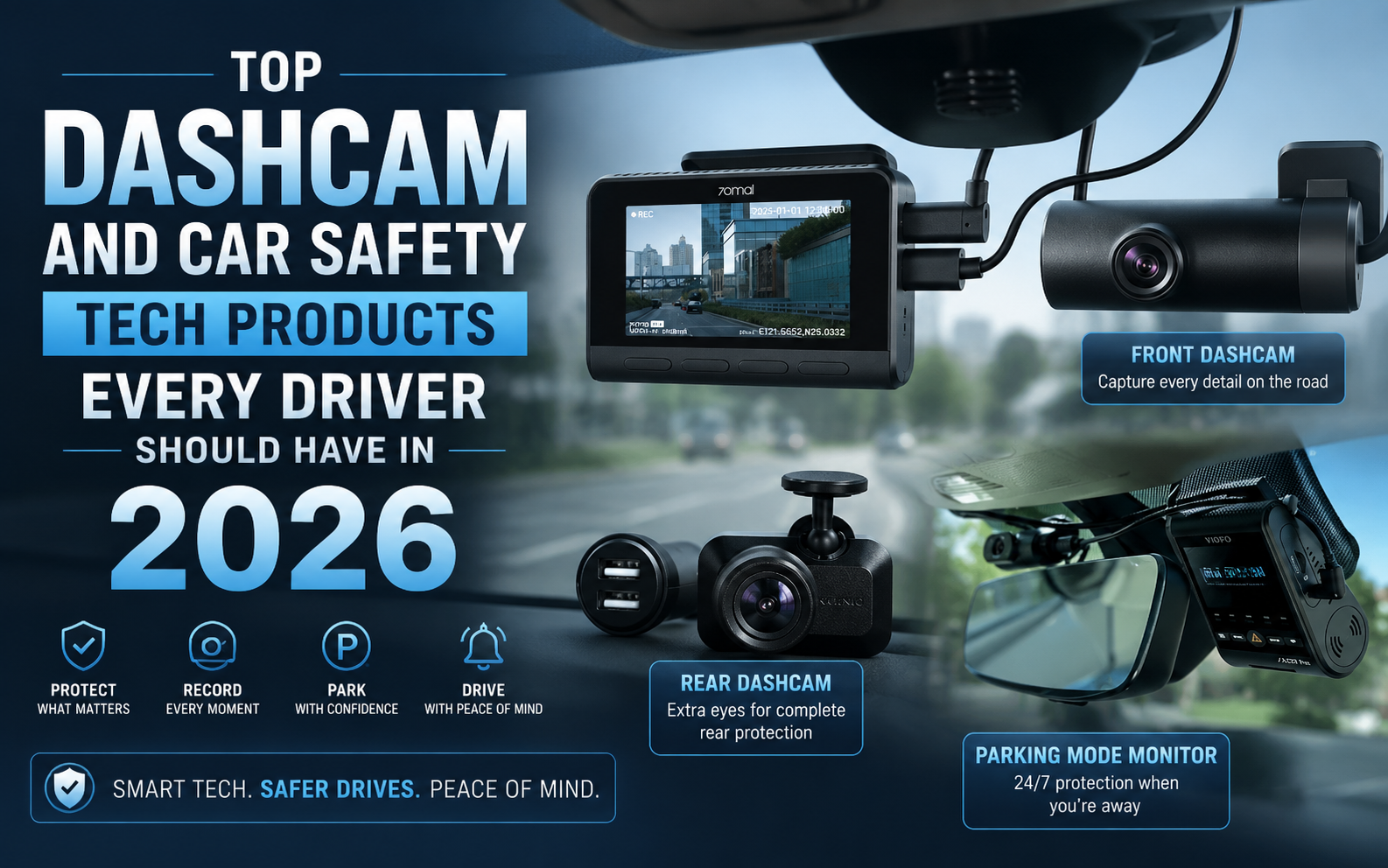
Best dashcams and car safety tech every driver needs in 2026, from AI collision alerts to tyre monitors. Drive smarter, drive safer. Think about the last time you were on a highway at night. Trucks overtaking from the left. Potholes with no warning signs. Someone running a red light at a junction you thought was clear. Indian roads are not forgiving. They are among the most unpredictable in the world, and that is not an exaggeration. In 2024, India recorded over 1.7 lakh road accident deaths, which is roughly one every three minutes. But here is what is changing. In 2026, the technology available to ordinary drivers, not just luxury car owners, is genuinely remarkable. Dashcams that record everything and call for help automatically. Tyre sensors that warn you before a blowout happens. Blind spot monitors: systems that keep you awake on long drives. Viofo A229 Pro 3-Channel If there is one dashcam built for Indian road reality, this is it. The Viofo A229 Pro covers three angles simultaneously: front, rear, and the cabin interior. So whether someone rear-ends you, you have a dispute at a toll booth, or a passenger causes trouble, it is all on record. The 4K front camera footage is clear enough to read number plates even at night. And night is when most serious accidents happen on Indian highways. The Sony STARVIS 2 sensor inside handles low light better than most cameras twice the price. It also has built-in GPS, which stamps your exact location and speed onto every clip, making it incredibly valuable as evidence in insurance claims or legal disputes.The parking mode is genuinely useful too. Park on a busy street, and if anyone bumps your car or breaks in, the camera wakes up and records it. In cities like Bengaluru and Mumbai,

How PMS Portfolios Perform During a Market Crash | Risk Management Guide

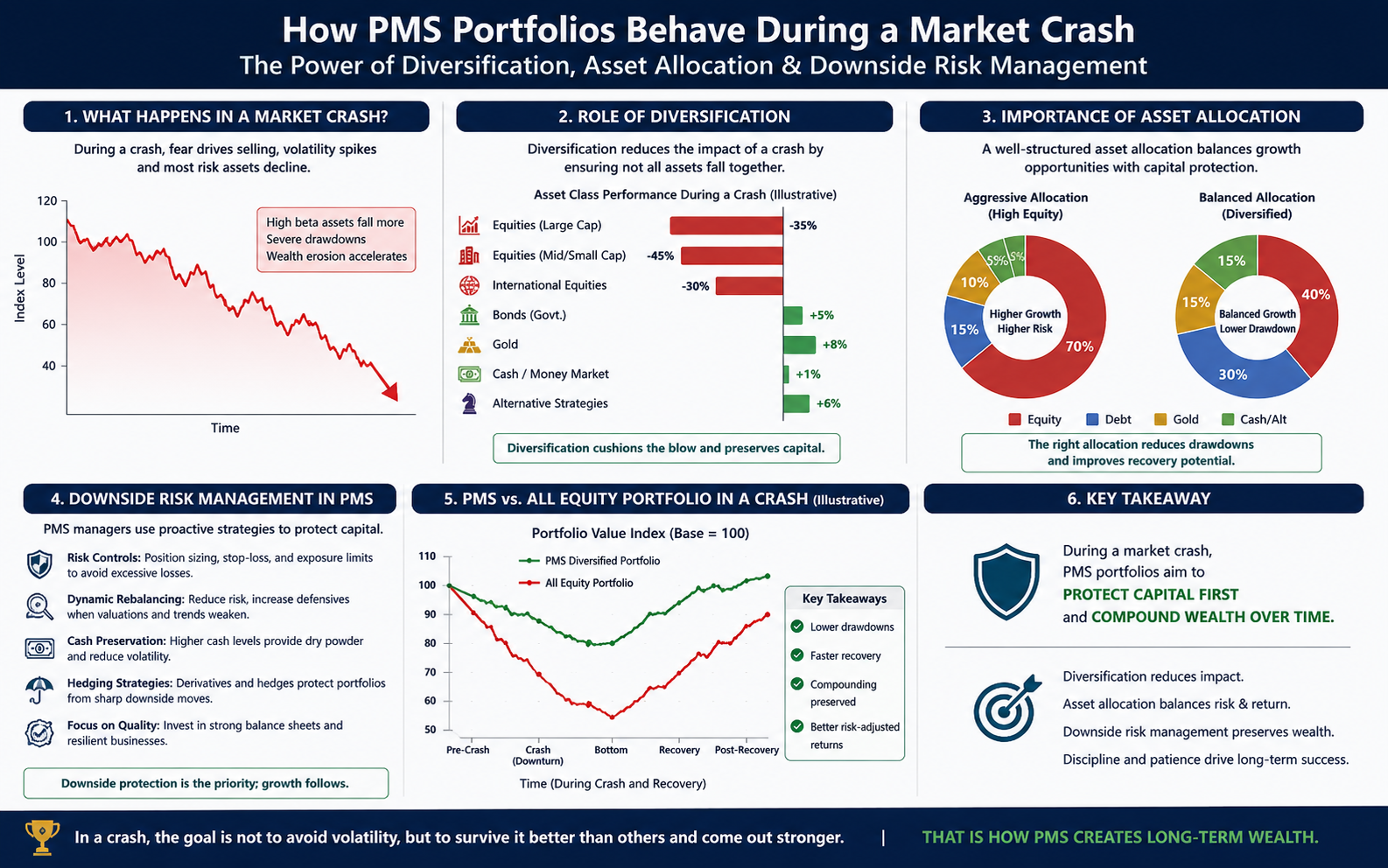
Market crashes are the ultimate stress test for any investment strategy. While returns dominate conversations during bull markets, it is during downturns that the true structure and resilience of a PMS portfolio become visible. Many investors assume that all portfolio management services portfolios behave similarly in a crash. In reality, outcomes can vary significantly depending on how the portfolio is constructed. 1. What a Traditional PMS Looks Like A traditional equity PMS is typically built as a concentrated portfolio of 15–30 individual stocks. This structure is intentional: Managers aim to generate alpha through high-conviction bets Capital is allocated meaningfully to each idea Diversification is limited compared to mutual funds However, during a market crash, this concentration becomes a double-edged sword. What happens in a crash? If a few key holdings fall sharply, the overall portfolio can decline disproportionately Single-stock risk gets amplified Liquidity issues in mid and small caps can worsen drawdowns For example, if a PMS holds 20 stocks and 3–4 of them fall 40–50%, the portfolio impact can be severe. This is the structure most investors picture when they think “PMS in a crash” — and it is also what has given PMS an unfair reputation for being high-risk by default. But concentration in direct stocks is a choice, not a requirement of the PMS structure. What sits inside the portfolio is what determines crash behaviour. 2. Not All PMS Portfolios Are Built the Same It is a common misconception that all PMS providers only buy direct stocks. In reality, a PMS is simply a personalized account managed by a professional. The strategy inside can vary wildly. While many providers stick to equities, others take a multi-asset approach. These providers build portfolios using a mix of mutual funds, direct bonds, gold, REITs (Real Estate Investment Trusts), and InvITs

Top Gaming Laptops That Can Handle Indian Summer Heat

April in Hyderabad, May in Delhi, and June in Chennai, you know what that feels like! The kind of heat that makes your phone hot just sitting on a table. The kind that turns a power cut into a genuine crisis. Now imagine gaming in that.Most laptops panic. The fans scream. The frame rates drop. The machine thermal throttles, which is a technical way of saying it gives up and slows down to stop itself from burning alive. But some laptops were built differently. Dhanush Kumar writes about the laptops that handle the heat, keep their cool, and let you game through an Indian summer without melting down. ASUS ROG Strix G16 If there is one laptop that truly understands Indian summer, it is this one. Asus put a Tri-fan technology system inside the ROG Strix G16, three fans working together, so no single part of the machine overheats. There are also liquid metal thermal compound pads on the CPU, which is a premium touch you usually only find on much more expensive machines. Even during long gaming sessions at room temperatures of 35 to 38 degrees, this laptop holds steady. Frame rates stay consistent. The keyboard doesn’t become a frying pan. The RTX 4070 inside pushes beautiful visuals in everything from BGMI to Cyberpunk. This is the one we would put our money on for an Indian summer. Lenovo Legion Pro 5i Gen 9 Lenovo’s Legion line has always been serious about thermal management, and the Pro 5i Gen 9 is their best effort yet. The Cold Front 5.0 cooling system uses a hybrid fan design with a bigger air intake. Translation: more cool air comes in, more hot air goes out, faster. What makes this special for India is how it handles dust. Indian summers come with dust.

Top AI Tools Everyone Must Use in 2026

Artificial Intelligence is no longer limited to tech companies or programmers. In 2026, AI tools are becoming essential everyday companions for students, professionals, entrepreneurs, designers, and content creators. From writing emails and designing visuals to coding software and researching complex topics, AI-powered platforms are transforming how we work and create. Experts say generative AI tools now help automate repetitive tasks, speed up creativity, and improve productivity across industries. They allow users to produce content, analyze data, generate visuals, and even compose music within minutes. Here are some of the most powerful AI tools everyone should consider using in 2026. 1. ChatGPT – The All-Purpose AI Assistant ChatGPT remains one of the most widely used AI tools globally. It can help users write articles, generate ideas, summarize information, plan projects, and even assist with coding. Its conversational interface allows people to interact with AI as if they were talking to a colleague. Best for: Writing and editing content Brainstorming ideas Coding and debugging Learning new topics For many professionals, ChatGPT has become a daily productivity companion. 2. Google Gemini – AI for Research and Productivity Google Gemini is designed to integrate deeply with Google’s ecosystem, including Gmail, Docs, Sheets, and Android devices. It excels at analyzing large amounts of information, summarizing reports, and answering complex research questions. Best for: Research and information analysis Email drafting and document summaries Data insights and knowledge work Because of its integration with Google tools, Gemini is especially useful for students and professionals. 3. Microsoft Copilot – The Workplace AI Microsoft Copilot is embedded directly into Microsoft 365 apps like Word, Excel, Outlook, and Teams. It can generate reports, create presentations, summarize meetings, and analyze spreadsheets. Best for: Office productivity Data analysis in Excel Drafting professional emails and reports For businesses and corporate teams, Copilot acts

You May Also Like

Connect with us