
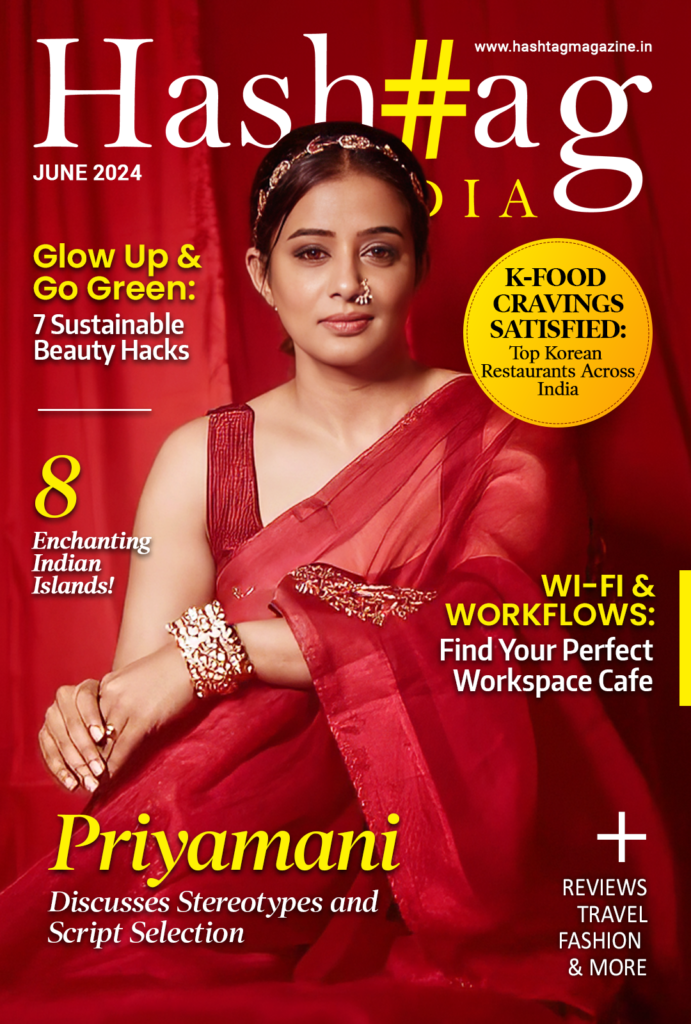
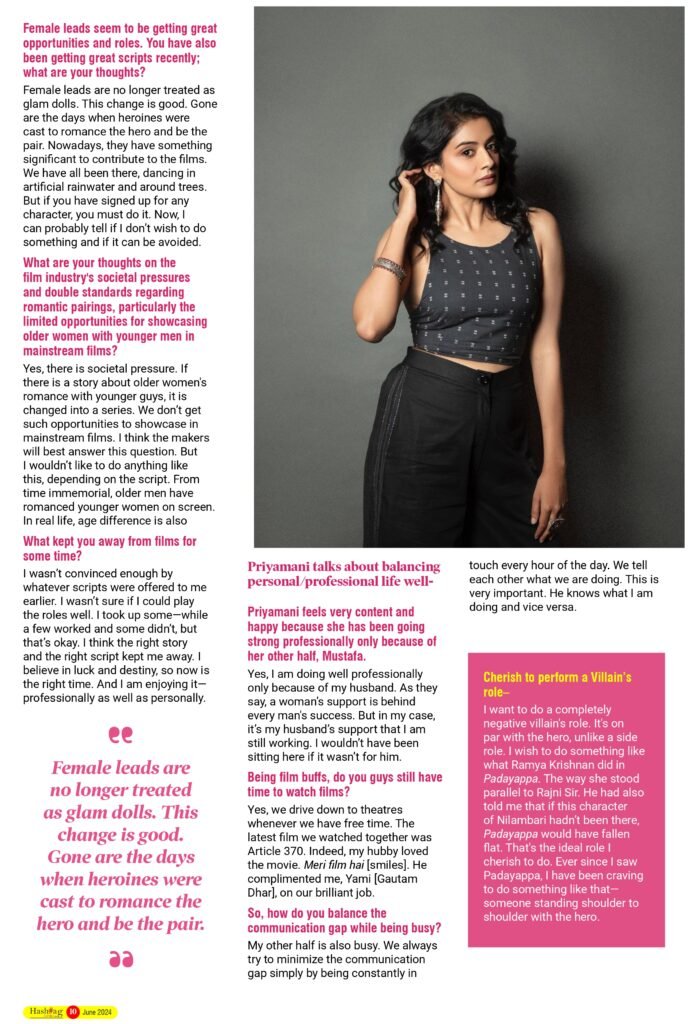
Priyamani, the talented actress making waves in both the South and Hindi film industries, is currently experiencing an exciting and dynamic career phase. She is thrilled to be a part of the Ajay Devgn-starrer film ‘Maidaan,’ directed by Amit Sharma and produced by Boney Kapoor, slated for release on April 10, 2024. Married to Mustafa Raj, an event manager, model, and industrialist, Priyamani has seamlessly transitioned to Bollywood and OTT films, thanks to her supportive husband. In an exclusive interview with Lipika Varma, Priyamani discusses her flourishing career, her experiences working with industry stalwarts, and her aspirations for the future.
Priyamani Exclusive Interview With Hashtag Magazine
So, given a chance simultaneously in South and Hindi films, which film will you choose?
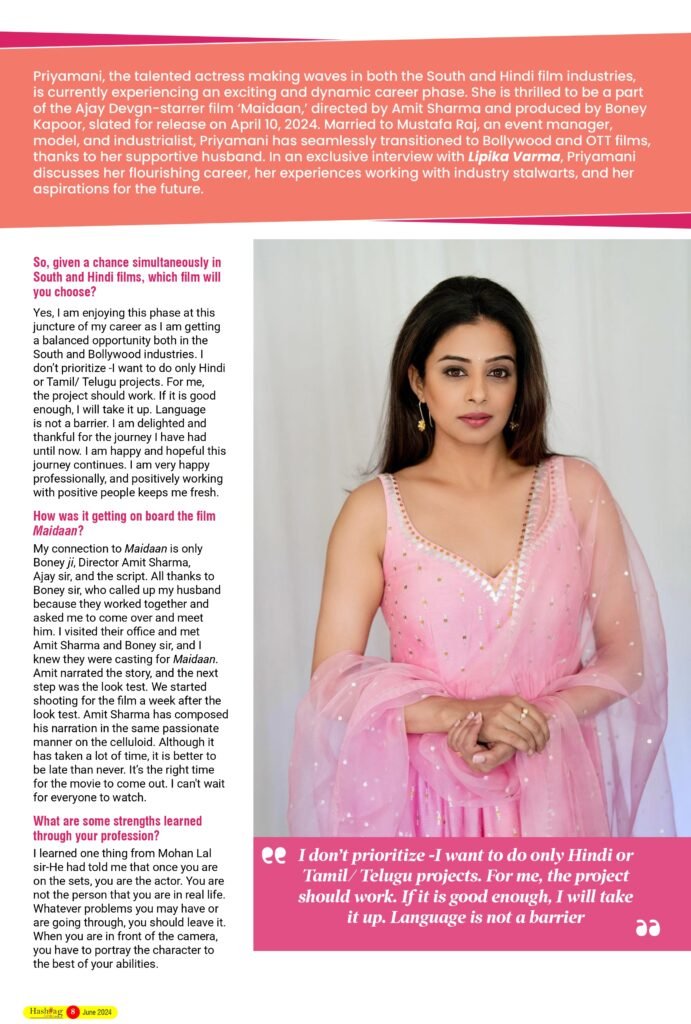
Yes, I am enjoying this phase at this juncture of my career as I am getting a balanced opportunity both in the South and Bollywood industries. I don’t prioritize -I want to do only Hindi or Tamil/ Telugu projects. For me, the project should work. If it is good enough, I will take it up. Language is not a barrier. I am delighted and thankful for the journey I have had until now. I am happy and hopeful this journey continues.I am very happy professionally, and positively working with positive people keeps me fresh.
How was it getting on board the film Maidaan?
My connection to Maidaan is only Boney ji, Director Amit Sharma, Ajay sir, and the script. All thanks to Boney sir, who called up my husband because they worked together and asked me to come over and meet him. I visited their office and met Amit Sharma and Boney sir, and I knew they were casting for Maidaan. Amit narrated the story, and the next step was the look test. We started shooting for the film a week after the look test. Amit Sharma has composed his narration in the same passionate manner on the celluloid. Although it has taken a lot of time, it is better to be late than never. It’s the right time for the movie to come out. I can’t wait for everyone to watch.
Priyamani, “I want to do a completely negative -villain’s role…..Someone who is standing shoulder to shoulder with the hero.”
What are some strengths learned through your profession?
I learned one thing from Mohan Lal sir-He had told me that once you are on the sets, you are the actor. You are not the person that you are in real life. Whatever problems you may have or are going through, you should leave it. When you are in front of the camera, you have to portray the character to the best of your abilities.
Citing an example, she added that we were shooting ’Grandmaster,’ and his mother wasn’t well. Post-shoot, he would be in the hospital, and in between breaks, he would visit the hospital if necessary. In the mornings, he would come directly from the hospital. He never cancelled shoots. He would always say I am a dutiful son, but that is off the camera. I have family and everyone around me, but that’s a different sphere of life. He would come back and act with the same conviction. He did not have any stress from his mother, who was in the hospital. I have learned this on the sets: You are an actor, no matter what ups and downs you may be facing. Never let stress come in when you are working.
How was it working with Ajay Devgan and Shahrukh Khan?
Both of them are poles apart from each other. Whatever they bring to the character, they portray it brilliantly. Ajay sir is a man of few words, but he speaks a lot through his eyes, revealing all his expressions so whatever he says makes an impact. It also depends on the character. There were a few scenes where I had a lot of dialogue, and he didn’t have that many, but the counter-expression and the reactions he gave to it were magical. This is my first time working with Ajay, sir, and it has been a great learning experience. He is a man of few words, but when he speaks, he is impressive. One cannot take your eyes off him. Maidaan is just another feather in his wonder cap. I am sure he is already proud of his work in Maidaan, and people will feel proud of him.
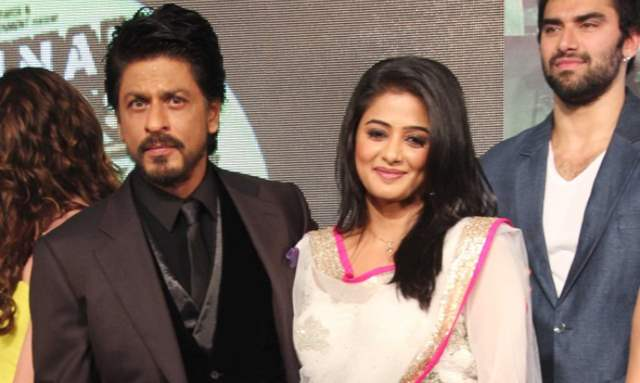
I am lucky to have worked with Shahrukh sir for the second time in Jawaan. We worked as a team, and he believed we all had to get to know each other better, so we had jam sessions every evening. Getting to know each other, we learned that Aaliyah [Qureshi] and Sanjeeta [Bhattacharya] are musicians. When Shahrukh sir learned about it, he got his music system and guitar the next day. We used to have great jam sessions hereafter. He also insisted that all of us have dinner together. These jamming sessions brought us closer, and we knew much more about our co-artists. The best thing was the respect he extended to one and all present on the sets, which is unparalleled and phenomenal. Though he is such a huge superstar, he is very down-to-earth and a friendly actor. He is humble and considerate. One of the actors got hurt while shooting the heist scene in Chennai, where we had to roll under the truck during that sequence. Once Shahrukh sir knew about it, he kept inquiring about it and took care of it.
Female leads seem to be getting great opportunities and roles. You have also been getting great scripts recently; what are your thoughts?
Female leads are no longer treated as glam dolls. This change is good. Gone are the days when heroines were cast to romance the hero and be the pair. Nowadays, they have something significant to contribute to the films. We have all been there, dancing in artificial rainwater and around trees. But if you have signed up for any character, you must do it. Now, I can probably tell if I don’t wish to do something and if it can be avoided.

What are your thoughts on the film industry’s societal pressures and double standards regarding romantic pairings, particularly the limited opportunities for showcasing older women with younger men in mainstream films?
Yes, there is societal pressure. If there is a story about older women’s romance with younger guys, it is changed into a series. We don’t get such opportunities to showcase in mainstream films. I think the makers will best answer this question. But I wouldn’t like to do anything like this, depending on the script. From time immemorial, older men have romanced younger women on screen. In real life, age difference is also significantly seen. I guess somewhere, real pairing age difference has worked.
What kept you away from films for some time?
I wasn’t convinced enough by whatever scripts were offered to me earlier. I wasn’t sure if I could play the roles well. I took up some—while a few worked and some didn’t, but that’s okay. I think the right story and the right script kept me away. I believe in luck and destiny, so now is the right time. And I am enjoying it—professionally as well as personally.
Priyamani talks about balancing personal/professional life well-
Priyamani feels very content and happy because she has been going strong professionally only because of her other half, Mustafa. Yes, I am doing well professionally only because of my husband. As they say, a woman’s support is behind every man’s success. But in my case, it’s my husband’s support that I am still working. I wouldn’t have been sitting here if it wasn’t for him.
Being film buffs, do you guys still have time to watch films? Yes, we drive down to theatres whenever we have free time. The latest film we watched together was Article 370. Indeed, my hubby loved the movie. Meri film hai [smiles]. He complimented me, Yami [Gautam Dhar], on our brilliant job.
So, how do you balance the communication gap while being busy? My other half is also busy. We always try to minimize the communication gap simply by being constantly in touch every hour of the day. We tell each other what we are doing. This is very important. He knows what I am doing and vice versa.
Can put this in a box-
Cherish to perform a Villain’s role– I want to do a completely negative villain’s role. It’s on par with the hero, unlike a side role. I wish to do something like what Ramya Krishnan did in Padayappa. The way she stood parallel to Rajni Sir. He had also told me that if this character of Nilambari hadn’t been there, Padayappa would have fallen flat. That’s the ideal role I cherish to do. Ever since I saw Padayappa, I have been craving to do something like that—someone standing shoulder to shoulder with the hero.